Science · NEWS EXPLAINER
Nobel medicine prize honors three optogenetics pioneers
Karl Deisseroth, Peter Hegemann and Georg Nagel share the 2026 award. Their work helped turn light-sensitive proteins into tools for studying nerve cells.
The 2026 Nobel Prize in Physiology or Medicine was awarded jointly on Monday, October 5, to Karl Deisseroth, Peter Hegemann and Georg Nagel. The Nobel Assembly recognized their discoveries involving light-gated ion channels and optogenetics, a method for controlling selected nerve cells with light.
A switch built from an algal protein
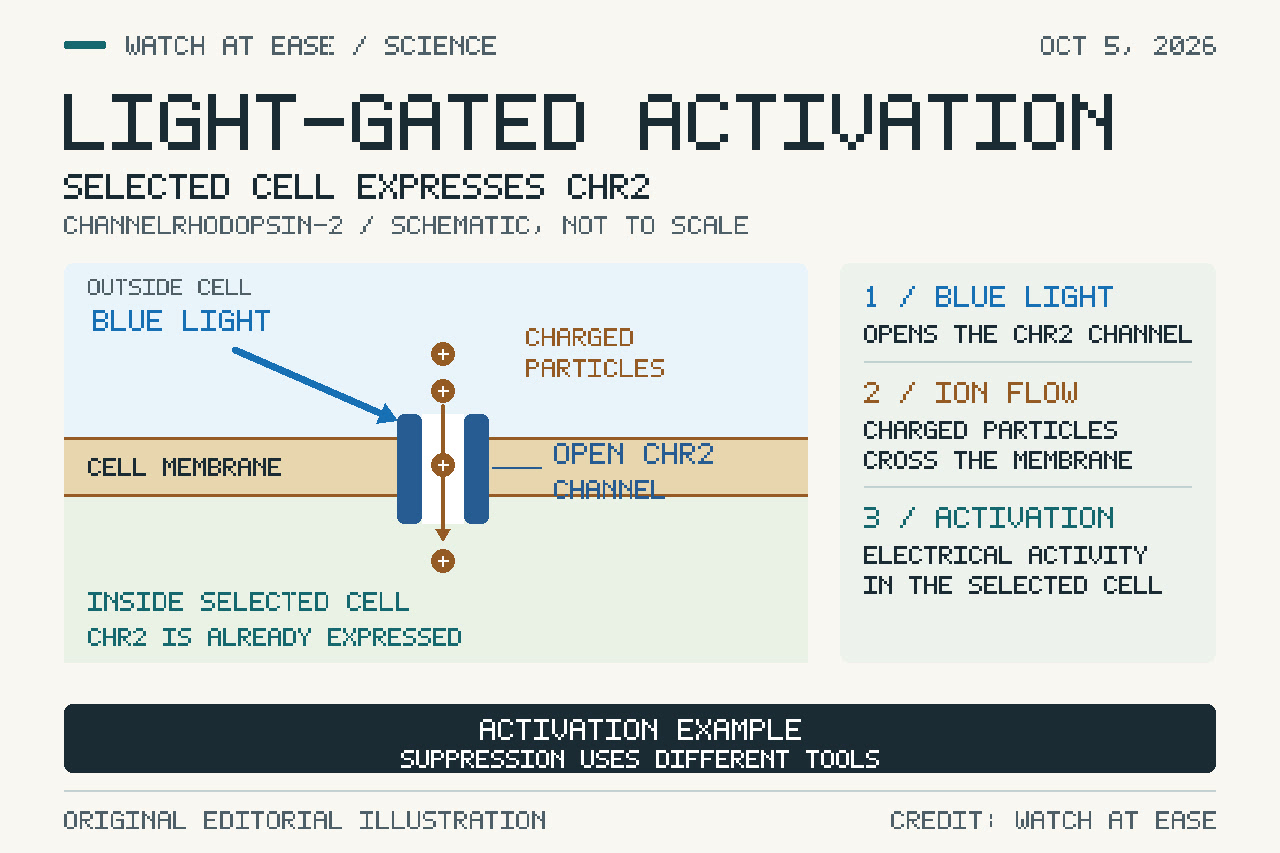
Hegemann’s starting question was how the single-celled alga Chlamydomonas responds so quickly to light. Working with Nagel, he identified proteins that combine light detection with an ion channel—a passage that lets electrically charged particles cross a cell membrane.
The key protein for this story is channelrhodopsin-2, or ChR2. Researchers can make selected cells produce it by introducing its genetic instructions. Illuminating those cells can then trigger electrical activity. Light sensitivity therefore depends on the selected cells expressing the protein.
Why the experimental setting matters
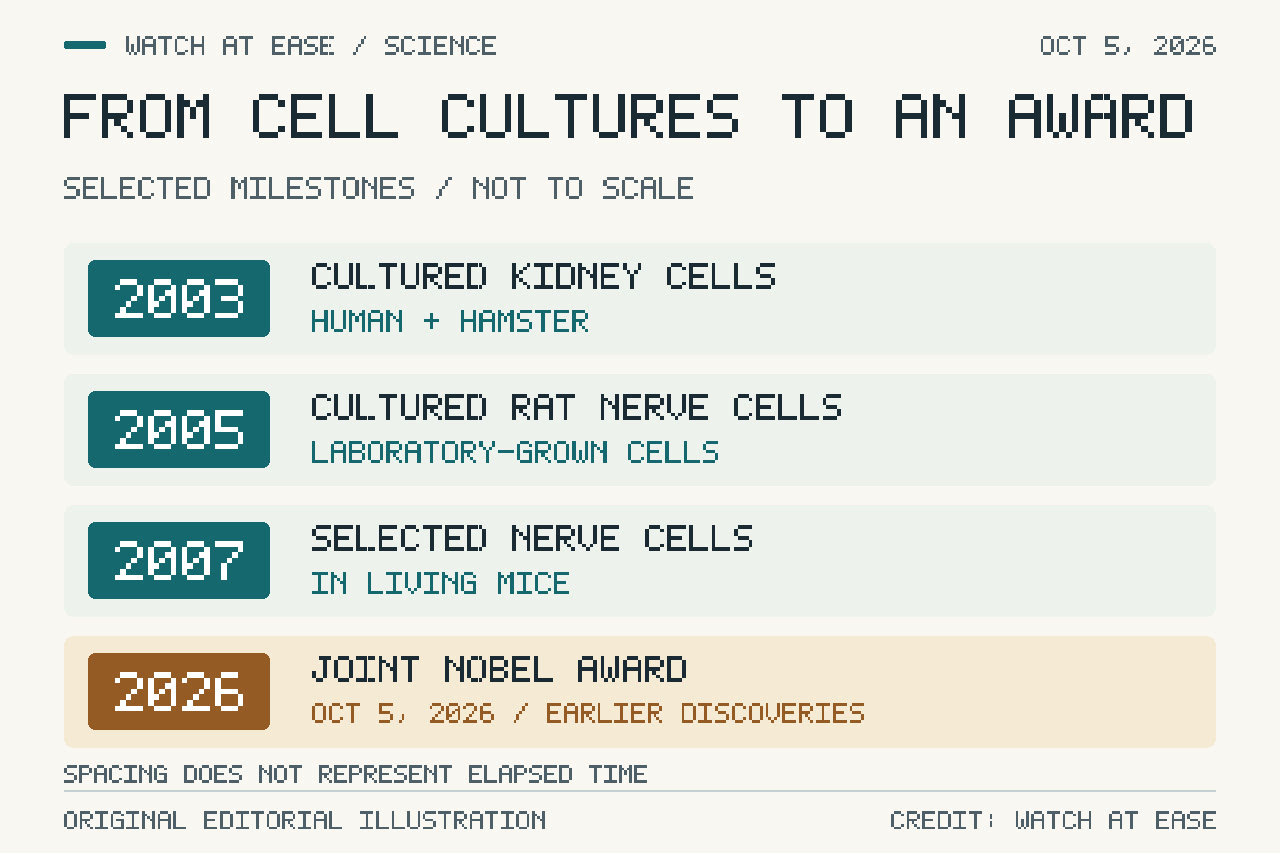
The official Nobel background distinguishes three settings. In 2003, Hegemann and Nagel reported results in cultured human and hamster kidney cells. In 2005, Deisseroth’s group used blue light to trigger signals in rat nerve cells grown in laboratory dishes.
The next milestone described in that account came in 2007, when the group activated selected nerve cells in living mice and controlled whisker movement. These are different experiments with different biological settings. Monday’s announcement recognizes those earlier discoveries.
Testing cells instead of only watching them
Being able to intervene is the central research advantage. Watching nerve cells become active alongside a behavior can reveal an association. Changing activity in a chosen cell population lets researchers test what those cells contribute to that behavior. The Nobel materials describe uses ranging from movement and wakefulness to memory.
Optogenetics also includes tools for suppressing activity, but ChR2 should not be pictured as a single blue-light switch that actively performs both jobs. The official account describes additional proteins responding to different wavelengths. The activation example in this article’s graphic covers one part of that wider toolkit.
A joint award for a long research path
Deisseroth is based at Stanford University and the Howard Hughes Medical Institute; Hegemann at Humboldt University of Berlin; and Nagel at the University of Würzburg. Those current affiliations are distinct from the institutions where some of the earlier work took place.
Reuters and AP report a total award of 12 million Swedish kronor shared by the three laureates. That is the prize’s combined sum. The October 5 decision recognizes a research method and the discoveries behind it; it does not announce a newly approved treatment.