Science · NEWS EXPLAINER
NASA asks industry about Hubble’s future: what the RFI does—and does not approve
NASA is testing interest in a higher-orbit boost, telescope servicing or controlled disposal. It has not selected or funded a mission.
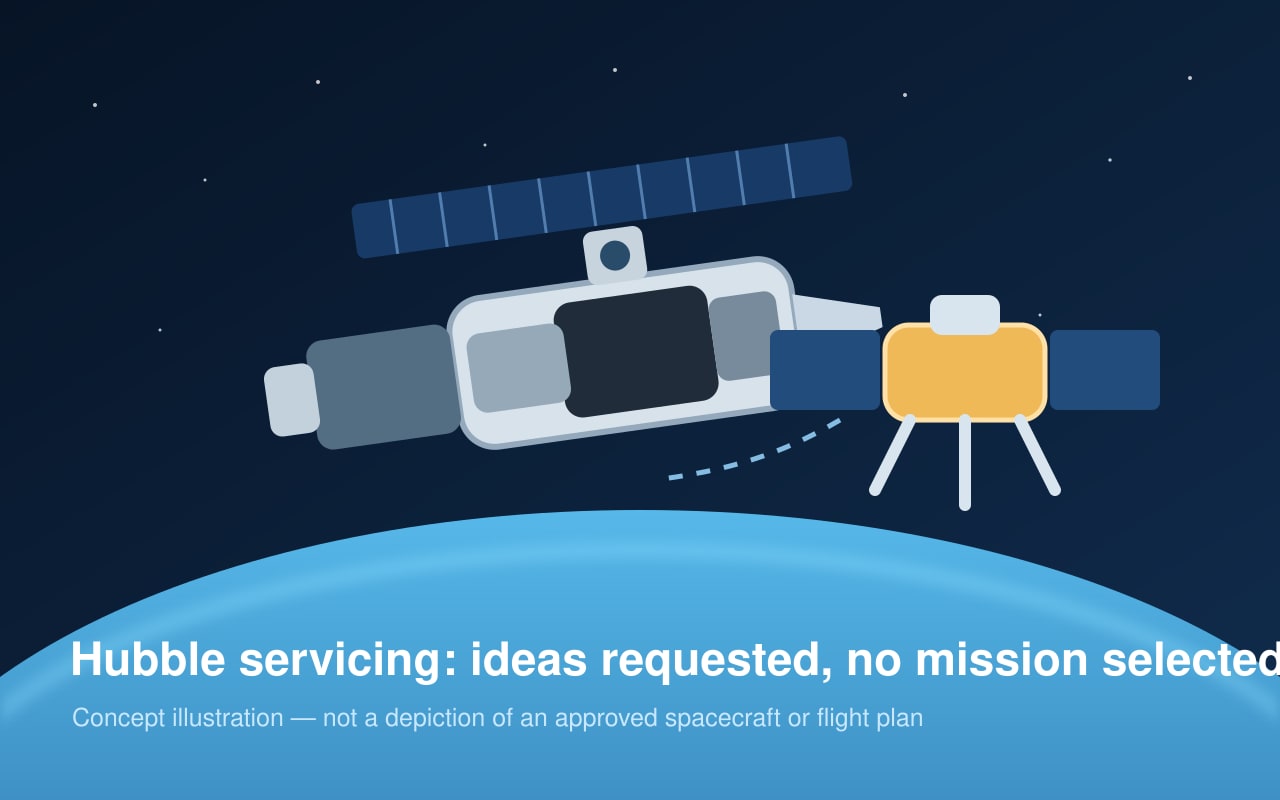
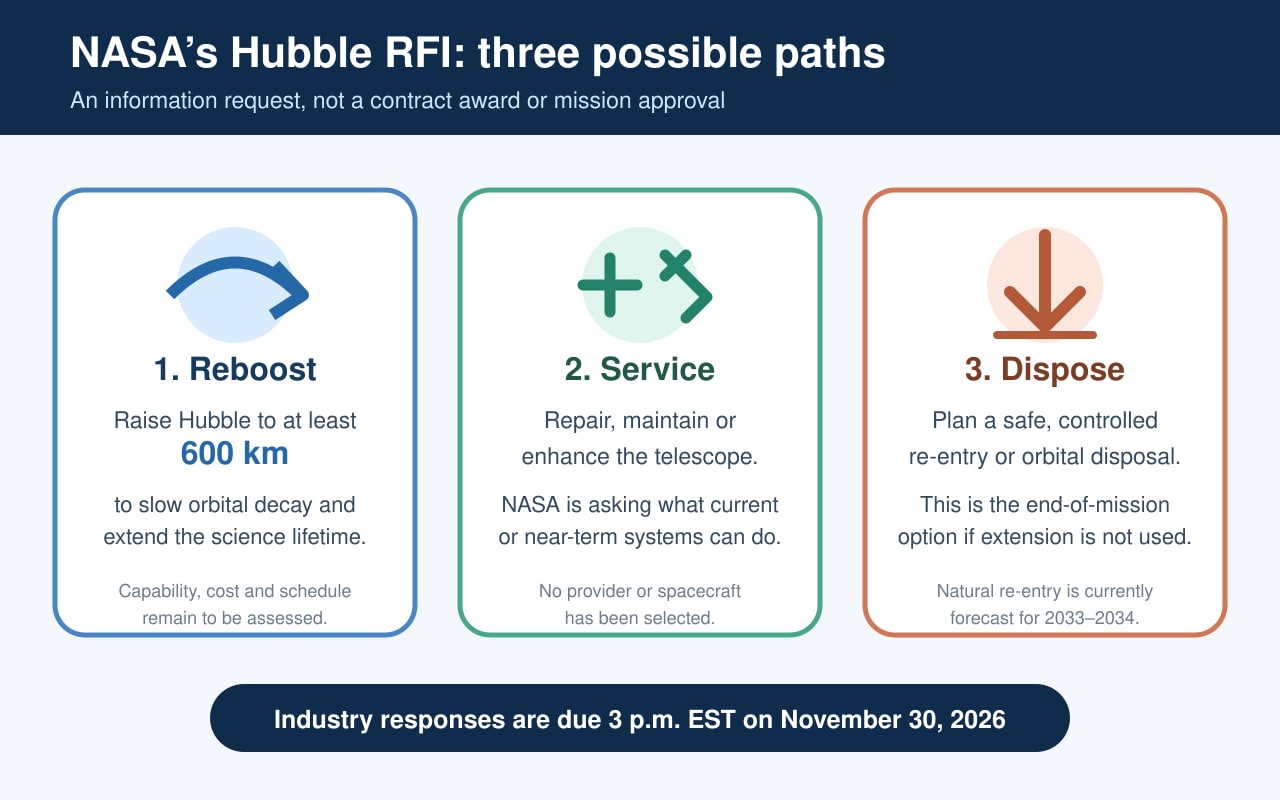
NASA has opened a request for information on commercial options for the Hubble Space Telescope, but it has not approved a rescue mission. The October 29 RFI asks companies to describe realistic capabilities, schedules and costs across three possible paths: a higher-orbit boost, servicing or enhancement, and safe controlled re-entry or orbital disposal.
For readers, the most important boundary is procurement. An RFI gathers market information; it is not a contract award, budget commitment or selection of a spacecraft. NASA’s announcement does not name a provider, promise a launch or say that any response will become a mission.
Companies have until 3 p.m. EST on November 30 to respond. NASA says Hubble has no propulsion system to maintain its own orbit, is currently expected to re-enter in 2033 or 2034 without intervention, and would likely need any boost or servicing mission to occur by 2032.
The RFI’s reboost path calls for raising Hubble to at least 600 kilometers. A servicing path could repair, maintain or enhance the telescope. The disposal path would plan a safe controlled re-entry or other orbital disposal at the end of science operations. Those are alternatives for industry to address, not three approved missions.
The exercise matters because Hubble still provides visible- and ultraviolet-light observations that newer observatories do not replace one for one. The useful next evidence will be NASA’s response to the submissions—whether it starts a procurement, narrows the mission scope, secures funding or takes no further action.
What NASA opened—and what it did not
NASA issued the RFI on October 29 and announced it publicly on October 30. The agency is asking companies for current or near-term capability, likely schedule, cost and risk information. That gives NASA a view of the market before any possible acquisition.
Nothing in the announcement authorizes a flight. There is no selected contractor, launch vehicle, servicing spacecraft or crew. Ars Technica also reported that NASA currently has no funding allocated to procure a Hubble reboost or servicing mission.
The three paths under review
A reboost response should explain how a vehicle could capture or otherwise work safely with Hubble and raise it to at least 600 kilometers. NASA’s goal would be to slow the orbital decay caused by atmospheric drag and extend the telescope’s useful lifetime.
A servicing response can address repairs or capability enhancements. A disposal response can instead explain safe controlled re-entry or orbital disposal when the mission ends. NASA may learn from all three categories without choosing any of them.
Why the 2032 window matters
Hubble lacks onboard propulsion for maintaining its orbit. NASA’s current analysis places likely natural re-entry in 2033 or 2034, although re-entry forecasts can change with solar activity and atmospheric conditions.
NASA therefore says an intervention would probably need to happen by 2032. That is a planning boundary rather than a booked launch date: a contractor would still need time for design, integration, testing, launch and on-orbit operations.
What to watch after November 30
The immediate milestone is the response deadline, 3 p.m. EST on November 30. NASA can use the submissions to judge feasibility and cost, but the agency has not promised to publish every response or begin a competition.
A real mission would require a later acquisition decision, funding and technical safety work. Until those appear, claims that Hubble has been saved—or that a particular commercial vehicle will fly—go beyond the evidence in the RFI.