Science · NEWS EXPLAINER
Francis Halzen wins the 2026 physics Nobel: what IceCube actually detects
The award recognizes the South Pole observatory and its observations of high-energy neutrinos from space. IceCube records light from secondary particles, not a direct photograph of a neutrino.
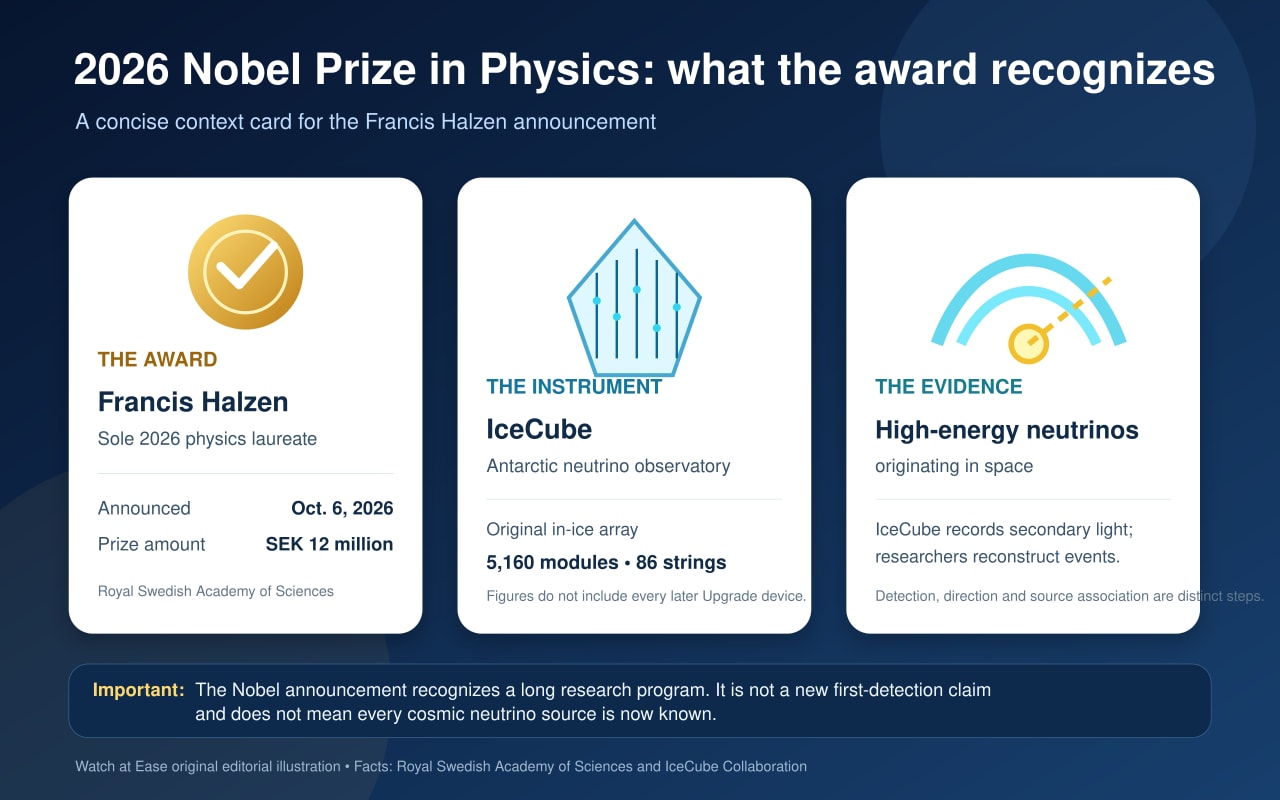
Francis Halzen has won the 2026 Nobel Prize in Physics for his work on the IceCube Neutrino Observatory and the discovery of high-energy astrophysical neutrinos. The Royal Swedish Academy of Sciences announced the award on October 6. The news is the recognition of that research—not a claim that the detector captured its first cosmic neutrino today.
What the Nobel recognizes
Halzen, a physicist at the University of Wisconsin–Madison, is the sole recipient of this year’s physics prize. The Academy credits both his contribution to IceCube and the discovery of high-energy neutrinos originating in space. The award is worth 12 million Swedish kronor.
The distinction matters when reading the announcement: building a working instrument and establishing a cosmic signal were a long research program, rather than a single observation made on the day of the prize. IceCube is an international collaboration; an individual Nobel award does not mean one scientist installed the detector or performed every analysis.
A telescope that watches the ice
Instead of gathering starlight in a mirror, IceCube uses a cubic kilometer of Antarctic ice as part of a particle detector. Its original in-ice array contains 5,160 digital optical modules on 86 strings. The modules sit roughly 1,450 to 2,450 meters below the surface. These figures describe the original array, not every device subsequently added through the IceCube Upgrade.
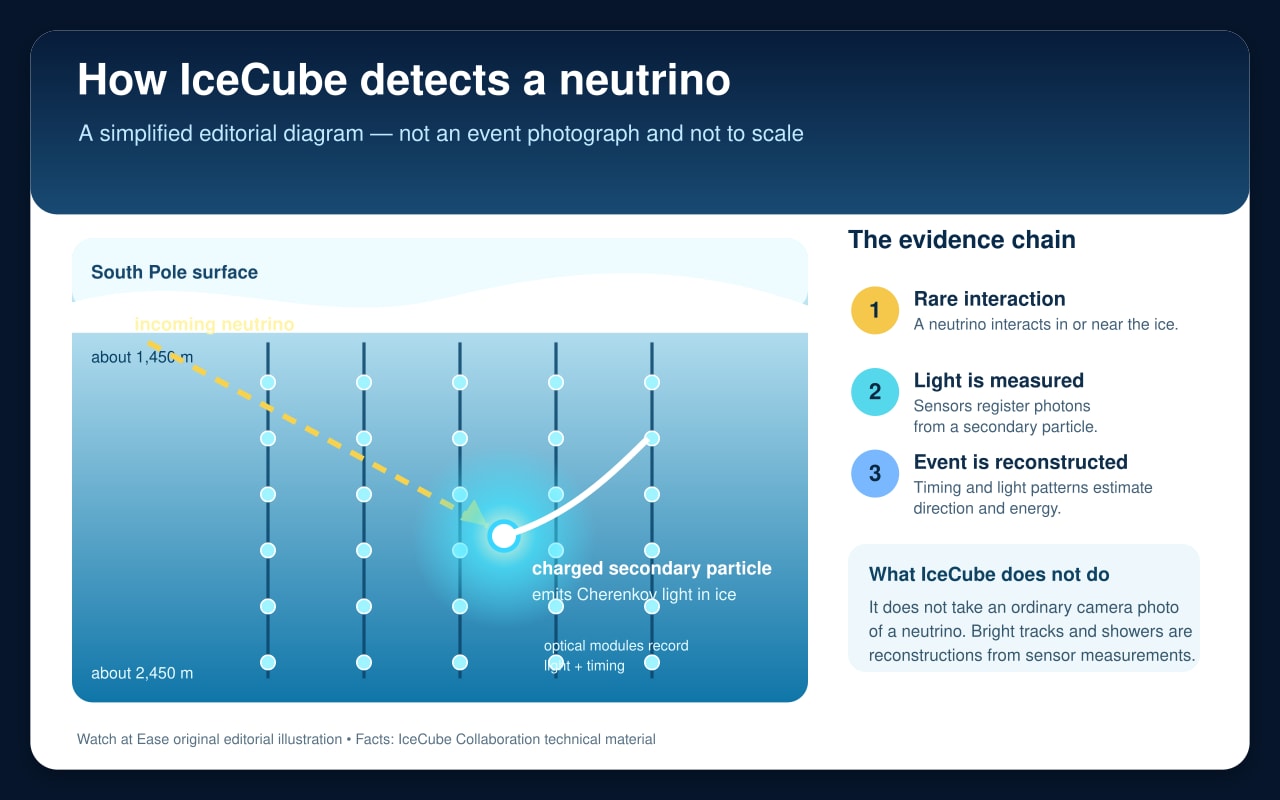
Most neutrinos pass through matter without leaving an observable trace. Occasionally, an interaction produces an electrically charged secondary particle. That particle can emit Cherenkov light while moving faster than light travels in ice. This does not mean it exceeds the speed of light in a vacuum.
Sensors record the light and its timing; researchers use the pattern to reconstruct the event’s direction and energy. In other words, the instrument detects evidence left by a neutrino interaction, rather than seeing the neutrino itself. A bright line or shower in an event display is a reconstruction of sensor measurements, not an ordinary camera image.
Why neutrinos add a different view of space
Neutrinos have no electric charge, so magnetic fields do not bend their paths in the way they bend the paths of charged cosmic rays. They also interact weakly with matter. That makes them difficult to catch, but useful as messengers from environments that are hard to study through other signals.
For readers, the useful comparison is between complementary measurements, not a contest in which neutrino astronomy replaces conventional telescopes. A reconstructed arrival direction helps scientists investigate where an event may have come from; it does not by itself identify an individual source beyond doubt. Detection, reconstruction and association with a source are different steps.
What this announcement does not settle
The award does not establish that every high-energy event has a known origin, or that the physics of all cosmic accelerators is understood. Reuters reported Halzen describing the field’s still-open possibilities, while AP reported his hope that the recognition would help further work. Those are comments about the future, not an announcement that a new detector expansion has been funded.
The clearest way to read today’s news is therefore to keep three things separate: the October 6 Nobel decision, the existing evidence for astrophysical neutrinos, and future improvements to the observatory. The Academy explains the award; IceCube’s technical material explains what the detector measures. Neither should be mistaken for a complete map of the sources producing the universe’s highest-energy particles.