Technology · PRACTICAL GUIDE
Kubernetes ImagePullBackOff? Read the Pod event before changing secrets
ImagePullBackOff is a retry state, not a diagnosis. Capture the exact Pod event, then test image identity, namespace-scoped credentials, node connectivity, platform and runtime storage one branch at a time.
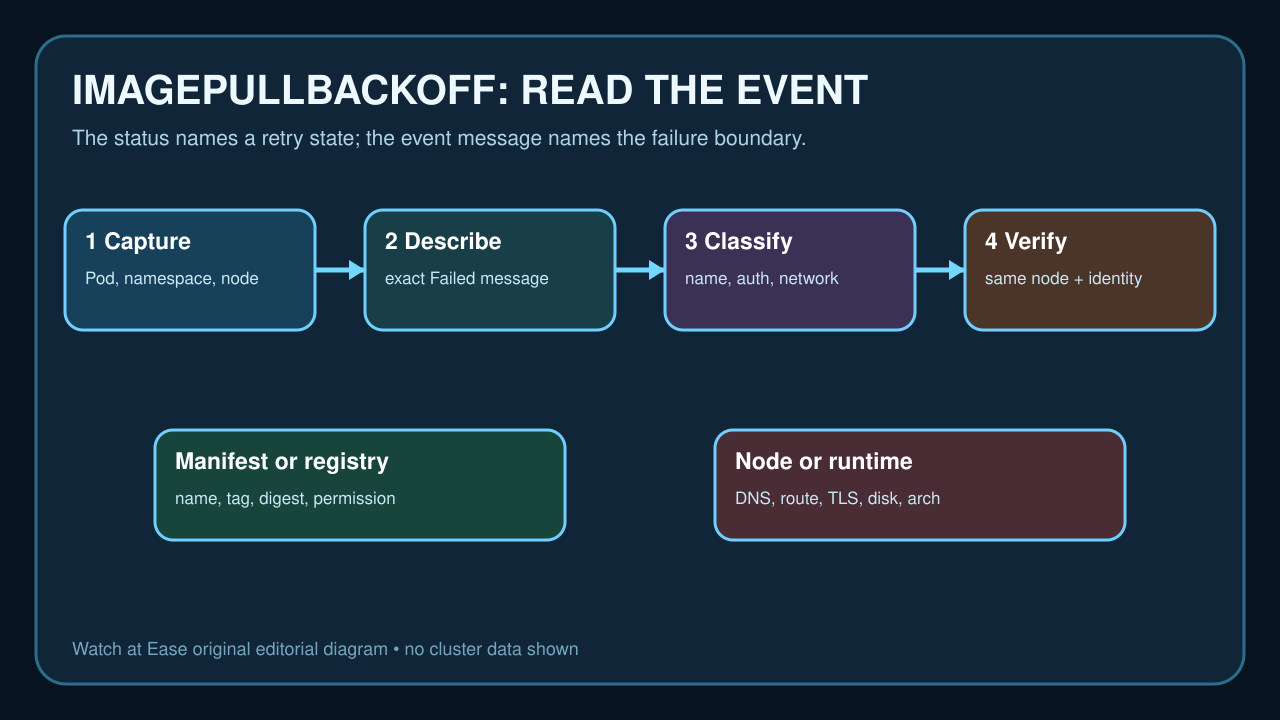
ImagePullBackOff is a waiting and retry state. The useful diagnosis is in the Pod's exact Failed event: wrong image, denied registry access, missing Secret, DNS or TLS failure, architecture mismatch, unpack error or node resource pressure.
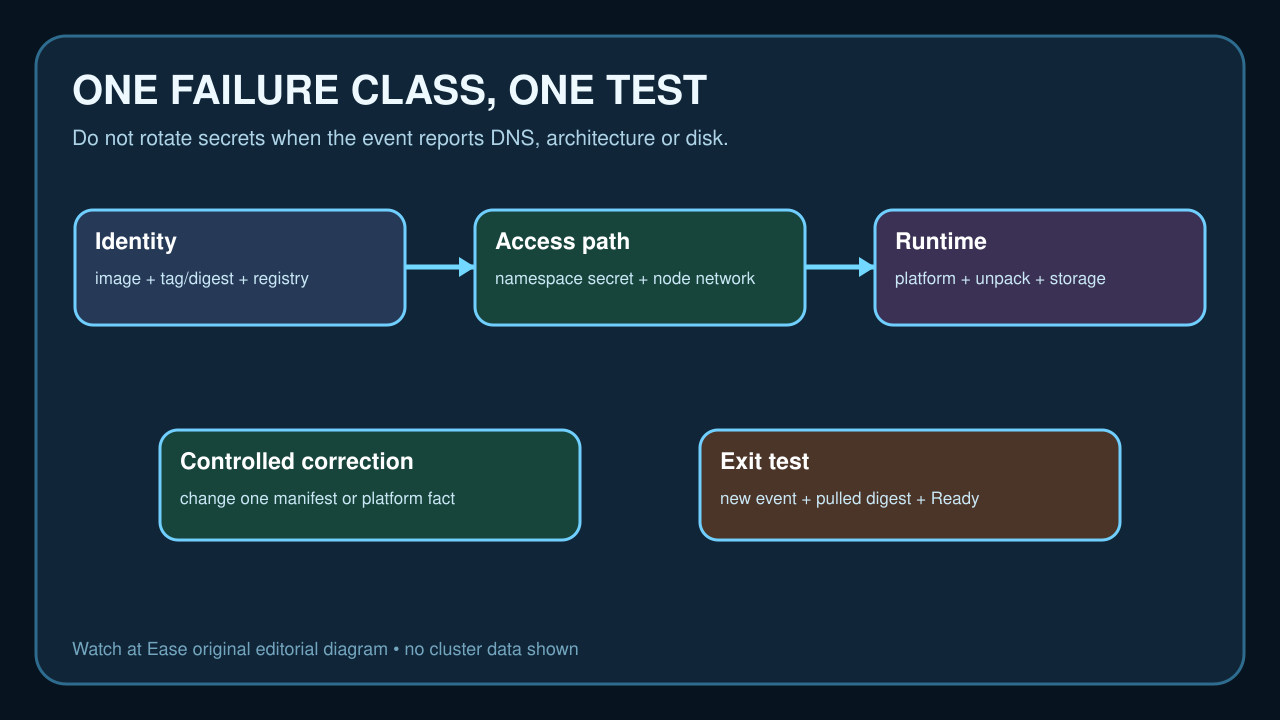
Preserve the deployed image reference, namespace, node and event message. Then test one failure class in the same context, make one correction and close only when the intended digest pulls and the workload becomes Ready.
Capture the Pod, node and exact event message
Record the namespace, Pod, owning workload, container name, scheduled node and the exact image reference before changing anything. Use kubectl describe on the failing Pod and preserve the newest Failed or FailedToRetrieveImagePullSecret message, not only the ImagePullBackOff status.
ImagePullBackOff means the kubelet is retrying with an increasing delay; Kubernetes documents a compiled-in maximum of 300 seconds. Recreating Pods can change timing, but it does not prove the registry, credential or runtime problem is fixed.
Verify image identity before touching credentials
Compare the deployed image registry, repository, tag or digest with the artifact that was actually pushed. Check the rendered Pod template, not only the Helm values or source manifest, because mutation and templating may change the final reference.
Treat not found, denied and platform mismatch as different findings. A digest proves one immutable manifest; a tag can move. Confirm the manifest includes the node architecture before assuming a successful pull from another laptop proves the cluster can run it.
Audit private-registry credentials in the Pod namespace
If the event reports unauthorized access or a missing pull secret, verify that the named Secret exists in the same namespace as the Pod and that the Pod template or ServiceAccount references it. Inspect metadata and type without printing credential contents into tickets or logs.
Kubernetes uses kubernetes.io/dockerconfigjson for registry credentials. A workstation docker login proves only that workstation's client can authenticate; it does not prove the kubelet has a matching registry entry, current token or permission to the requested repository.
Test the node-to-registry path and runtime boundary
For DNS, timeout, TLS or connection errors, test from the failing node or an approved equivalent network context. Check resolver results, routes, proxy and firewall policy, registry certificate trust and whether an isolated cluster has outbound access. Do not weaken TLS or open broad egress merely to make one retry disappear.
For unpack, disk, schema or architecture messages, inspect node storage, inode pressure, container-runtime logs and the image manifest. GKE's current taxonomy explicitly separates authentication, network, missing image, performance, incompatible architecture and incompatible schema causes.
Make one correction and require a clean exit test
Change only the fact supported by the event: correct one image reference, update one scoped credential, repair one network or trust path, publish the missing platform, or resolve one node-runtime resource problem. Record the previous manifest or Secret metadata so the change can be rolled back.
Watch a newly attempted pull, confirm the old failure message is gone, and record the resolved digest. The exit condition is not merely a restarted Pod: the intended container must become Ready on the expected workload, and another replica on a relevant node must pull the same identity without the old event.