Technology · NEWS EXPLAINER
Huawei–Qualcomm deal pairs 5G and AI licenses with a US patent purchase
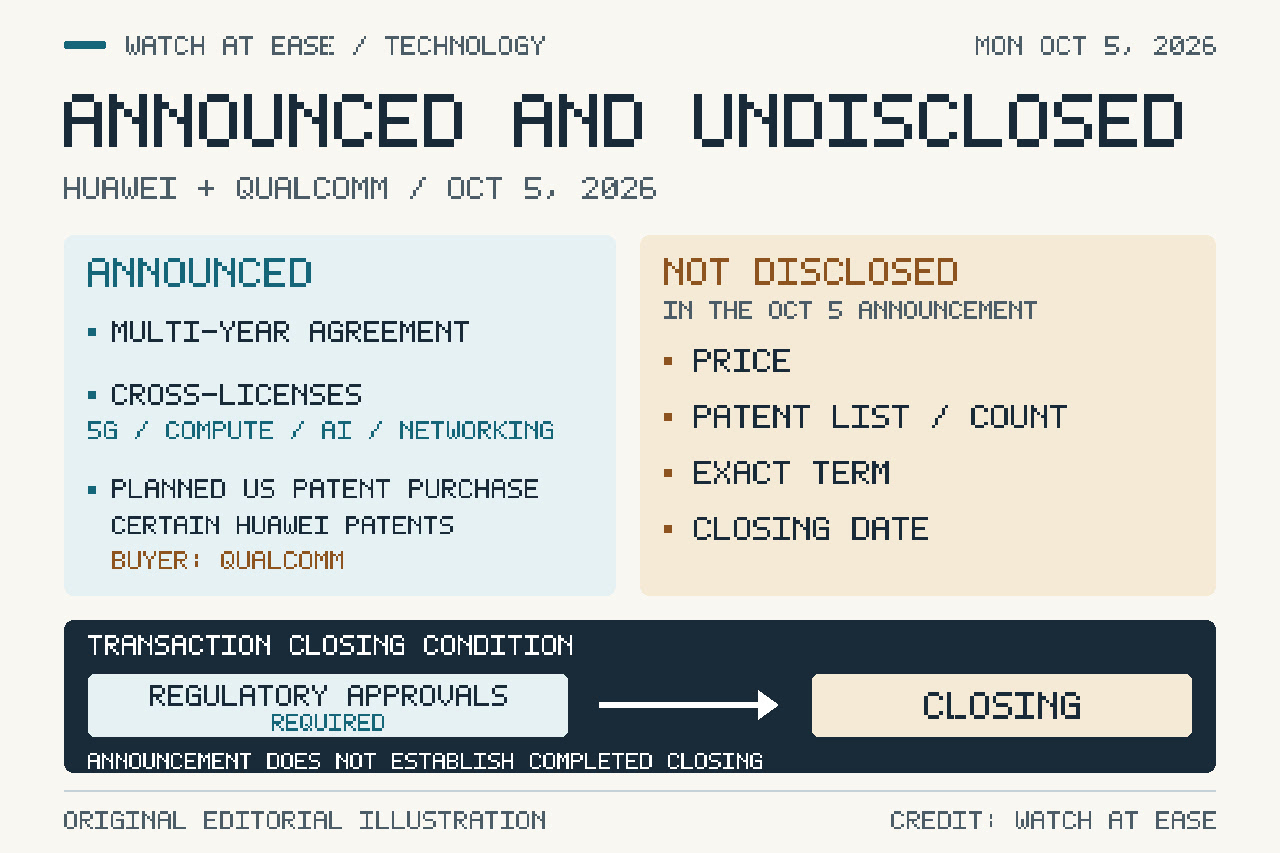
The October 5 agreement combines two-way patent licenses with Qualcomm’s purchase of selected Huawei US patents. Closing still requires regulatory approvals, and the financial terms remain undisclosed.
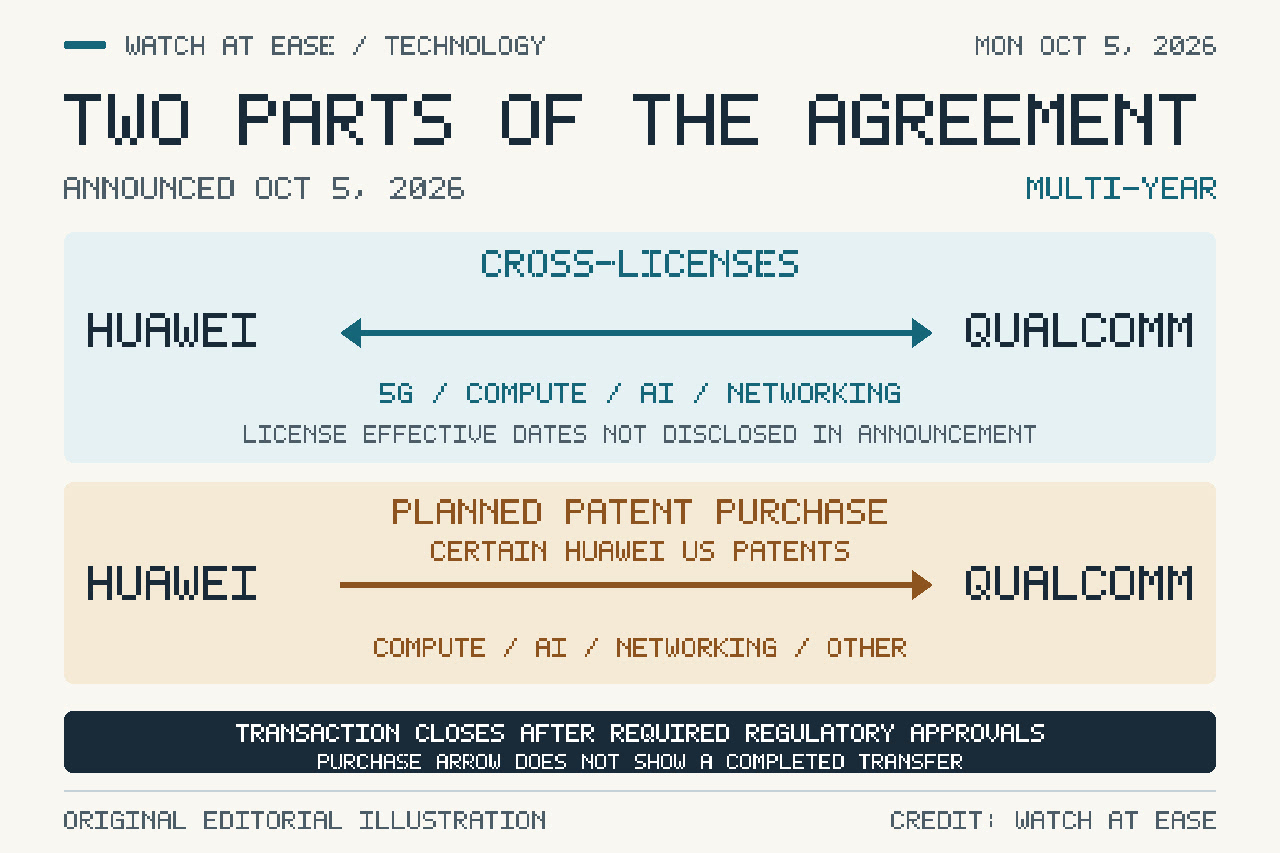
Huawei and Qualcomm announced a multi-year patent agreement on Monday, October 5, covering 5G, computing, artificial intelligence and networking. It combines licenses in both directions with Qualcomm’s planned purchase of certain Huawei US patents. Huawei says the transaction will close after the necessary regulatory approvals.
Two different movements of patent rights
The cross-licenses are the agreement’s two-way component, covering both companies’ patent portfolios in the listed fields. The purchase is a separate component: specified US patent rights would move from Huawei to Qualcomm. A license to use patented technology and ownership of a patent serve different purposes.
Huawei’s announcement and its accompanying FAQ describe both components. The companies say their licensing practices follow fair, reasonable and nondiscriminatory principles, commonly abbreviated FRAND. The announcement does not include the agreement itself or explain the terms for each individual patent.
What has been announced, and what remains pending
The announcement establishes that the companies have reached an agreement. Its closing condition matters because regulatory approval still stands between the announced transaction and completion. The release does not name the regulators involved, provide an approval timetable or give an expected closing date.
Multi-year also leaves the exact duration open. Readers can identify the broad technology fields and the direction of the patent purchase, but cannot determine which individual patents are included or how many Qualcomm will acquire from the published announcement.
The $6.9 billion figure is an aggregate
Reuters reports that Huawei expects completion to take the total value of its patent licensing agreements above $6.9 billion. That is a projected total across Huawei’s agreements. It does not price this transaction or state what Qualcomm will pay for the patents being purchased.
Notebookcheck likewise distinguishes the purchase from the cross-licenses and reports that financial terms and specific patents were not disclosed. Without those terms, the aggregate figure cannot be used to calculate this deal’s purchase price or the royalty rates under its licenses.
Where this fits in Huawei’s wider technology activity
The immediate news is about patent access and a proposed ownership transfer. The announcement names broad technology areas without specifying a new phone, processor or software release. It therefore provides no product-level performance result or availability date to attach to the agreement.
For that separate product context, our Mate 90 coverage explains the different Kirin processors, configuration-specific prices and China-market launch limits. Our report on DeepSeek and Huawei’s Ascend programming tools examines the software layer around Ascend AI chips and distinguishes the new partnership from TileLang’s earlier public history.