Technology · NEWS EXPLAINER
DeepSeek and Huawei open-source Ascend programming tools built around TileLang
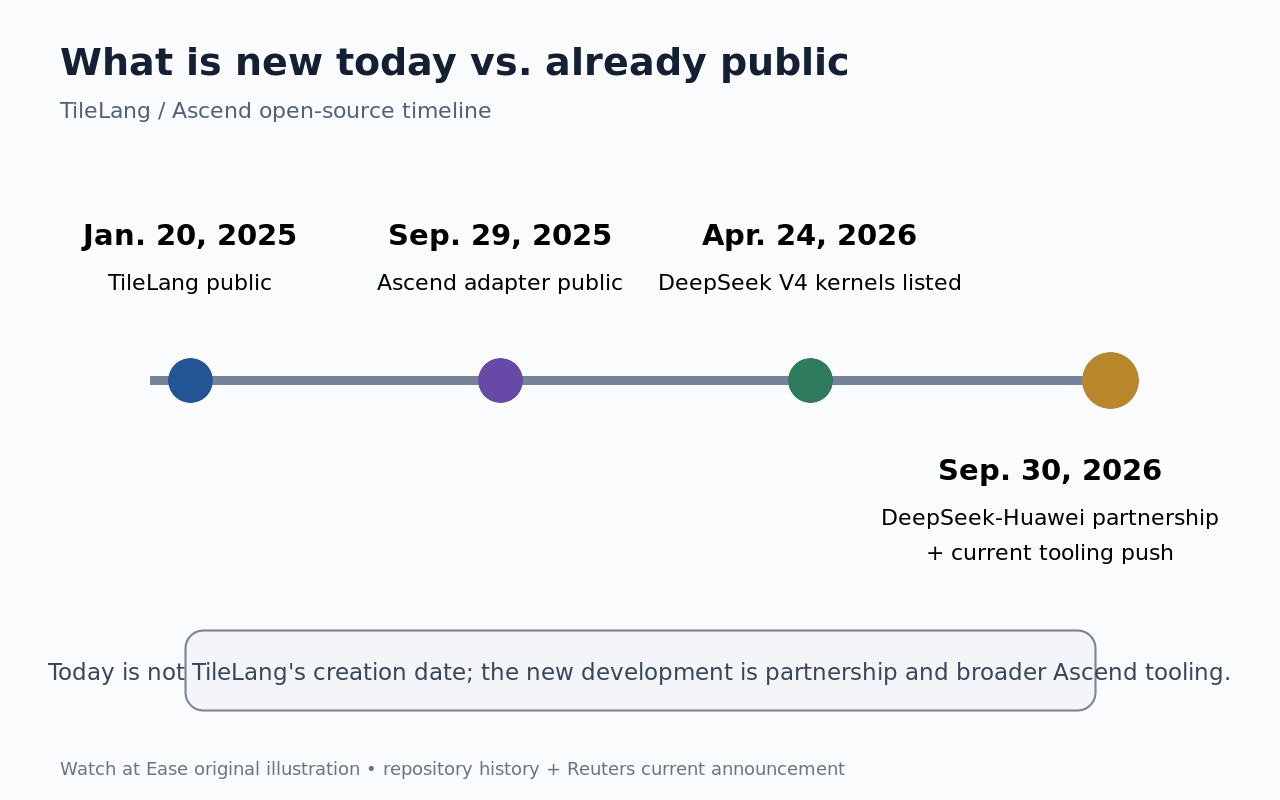
DeepSeek says it is working with Huawei on programming tools for Ascend AI chips and is open-sourcing infrastructure that includes TileLang plus compute and communication libraries. TileLang and its Ascend adapters already existed publicly, so the new development is the partnership and broader tooling push—not proof that Nvidia CUDA has already been replaced.
DeepSeek says it has partnered with Huawei Technologies to expand the programming stack around Huawei's Ascend AI chips, opening infrastructure that includes the TileLang kernel language and related compute and communication libraries. The September 30 announcement is aimed at making Ascend hardware easier to program without requiring developers to work only at lower-level interfaces.
The important distinction is that TileLang itself is not brand new and is not limited to Huawei hardware. Its public project predates today's announcement and describes a Python-like domain-specific language for high-performance kernels across several accelerator backends. Separate open-source Ascend adapters already connect TileLang to Huawei's NPU software stack.
The new part is the DeepSeek-Huawei tooling push
Reuters reports that DeepSeek announced the Huawei partnership on September 30 and said it is open-sourcing infrastructure for Ascend. The package described by DeepSeek includes TileLang as a high-level programming language together with compute and communication libraries.
DeepSeek's stated problem is developer friction. It argues that an independent accelerator software ecosystem needs a high-level language that is easier to program while still exposing enough control to use the hardware efficiently. Reuters quotes the company describing TileLang as simpler to program than Nvidia's CUDA.
TileLang already existed before today's announcement
The public TileLang repository shows that the language was open-sourced in January 2025. It uses a Pythonic syntax and is designed for high-performance kernels such as matrix multiplication and attention operations, while relying on lower-level compiler infrastructure to turn those programs into hardware-specific code.
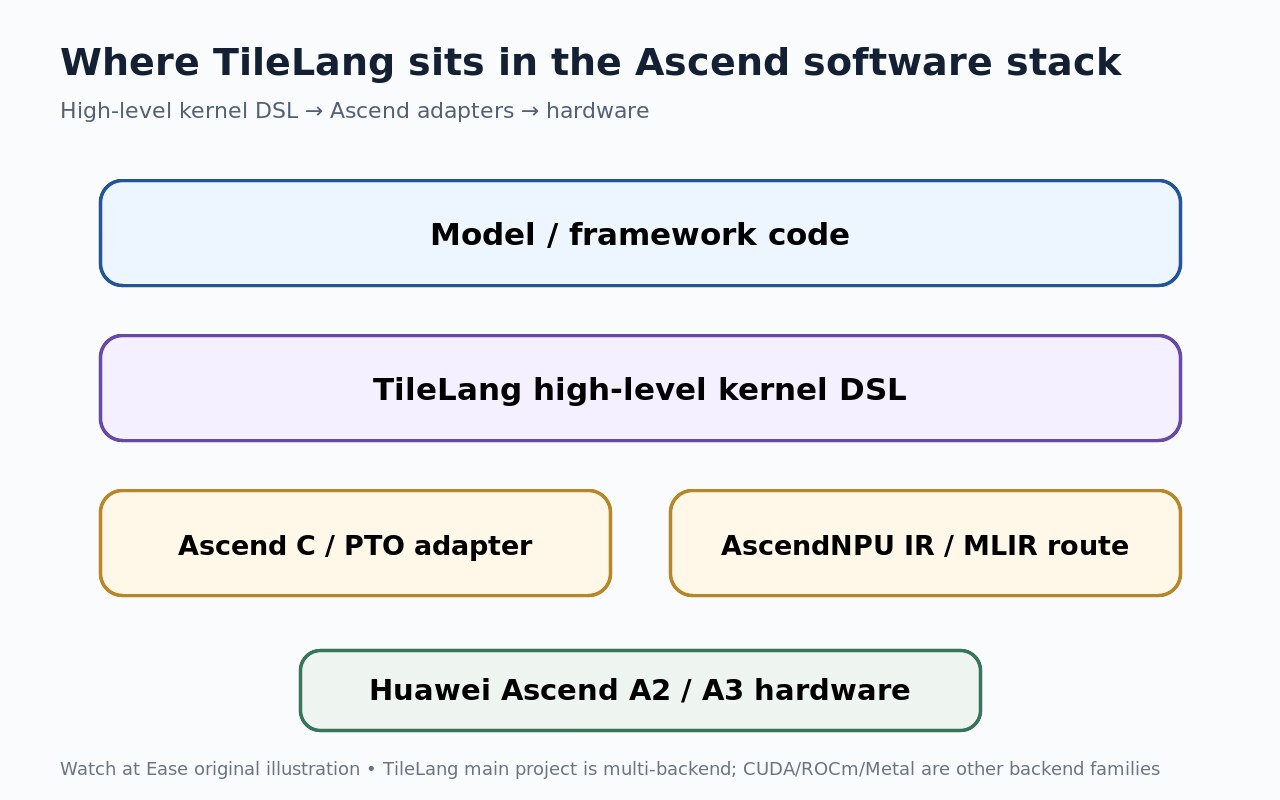
The main project is deliberately multi-backend. Its documentation lists Nvidia CUDA, AMD ROCm, Apple Metal and other targets, with Huawei Ascend supported through ecosystem adapter projects. That makes today's news better understood as an expansion and coordination of the Ascend path rather than the birth of an Ascend-only language.
Ascend support already has two visible compiler routes
The TileLang-Ascend repository describes an Ascend-specific implementation that can target Ascend C/PTO and has been tested on Huawei Ascend A2 and A3 accelerators. Its project history also lists DeepSeek V4 kernels released in April 2026, showing that DeepSeek workloads were already part of the public Ascend work before today's partnership announcement.
A separate MLIR-based repository, tilelang-mlir-ascend, documents an AscendNPU IR path. In practical terms, those projects are pieces of the compiler and kernel layer developers need between high-level model code and the accelerator hardware.
This is not yet the same as replacing CUDA
DeepSeek's comparison with CUDA is about programming model simplicity, not a demonstrated one-for-one replacement of Nvidia's full software ecosystem. CUDA includes mature libraries, developer tools, profiling, debuggers, deployment workflows and years of application compatibility beyond the syntax used to write individual kernels.
The new partnership can lower one barrier to using Ascend by making the kernel-development layer more accessible and open. Whether that becomes a broad alternative depends on adoption, tool maturity, library coverage, performance across real workloads and how easily developers can move existing software—not on a single language announcement.