Technology · PRACTICAL GUIDE
systemd status=217/USER? Prove the identity boundary before fixing permissions
Read the first journal failure, inspect the effective unit, test User= and Group= through NSS, then isolate provider readiness or PrivateUsers before touching ExecStart.
status=217/USER is a systemd pre-execution failure, not proof that the application crashed. Upstream systemd assigns 217 to failure to determine or change user credentials or to establish user namespacing. The first journal line therefore matters more than a generic permissions guess.
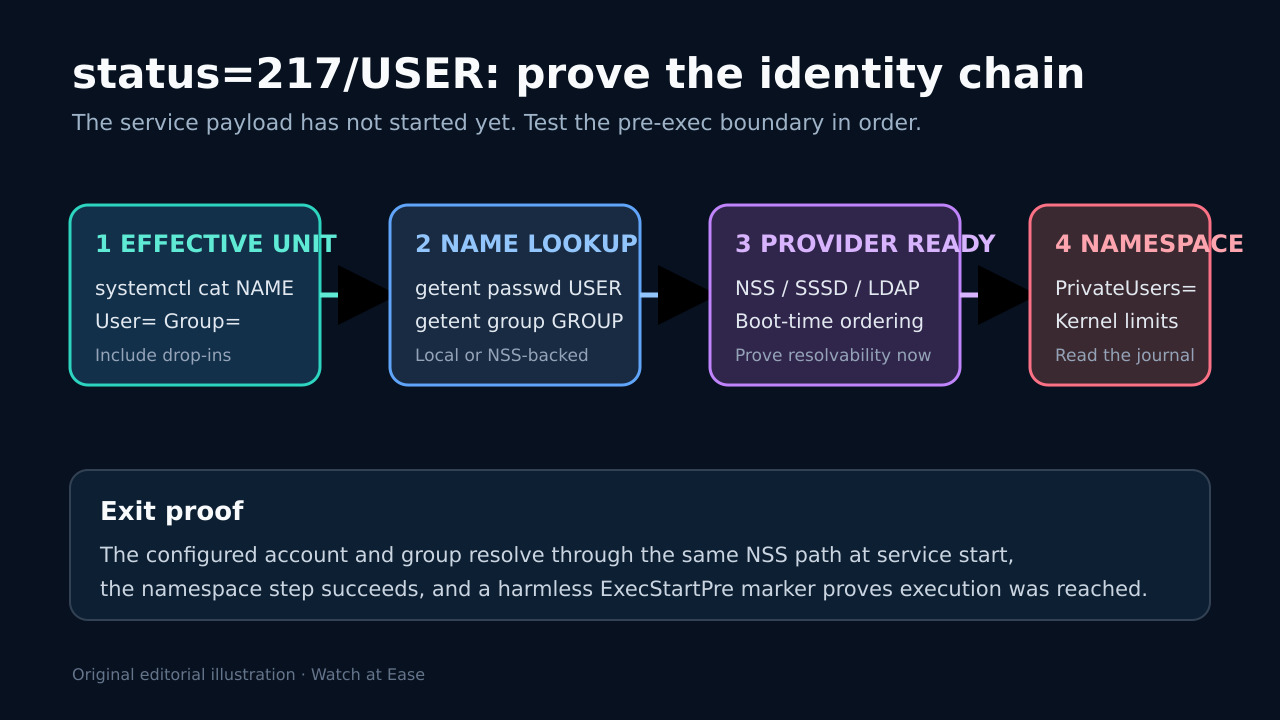
Preserve the unit and logs, then prove one chain: the effective User= and Group=, name resolution through the host NSS path, readiness of any external identity provider, user-namespace setup, and finally a harmless marker showing that execution was reached.
Start with the first journal failure
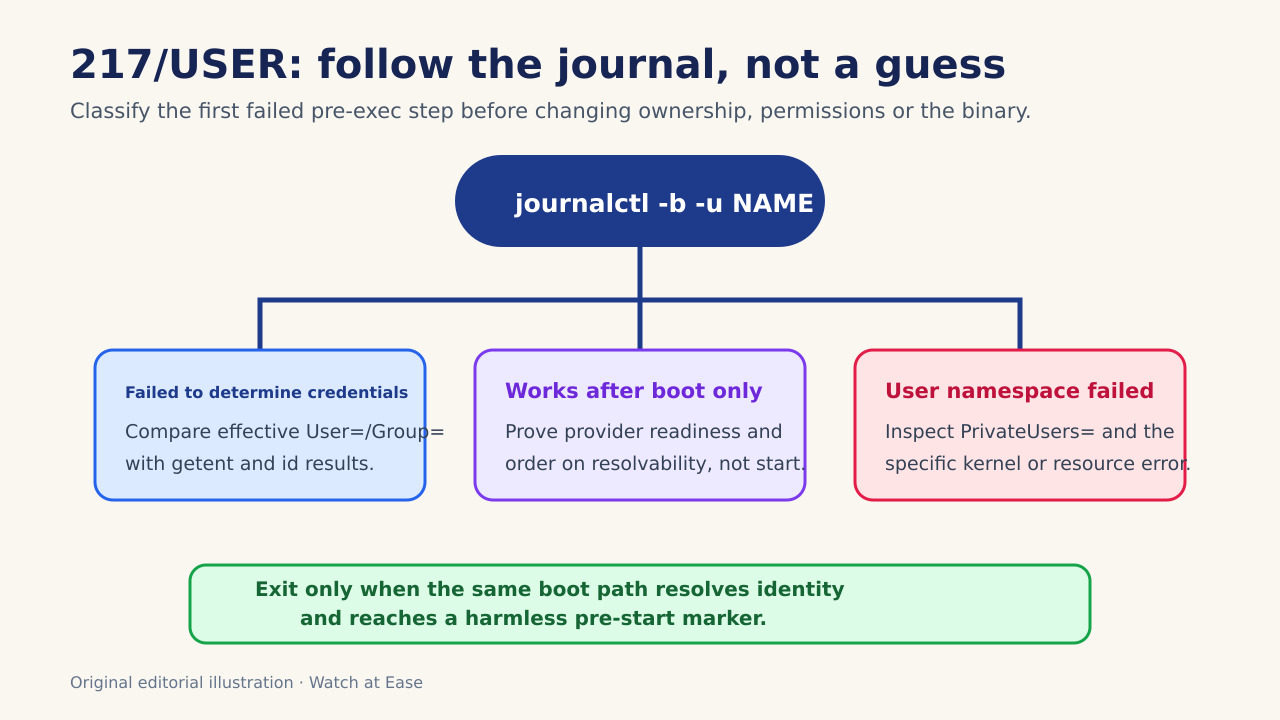
Capture systemctl status NAME.service and journalctl -b -u NAME.service around the first failure. Preserve messages such as “Failed to determine user credentials”, “Failed at step USER” or “Failed to set up user namespacing”, plus the underlying errno. The headline 217 code groups more than one pre-exec boundary.
Do not begin with chmod, chown or edits to the application. If systemd cannot establish the requested identity or namespace, ExecStart has not yet supplied evidence about the payload. Record the boot, unit name and exact first failed step before restarting.
Read the effective unit, not one file
Use systemctl cat NAME.service and systemctl show NAME.service -p User -p Group -p DynamicUser to expose the vendor unit and all drop-ins. A stale override can keep a deleted account even after the main file was corrected. Record the exact User= and Group= values; an empty Group= is different from a misspelled explicit group.
If the unit uses templates, environment generators or configuration management, record the instantiated unit and deployed drop-ins. Run systemd-analyze verify on the exact unit when syntax is in doubt, but do not treat a clean syntax check as proof that the account resolves.
Prove identity resolution through NSS
Run getent passwd USER and getent group GROUP, then id USER. getent matters because it follows the configured Name Service Switch path and can expose users supplied by SSSD, LDAP or another resolver rather than only /etc/passwd. Canonical’s SSSD guidance uses getent and id as the final identity checks.
Compare UID, primary GID, supplementary groups, home and shell with what the service expects. Repeat the checks in the same boot phase where the unit fails. A manual start ten seconds later can succeed while proving that startup readiness—not the account spelling—was the original boundary.
Separate provider start from provider readiness
For directory-backed identities, inspect the resolver logs and test when getent first succeeds. After= orders unit start events; it does not necessarily prove that an asynchronous directory cache can answer NSS queries. Add dependencies only to a readiness signal that is valid for that provider and distribution.
The Kanidm demand example failed during boot but worked later because the identity became resolvable after the service manager had already exhausted retries. Preserve a timestamped getent result and the provider’s own ready event. Avoid a blind sleep unless it is only a temporary experiment, because it hides the missing readiness contract.
Test the user-namespace branch
If the journal names user namespacing, inspect systemctl show NAME.service -p PrivateUsers and the effective hardening options. Upstream systemd explicitly includes failure to set up user namespacing in EXIT_USER 217. The next step is the recorded kernel, resource or policy error—not creating another account.
Compare a controlled override only in a safe test environment and preserve the before-and-after unit. Do not permanently disable hardening merely to make the status disappear. Confirm whether the host, container policy, UID mapping and relevant namespace limits support the requested configuration.
Require an exit proof before debugging the payload
Once User= and Group= resolve at service-start time and namespace setup succeeds, add a harmless ExecStartPre probe in a temporary drop-in, such as /usr/bin/id writing to the journal. Reload, start once and capture the marker. Remove the diagnostic override after the test.
The incident is not closed just because one manual restart succeeds. Record the effective unit, getent and id output, provider readiness evidence, namespace result and pre-start marker from the same boot path. Only then move to executable paths, working directories and application logs.