Technology · PRACTICAL GUIDE
Too many levels of symbolic links? Find the looping component before changing the path
Separate a real cycle from an overdeep chain, trace each component, identify the link owner, and replace only the broken entry.
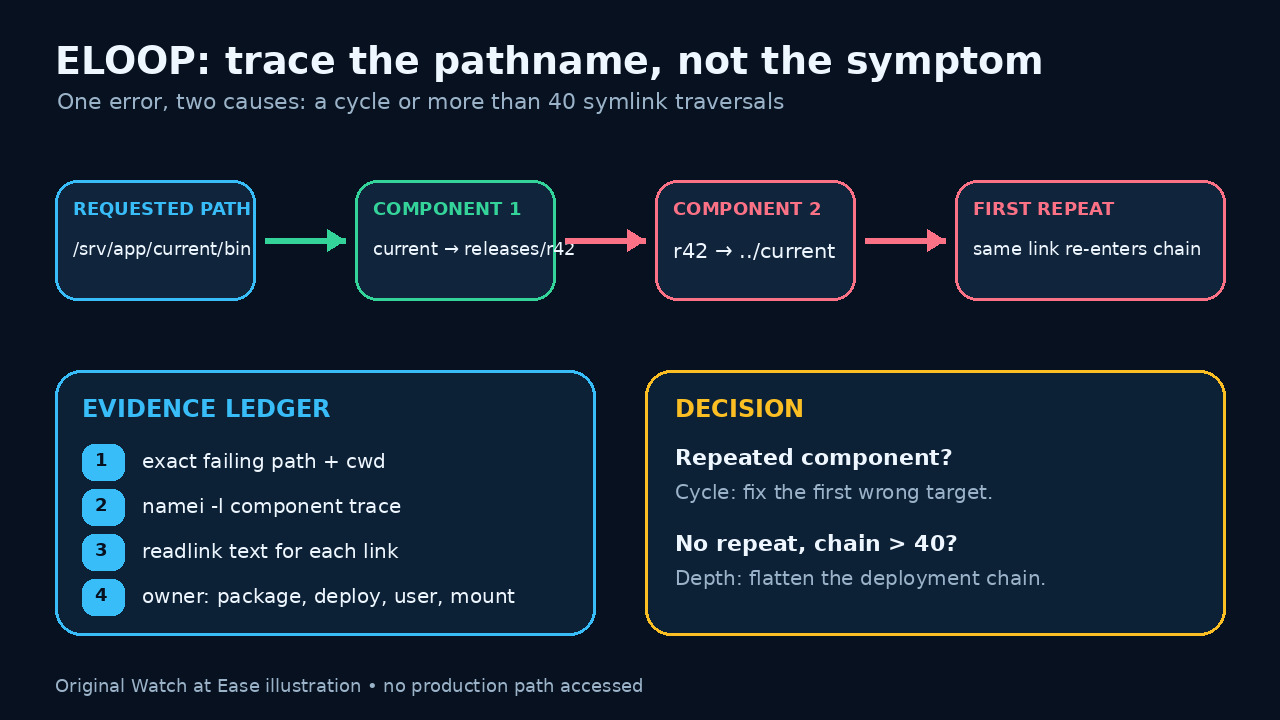
Linux reports ELOOP as “Too many levels of symbolic links” when pathname resolution crosses its symlink limit. A direct or indirect cycle is one cause; an acyclic chain that needs more than 40 traversals is another. The message does not identify the first wrong component.
Preserve the exact caller, working directory and unresolved path. Trace component text without deleting targets, classify the first repeat or excess depth, find who generated the link, and change one entry with a rollback and an exit test.
Freeze the exact caller and failing pathname
Copy the failing command, its exit text, current working directory, effective user, hostname or container, root or chroot, and the pathname exactly as passed. Keep relative and absolute forms separate. Do not replace the path with a hand-expanded guess.
Record whether the failure comes from a shell, web server, service, package hook or deployment process. The same spelling can start from a different directory or mount namespace, so a successful administrator test does not yet reproduce the application lookup.
Trace every component without following blindly
Run a component trace such as namei -l -- "$path" from the same view when available. Save each directory, symlink and stored target in order. Use lstat or ls -ld and readlink -- on individual links so you can inspect the link itself without resolving through it.
Do not begin with readlink -f as your only record: canonicalization can fail without showing the component that caused it. Keep raw link text because a relative target is evaluated from the link’s containing directory, not the directory where an operator typed ln.
Prove cycle, depth or a different boundary
Mark the first link entry that repeats in the trace. A self-link or a chain that returns to an earlier link is a cycle. If no entry repeats, count traversals: Linux can still return ELOOP when an acyclic chain requires more than 40 symbolic-link resolutions.
Separate ELOOP from ENOENT, ENOTDIR and EACCES. A missing component, a non-directory in the middle, or missing search permission needs a different repair even when an application translates several failures into one generic message.
Find the owner before replacing the link
Identify whether the bad entry is managed by a package, configuration manager, framework command, container image, release switch or manual action. Capture inode, timestamps, stored target and package or deployment evidence before editing. A generated link will return unless its source of truth is fixed.
Check that the proposed target exists in the same root and mount namespace as the failing caller and has the expected object type. Do not chmod the whole tree, delete the target directory, or convert every relative link to an absolute path as a diagnostic shortcut.
Replace one entry and require an exit test
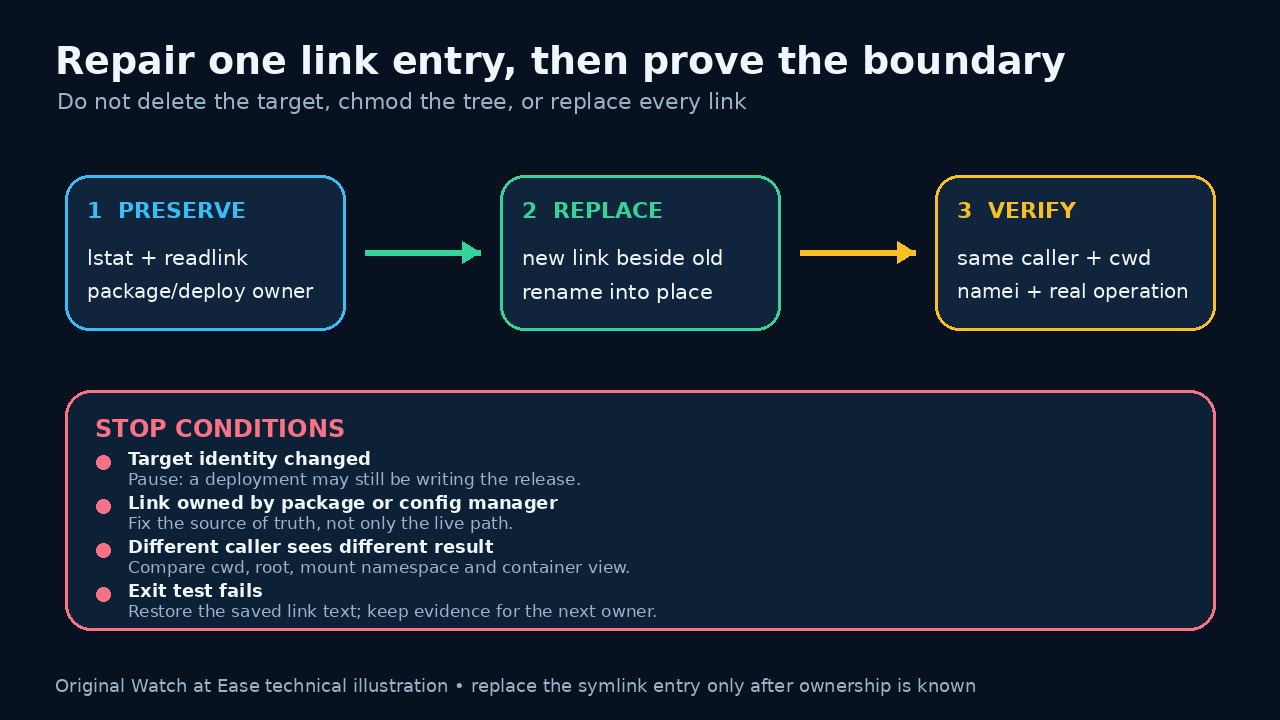
Create the corrected link under a new name in the same directory, verify its raw target, then rename it into place using the deployment method that owns the path. Keep the saved old link text and rollback command. If a release is still changing, stop instead of racing it.
Repeat namei and the original operation from the same user, working directory, root and namespace. Success requires the component trace to terminate at the intended object, the application operation to pass, and the package or deployment source of truth to retain the correction on the next run.