Business · NEWS EXPLAINER
IMFC urges support for financing strains: the conditions behind the call
The October 17 chair's statement calls for more support to countries with sustainable debt and strong reform plans. It does not allocate country-by-country funding.
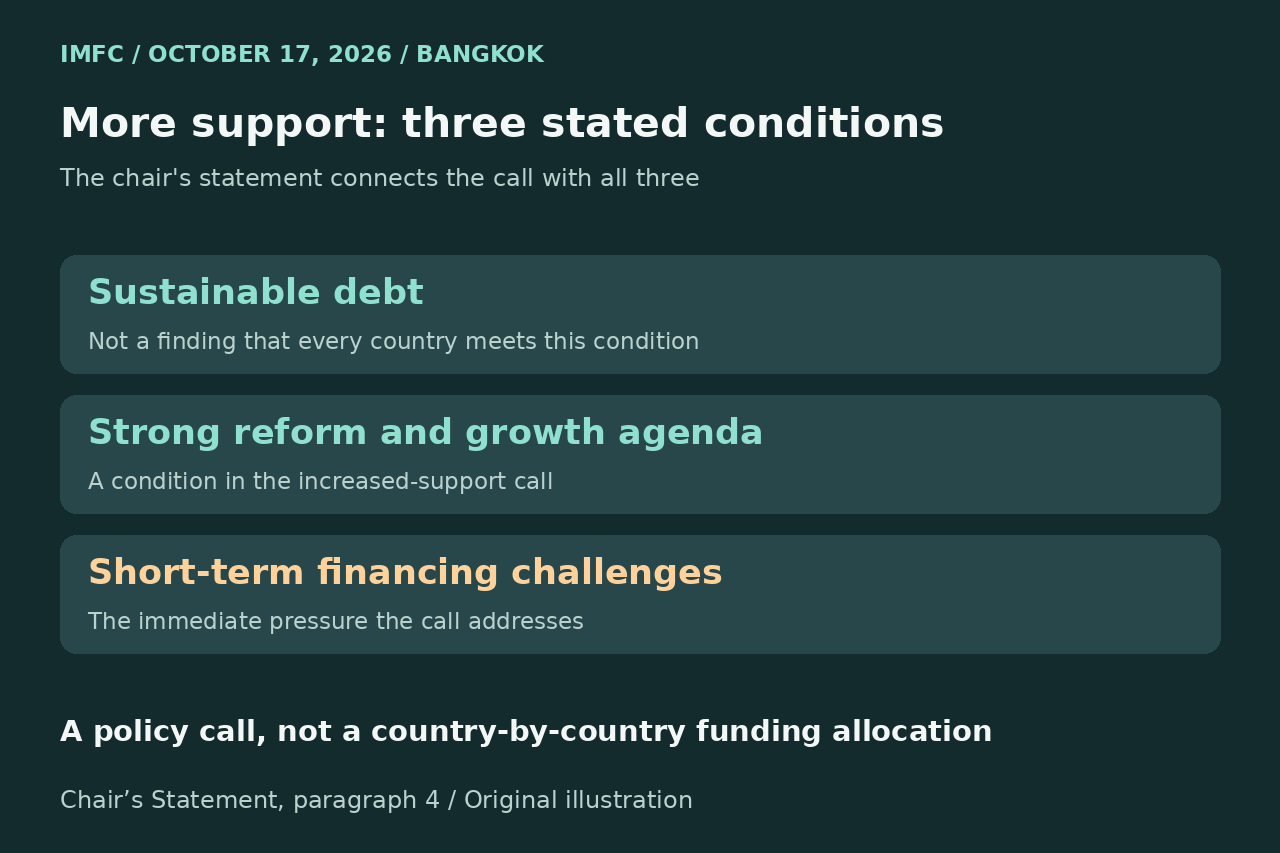
International Monetary Fund members called for greater support to countries facing short-term financing pressure after wars and high energy prices, according to the October 17 IMFC chair's statement and a full Reuters report. The call singles out sustainable debt and a strong reform and growth agenda; it is not an unconditional offer to every affected economy.
The new document comes from the International Monetary and Financial Committee's 54th meeting in Bangkok. It is headed Chair's Statement and explicitly introduces text agreed by IMFC members. The policy signal is significant, while approvals, financing assurances and money delivered remain different stages.
Who the increased-support call is for
Paragraph four connects greater support with countries whose debt is sustainable and whose reform and growth agenda is strong, but which face short-term financing difficulties. It calls for faster implementation of the IMF–World Bank Group 3-Pillar Approach. The reviewed statement does not explain every operational detail of that framework.
These conditions matter when reading the headline. Temporary financing pressure and an unresolved debt problem are not automatically the same diagnosis. The statement also calls for better debt-restructuring processes and greater transparency, including from private creditors; it does not declare every country's debt sustainable.
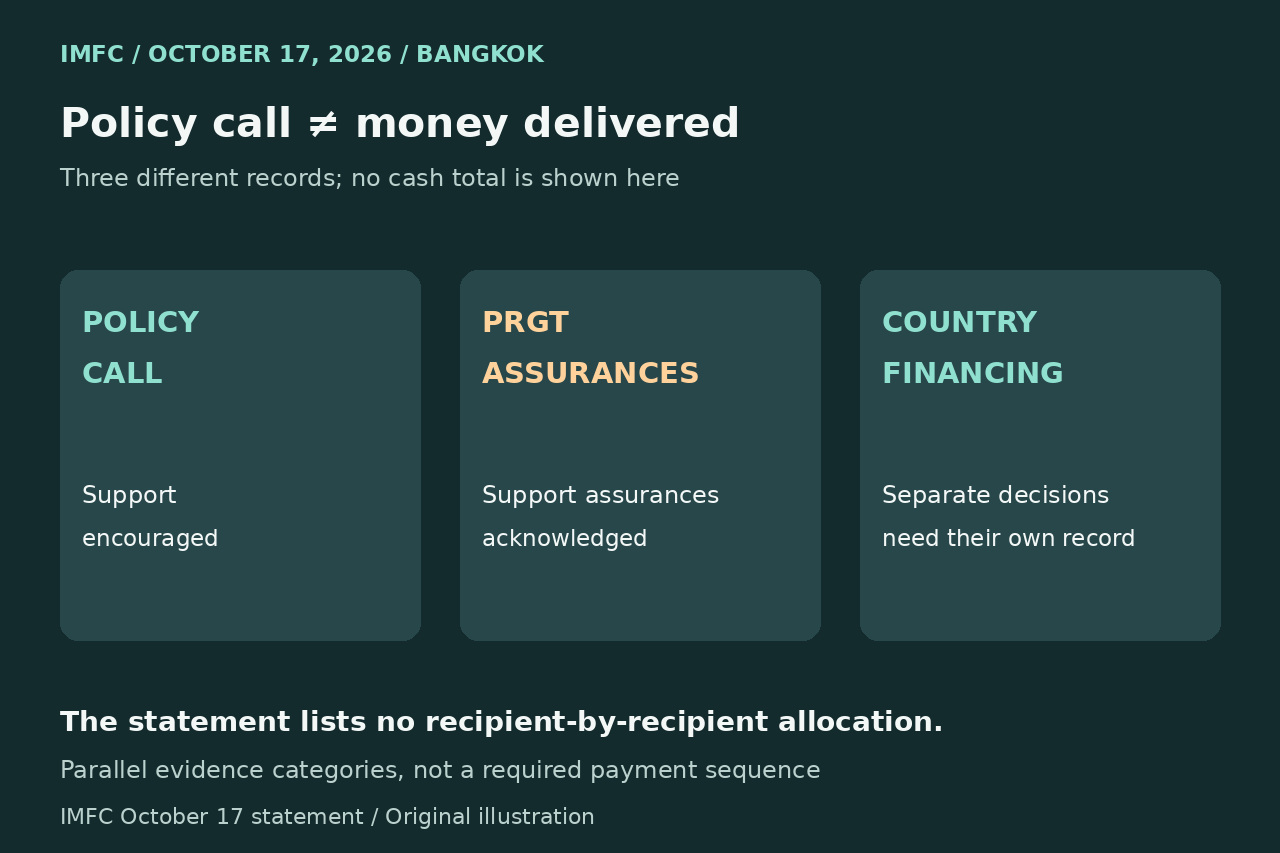
PRGT assurances are a different measure from funds delivered
The chair's text thanks members that have provided the necessary assurances to support the Poverty Reduction and Growth Trust's self-sustained lending capacity, and calls for swift delivery of assurances by others. Reuters independently reports the support assurances in its account of the meeting.
The three-page document does not provide a recipient-by-recipient allocation, a new total of money already paid out or a timetable for each borrower. Its acknowledgment of assurances should therefore not be turned into a claim that a named country has already received a new loan. Separate financing decisions require their own evidence.
Resilience and risk appear in the same assessment
The committee says the economy has handled recent shocks better than expected, while warning that buffers have weakened. Its concerns include conflict, disrupted trade routes, energy and food security, and higher borrowing costs spilling into heavily indebted economies.
Technology receives the same two-sided treatment: the statement associates rapid advances with investment and trade, but says uncertainty about their effects can amplify financial vulnerabilities. The IMF's published briefing excerpts likewise describe resilience alongside worry. These are officials' assessments, not a new quantified growth guarantee or proof that every country shares the gains.
What would establish implementation
For subsequent announcements, the important details are the country or facility, the financing instrument and amount, the decision stage and the conditions. A call to increase support, an assurance to a lending trust and an approved country arrangement answer different questions. This statement does not announce a universal grant window.
The document expects the next IMFC meeting in April 2027 in Washington. That is the committee's anticipated meeting, not a promise that aid arrives then or that decisions must wait until then. The new development here is the October 17 agreed policy text; country-level approvals and delivered financing remain matters to verify in their separate records.