Technology · NEWS EXPLAINER
IMF chief urges AI safeguards in Bangkok as Clark calls for standards beyond voluntary pledges
The October 16 discussion joined safety, productivity and access to infrastructure. It was a policy debate, not the adoption of a new global AI rule.
IMF Managing Director Kristalina Georgieva called for safeguards and an ethical foundation for artificial intelligence at the IMF–World Bank annual meetings in Bangkok on October 16. Reuters reported that she supported industry self-regulation alongside engagement with society and major governments.
Anthropic co-founder and policy chief Jack Clark argued that decisions could not rest with companies alone. Reuters reported his support for common standards and his view that testing and disclosure should not remain entirely voluntary; AP independently reported his warning about company-only decision making.
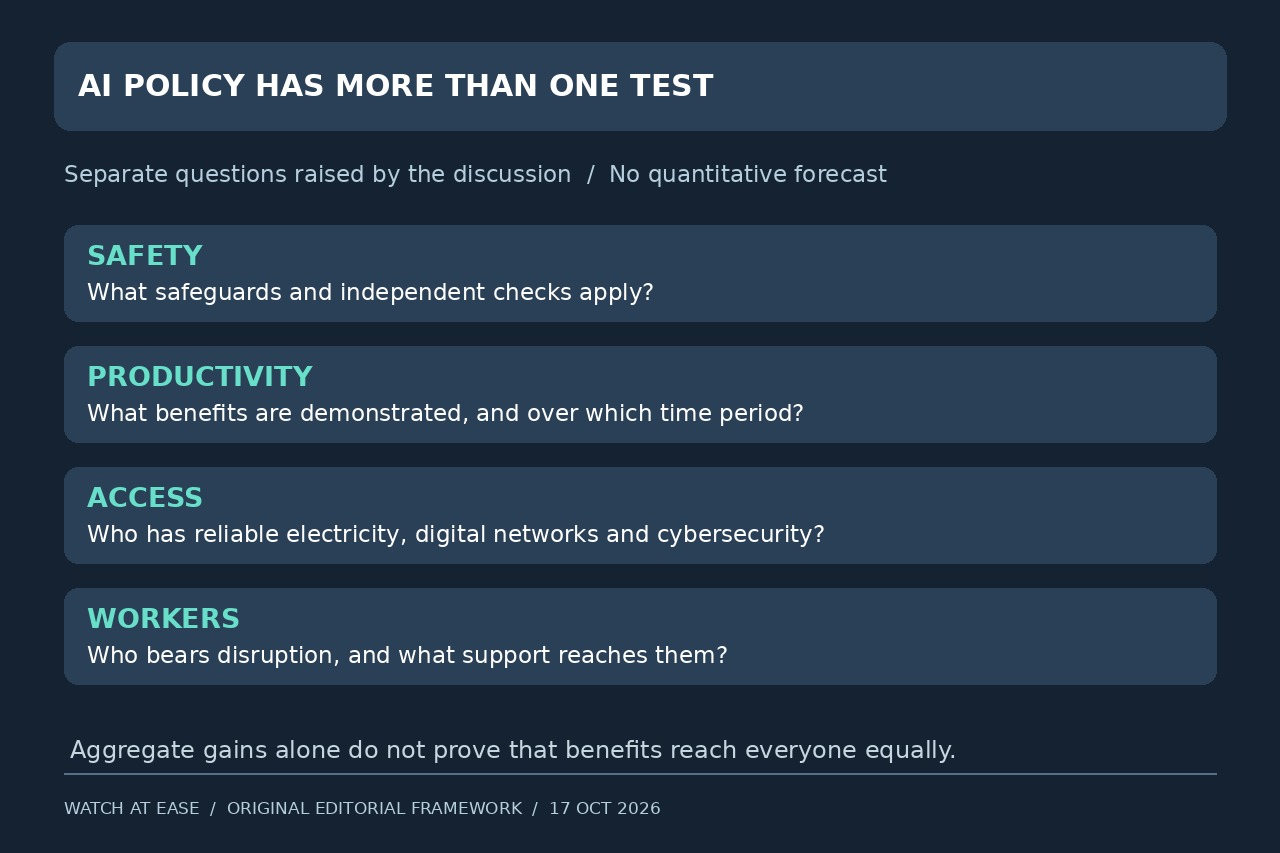
The discussion matters beyond model safety. Access to electricity and digital networks affects who can benefit, while gains in output can coexist with people losing particular jobs. The useful question is which institutions will translate those concerns into specific obligations, investment or worker support.
What was said, and what the official record establishes
The IMF listed the seminar, AI and the Global Economy: From Risk to Opportunity, for 11:15 a.m.–12:15 p.m. ICT on October 16. Its agenda covered productivity, work, financial stability and public policy, with Georgieva, Clark, Bank of Canada Governor Tiff Macklem and other participants.
That page establishes the session's identity and planned scope. It is not a transcript or a text of adopted rules. The accounts of what speakers said here come from the complete Reuters and AP reports, read as two independent reporting families; their syndicated copies are not extra confirmations.
Who will set and verify the standards?
Reuters reported that Georgieva saw a role for industry self-regulation because governments struggle to oversee a rapidly changing sector, while also involving society, major AI-producing countries and relevant international institutions. Her position should not be shortened to either regulation by companies alone or one new worldwide regulator.
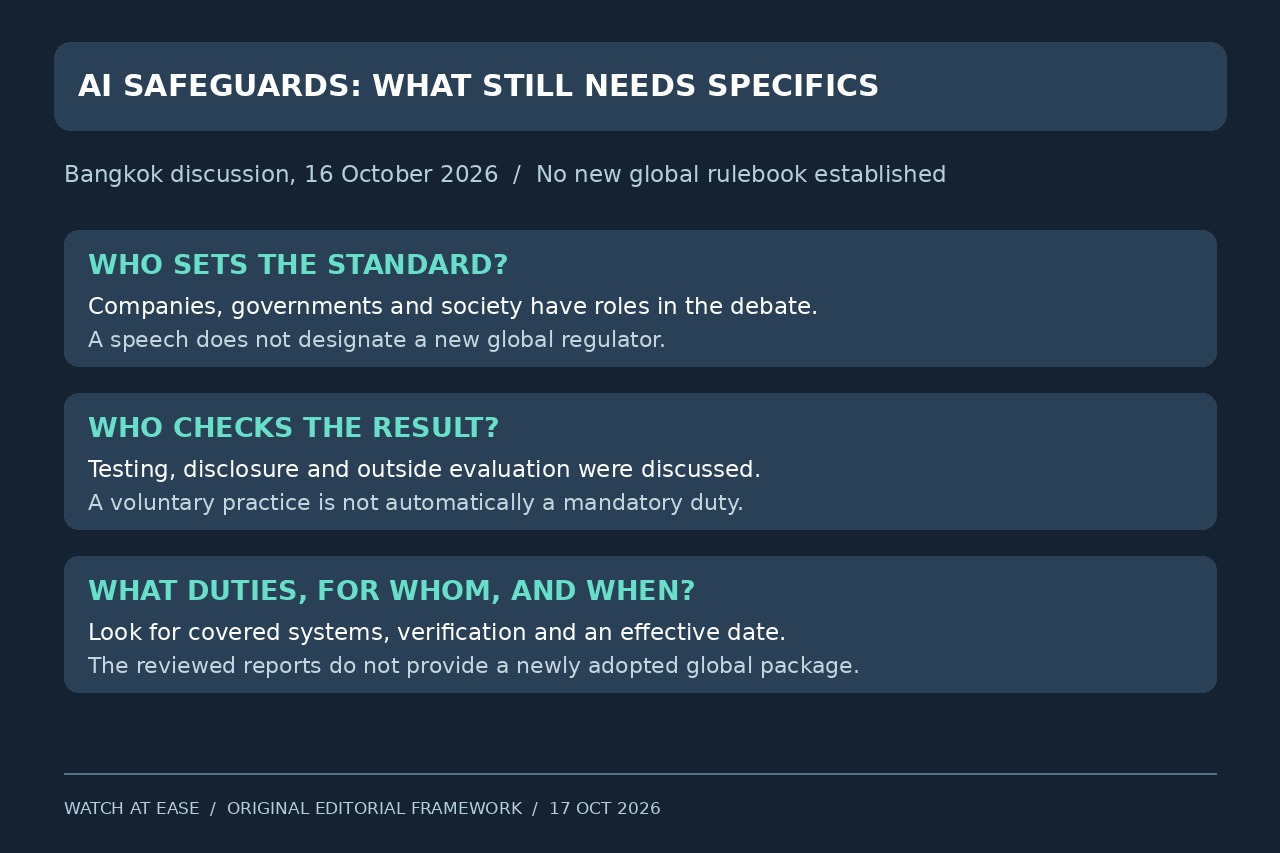
Clark described testing, published information and outside evaluation as parts of the response, according to Reuters, while saying the system should not be completely voluntary. AP also reported his insistence that companies cannot be the sole decision makers. Those positions leave practical questions about who sets a standard, who checks it and what happens when it is missed.
Infrastructure and workers shape who receives the gains
AP reported that Georgieva identified electricity, digital networks and cybersecurity as conditions for wider participation. Their availability is a separate issue from how capable a model is: a community without reliable access cannot obtain the same benefits simply because a better system exists.
Macklem compared the distributional challenge with trade, AP reported: aggregate gains can accompany serious losses for particular workers, and support matters. This is not a forecast that any named occupation will disappear. We have not independently reviewed the underlying IMF jobs study, so this article does not turn remarks about it into a quantified employment projection.
Which next steps would change the policy picture
Readers should distinguish a speech or panel position from an adopted instrument. A concrete next development would name the responsible body, the covered systems or organizations, the duties, the method of verification and an implementation date. The reviewed event listing and reports do not supply such a newly adopted global package.
The same distinction applies to economic claims. Productivity gains, access spending and help for displaced workers need their own evidence and time horizons. The Bangkok discussion identifies the issues to watch; it does not prove that benefits will arrive evenly, that an investment boom is safe, or that one firm's evaluation practices have become mandatory for everyone.