Business · NEWS EXPLAINER
Google’s 3,590 MW Constellation deal: only 890 MW is new nuclear capacity
Two contracts do different jobs: one supports extra output from existing reactors; the other secures power from Constellation’s operating fleet. The first uprate is expected in 2028.
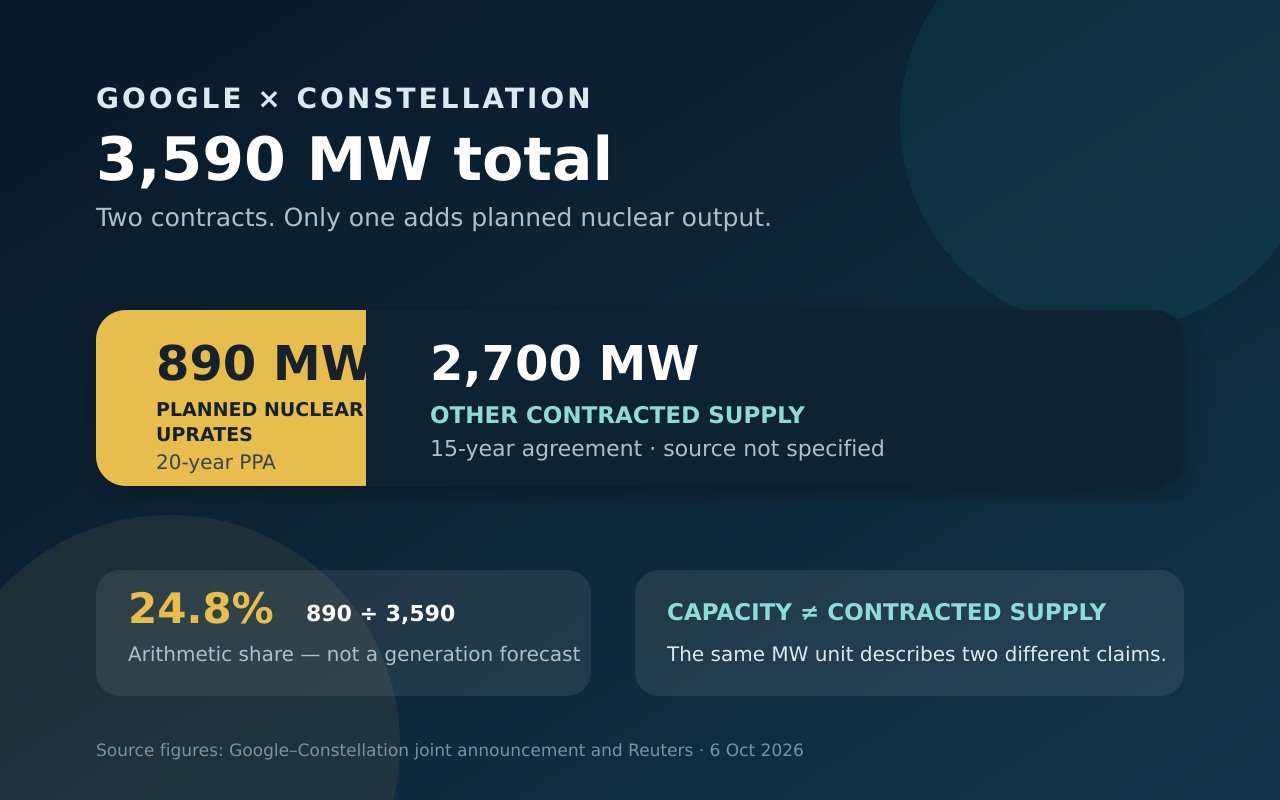
Google and Constellation announced a 3,590-megawatt power arrangement on October 6, but the entire headline figure is not new nuclear capacity. The package combines 890 MW of planned additional nuclear output with 2,700 MW of other contracted supply in the PJM electricity market. The distinction changes how the deal should be read.
Two contracts, two different claims
The new nuclear portion has a 20-year power purchase agreement. The additional supply arrangement lasts 15 years. Reuters reports that the 2,700 MW is not tied to a specific generation source; it should not therefore be described as another block of newly built nuclear power.
Adding 890 and 2,700 gives the reported total of 3,590 MW. Dividing the first number by that total puts the new nuclear portion at about 24.8%—roughly one quarter. That is our calculation from the announced figures, not a separate forecast of how much electricity the projects will generate.
For a reader comparing announcements, this is the central test: does a number describe more generating capability, or a contract for supply? Both can matter commercially, but they do not mean the same thing. Counting every contracted megawatt as an addition to the grid would overstate this agreement’s new nuclear contribution.
An uprate is not a new reactor
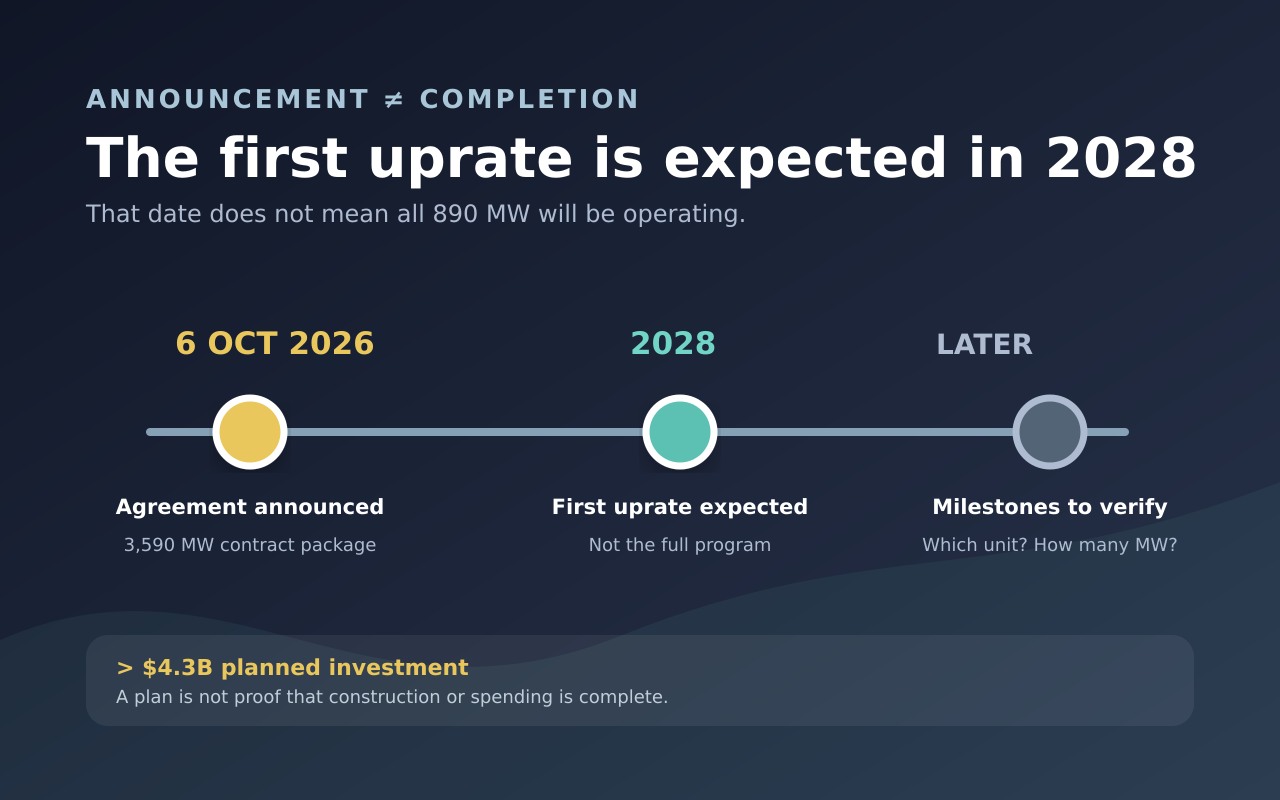
The companies plan upgrades at 11 existing nuclear units across six sites in Illinois, Pennsylvania and New Jersey. The joint announcement describes equipment and technology improvements, with the first uprate expected in 2028. It does not say all 890 MW will be operating by that date.
The physical distinction is straightforward: more output from an existing plant is not the same project as constructing an additional reactor. A comparison with the output of a large reactor describes scale, not the type of construction being commissioned.
There are also two clocks to keep separate. October 6 is the agreement’s announcement date; 2028 is the expected start for the first upgraded output. Signing the contract does not make that future capacity available today, and a first-delivery milestone is not a completion date for the whole program.
What the headline cannot tell you
Megawatts describe a rate of power, not an annual amount of electrical energy. The total alone is insufficient to calculate annual generation: a meaningful energy estimate would also need an operating period and assumptions about actual output.
The two contract terms do not cure that information gap. A 20-year agreement is a commercial duration, not evidence that every plant will produce its maximum output continuously for 20 years. For the same reason, the headline does not establish the physical path of electricity to a particular data center.
Nor does the announcement calculate a household’s future bill. Adding capacity, securing long-term revenue and delivering a measurable reduction in a customer’s charge are separate propositions. The first two can be discussed from the agreements; the third would require evidence the announcement does not provide.
What to watch when the projects advance
The companies put Constellation’s planned investment above $4.3 billion. Treat that as the announced investment program, not proof that the work or the spending is already complete.
A useful follow-up should identify which uprate has entered service, how much additional output it delivers and whether later milestones have changed. Those observations would show progress on the 890 MW program. Another reference to the overall 3,590 MW contract figure would not, by itself, answer those questions.
For now, the accurate reading is narrower than “Google adds 3.6 GW of new nuclear power”: the deal supports 890 MW of planned nuclear uprates and separately arranges 2,700 MW of supply. That preserves the scale of the agreement without turning contracted power into generation that does not yet exist.