Pack around the job you do most
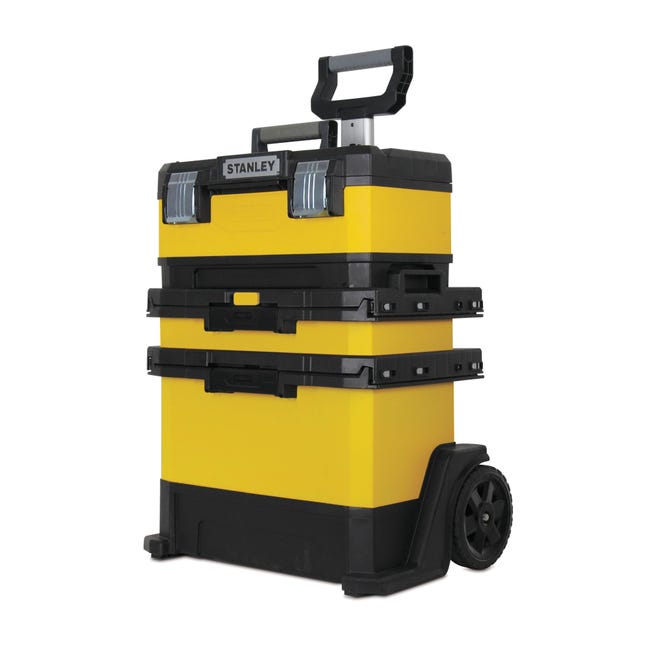
Think about a normal repair session: hand tools, drill accessories, a few fasteners, and perhaps a larger power tool. A rolling organizer is useful when those items repeatedly travel together. Instead of buying by the number of compartments alone, lay out your regular kit and decide which pieces you need to reach first. Put frequently used small tools near the top and reserve the deeper space for larger cases or equipment. This is the STANLEY 1-95-621 workshop, not an interchangeable module from every other STANLEY storage family. It makes most sense as one coordinated storage system for a recurring set of jobs around the house, garage, or work area.
Different storage zones, easier access
The manufacturer identifies a removable 50 cm top toolbox, a detachable tray, a drawer on ball-bearing slides, a deep lower bin, and a cantilever opening arrangement. The drawer is described as approximately 10 cm deep. Large wheels and metal latches are also part of the design. These features are valuable when they match the shape of your kit; a long saw or an unusually tall tool case still needs a fit check. Tools shown in product photography should not be assumed to be included. Padlock points allow you to add a compatible lock, but they do not turn a portable workshop into a high-security cabinet.
Check the route before loading it
A wheeled workshop is easiest to appreciate along the route it will actually take. Measure door openings, storage space, and the threshold between your garage and the work area. The source lists overall dimensions around 57 by 39 by 73 cm; verify the current assembly dimensions if fitting under a specific shelf matters. Large wheels help with movement, but a rolling container is not a stair-climbing trolley. Think carefully about lifting a loaded system into a vehicle or carrying it between floors. Keep heavier items low, stay within the manufacturer's load limits, and check that the drawers and latches are secured before moving. A tidy packing plan supports controlled handling.
Decide between mobile storage and a fixed cabinet
Choose mobile storage when the work moves: a room repair today, an outdoor installation tomorrow, and a garage project over the weekend. A fixed workshop cabinet may be more convenient if every job happens beside the same bench. For this rolling unit, the removable top box is especially useful when you only need a smaller hand-tool kit for a short task. Avoid filling the available space simply because it is there; leaving room to see and lift the tools is part of the benefit. Label small parts and keep accessories in suitable containers. The real upgrade is a repeatable way to find, transport, and put away your regular tools, rather than an excuse to carry the entire garage everywhere.
What to consider
A good fit if…
- Removable top storage supports smaller trips.
- A drawer and deep lower bin separate different tool shapes.
- Wheels and a cantilever layout make one organized kit easier to use.
Keep in mind
- Tools, locks, and extra organizers are not assumed included.
- Loaded stairs and vehicle lifting require a separate handling plan.
- Compatibility with other storage families should not be assumed.
Buy the 1-95-621 if you want the same core tools ready to move together. Check the largest tool against the compartments, measure the route, and plan the loaded weight. For a kit that regularly moves around the home, sensible organization can matter more than adding another loose toolbox to the shelf.
Sources & product details
Check the exact model and specification against your needs. Product guides use the linked source material; they do not imply hands-on testing unless explicitly stated.