Sports · NEWS EXPLAINER
Zheng wins her first WTA 1000: three saved set points changed the Beijing final
Zheng beat Mirra Andreeva 7–5, 6–4 for her first WTA 1000 title. Straight sets conceal the pivot: Andreeva had three chances to win the opener before Zheng took control.
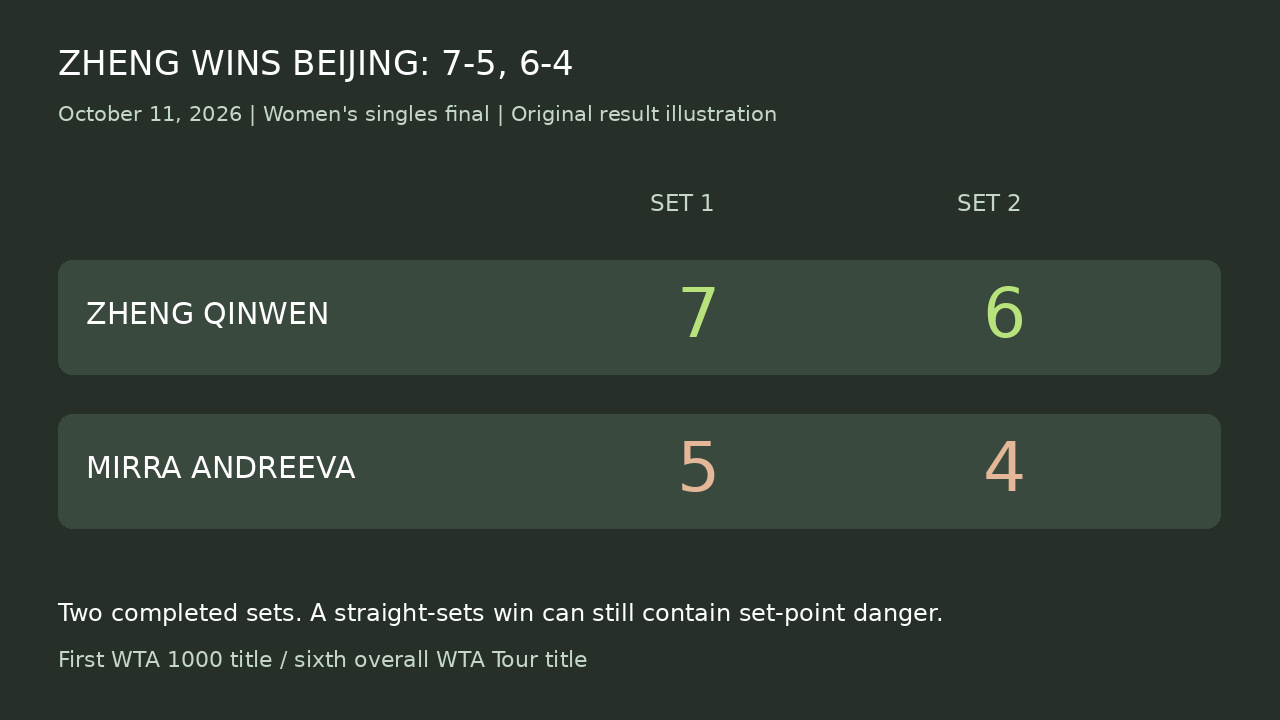
Zheng Qinwen won the China Open women's singles final on October 11, beating Mirra Andreeva 7–5, 6–4 in Beijing. It was Zheng's first WTA 1000 title and made her the first Chinese woman to win this tournament.
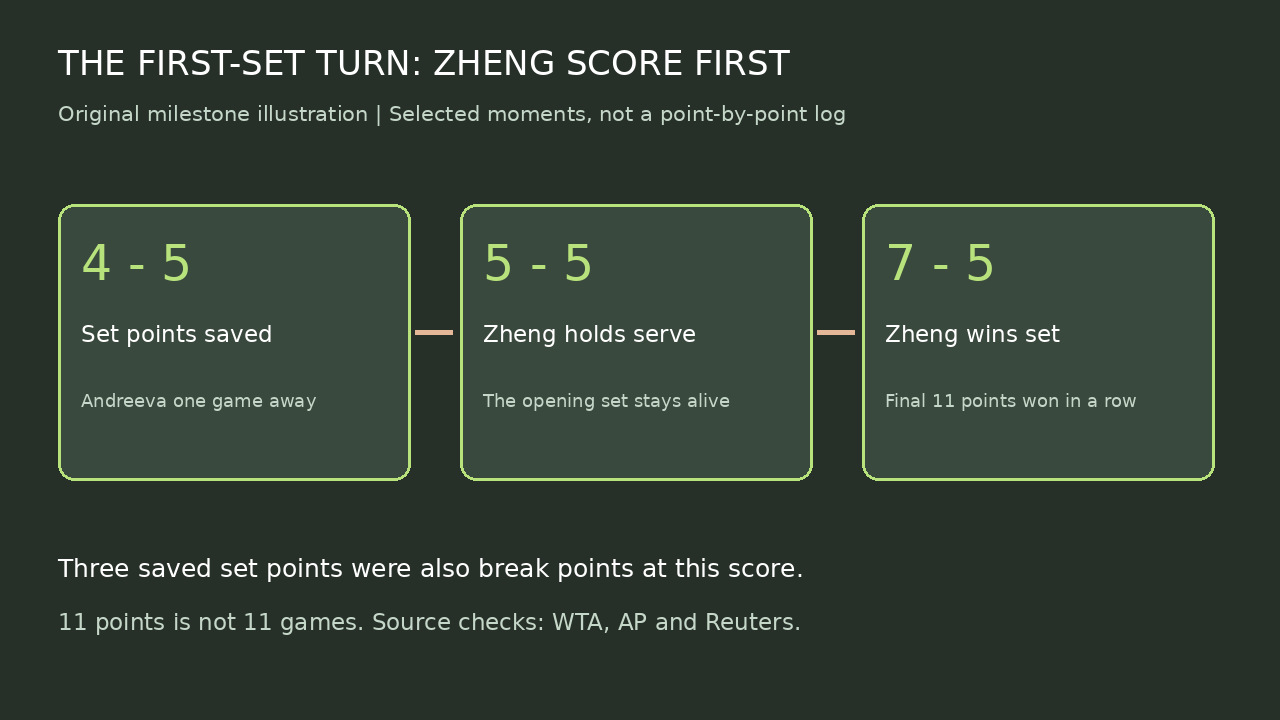
The score records two completed sets, but the opening one was close to going the other way. Zheng saved three set points while Andreeva led 5–4, then won the final 11 points of the set. That passage explains the result more clearly than treating 'straight sets' as a synonym for an easy final.
Three set points were also break points
At 5–4, Andreeva was one game from the first set. A break of Zheng's serve would have finished it. Reuters describes three saved break points; the WTA and AP identify them as set points. In that position, both descriptions apply to the same opportunity.
Zheng held for 5–5 and finished the set 7–5. The reader should not turn those saved chances into a claim that she had already lost a set, or confuse the 11-point closing run with 11 games. Points, games and sets describe different levels of the score.
The second set turned at 4–4
After early breaks were exchanged, the second set reached 4–4. Zheng broke in the ninth game and held in the next. AP reports that she converted her first match point with an ace toward Andreeva's backhand.
The first-set escape and the second-set finish were separate passages. The former prevented Zheng from falling a set behind; the latter supplied the late break and service hold that completed the title. A final ace shows the ending, but the break immediately before it made that ending possible.
First at this level, rather than first in her career
The WTA identifies this as Zheng's first WTA 1000 trophy and sixth overall tour title. AP places her previous tour title in Japan in October 2024, after a year that also included the Paris Olympic singles gold medal.
The new milestone is specific to the WTA 1000 level and the China Open. It does not erase her earlier achievements or turn Beijing into a Grand Slam title. Keeping the tournament category visible makes the significance precise.
A low ranking did not make the title automatic—or impossible
Zheng entered her home tournament as a wildcard ranked No. 54. AP reports that her ranking had fallen sharply during an elbow-injury interruption. The result confirms that she won this final; it is not a medical declaration that every effect of the injury has disappeared.
The WTA describes a demanding route: her first four matches went three sets, followed by three straight-sets wins. The final score alone therefore does not describe the workload of the whole tournament, nor predict how she will recover for her next match.
The loser can still rise in the rankings
The WTA and AP expect Andreeva to reach No. 3 in the next ranking release despite losing the final. Zheng is expected to return to the Top 30. These are forward-looking ranking outcomes reported on Sunday, not a published Monday list already in hand.
A ranking considers more than this one head-to-head result. Winning the trophy and moving in the rankings are related but different questions. Reuters's reference to Zheng aiming for the Top 20 concerns what she hopes to do next, rather than her confirmed rank after this final.
What to follow when replaying the match
Start with Zheng's service game at 4–5 in the opener, then the late break at 4–4 in the second set and the title-clinching service game. That sequence links the threatened first set to the decisive finish without implying the rest of the match was irrelevant.
The original illustrations present the completed set scores and selected first-set milestones. They are score-based editorial graphics, not match photographs, court-position tracking or a reconstructed point-by-point feed.