Technology · NEWS EXPLAINER
YouTube Music starts labeling AI-made tracks: where the badge appears and what it can tell you
The rollout puts a “Made with AI” disclosure on the player page for music created primarily with generative AI. The badge opens more context, but it is a transparency signal—not a filter, a copyright ruling or a complete production history.
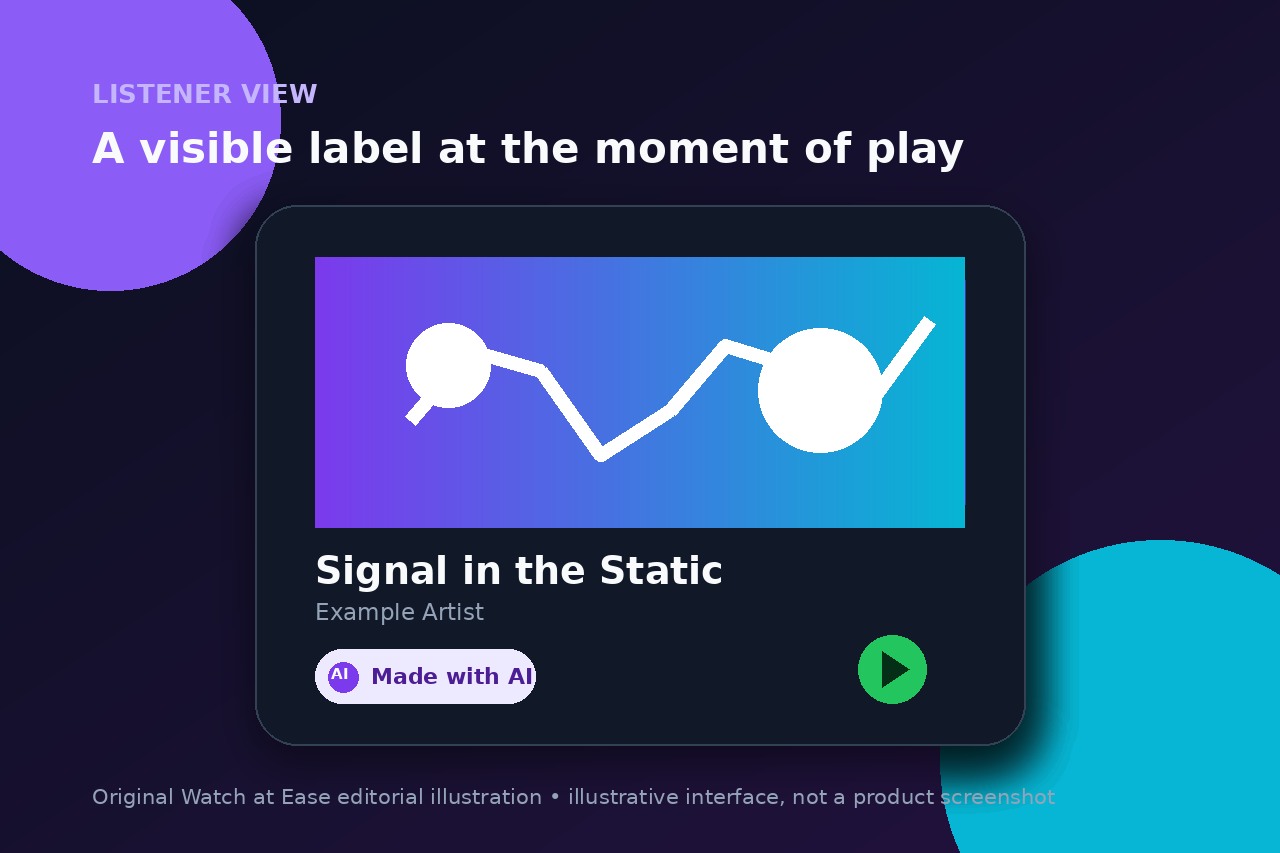
YouTube Music began rolling out listener-facing labels on October 14 for tracks created primarily with generative AI, including music whose composition and vocals were generated. The disclosure sits on the player page, and tapping it opens a short explanation of how AI figured into the track.
What changed on October 14
YouTube says the rollout starts with songs created primarily using generative AI. Its example is a track for which a generative model produced the composition and vocals. The official announcement does not say that every use of an automated production tool triggers the same listener-facing badge. It instead describes a significant role for generative AI and points partners to more detailed disclosure guidance.
Where listeners will see the label
On YouTube Music, the disclosure appears directly on the player page near the track information. Tapping the badge opens a “How this was made” panel with more context. 9to5Google’s review of the rollout shows wording that tells the listener the audio was altered or fully generated using AI. YouTube also says the music labels will expand to the main YouTube app, but it did not give a date for that expansion.
Fully, partly or not generated with AI
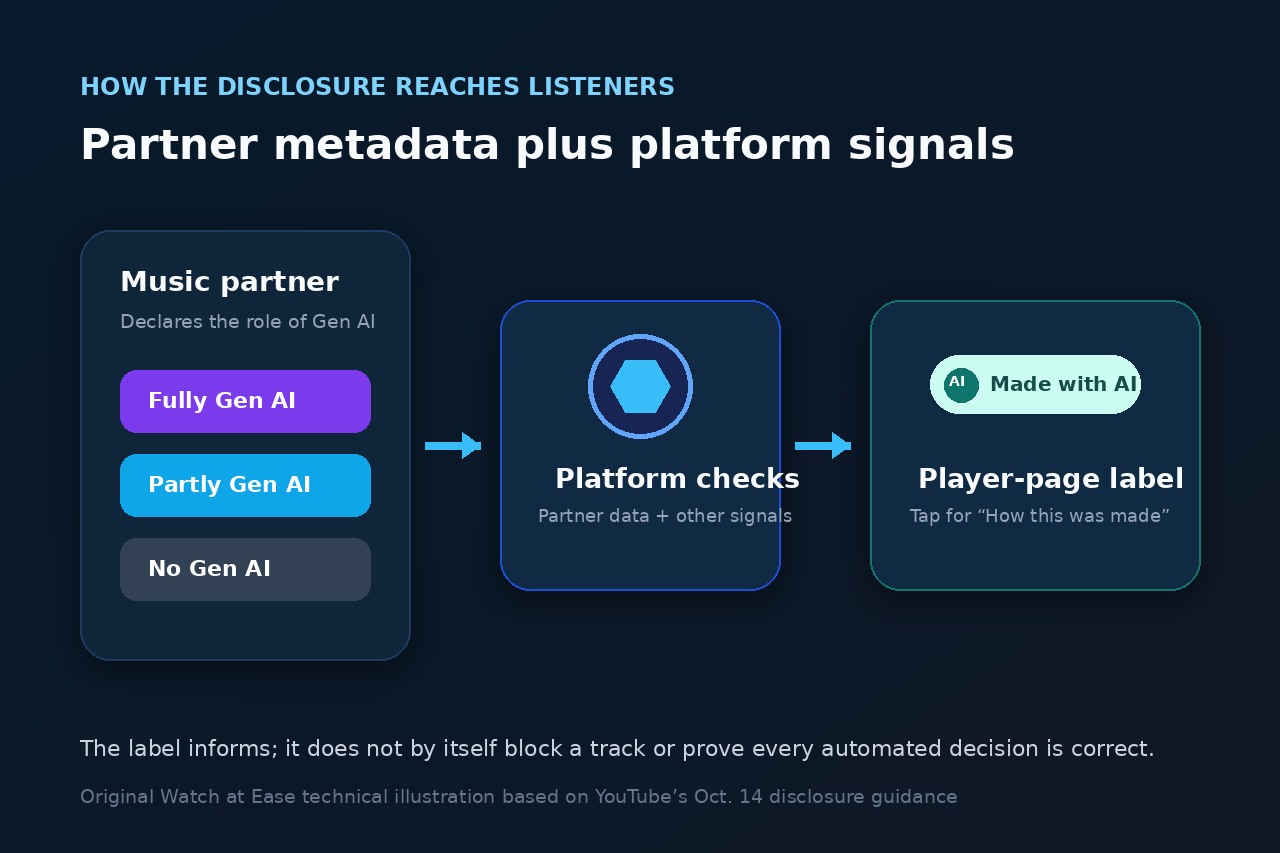
YouTube’s Help Center gives music partners three metadata choices. “Fully Gen AI” covers a track made entirely with generative AI, such as prompting a model to create the composition, instrumental performance and vocals. “Partly Gen AI” covers mixed workflows, including an AI-generated bassline beneath live instruments or lyrics and melodies developed with a model before a studio recording. “No Gen AI” includes conventional pitch correction and automated mastering in the examples YouTube provides.
Who supplies the information
The first input is the music partner’s declaration, delivered through supported DDEX metadata, a YouTube CSV template or YouTube Studio. A missing value is treated as unknown unless YouTube can decide from other signals. YouTube says it will combine partner information with its own detection tools, which means the badge is not solely a voluntary uploader note. The announcement does not publish an error rate or an appeal process for listeners, so the label should be read as the platform’s current disclosure, not an independent audit of a song’s entire production.
What the badge does not mean
A “Made with AI” badge does not by itself say that a track infringes copyright, impersonates an artist or is ineligible to earn money. TechCrunch reports that YouTube is using disclosure rather than a blanket ban, and that AI involvement alone does not make a track ineligible for monetization. The label also is not an opt-out switch: YouTube’s October 14 announcement describes information shown to listeners, not a control that removes AI music from recommendations or search results.
How to use the new information
When the badge appears, tap it before assuming how much of the recording was generated. The help guidance distinguishes a fully generated track from a mixed human-and-AI production, while ordinary pitch correction and automated mastering can still fall under “No Gen AI.” For an unlabeled track, absence of the badge is not proof of a completely human workflow: partner metadata can be unknown, the rollout is still beginning, and YouTube says it may rely on other signals when a declaration is missing.