Business · NEWS EXPLAINER
WeRide launches global robotaxi insurance program: what is covered—and what is not
Allianz Insurance Singapore and Ping An P&C are the first partners. The announcement names risk categories, but it is not one worldwide policy with universal terms.
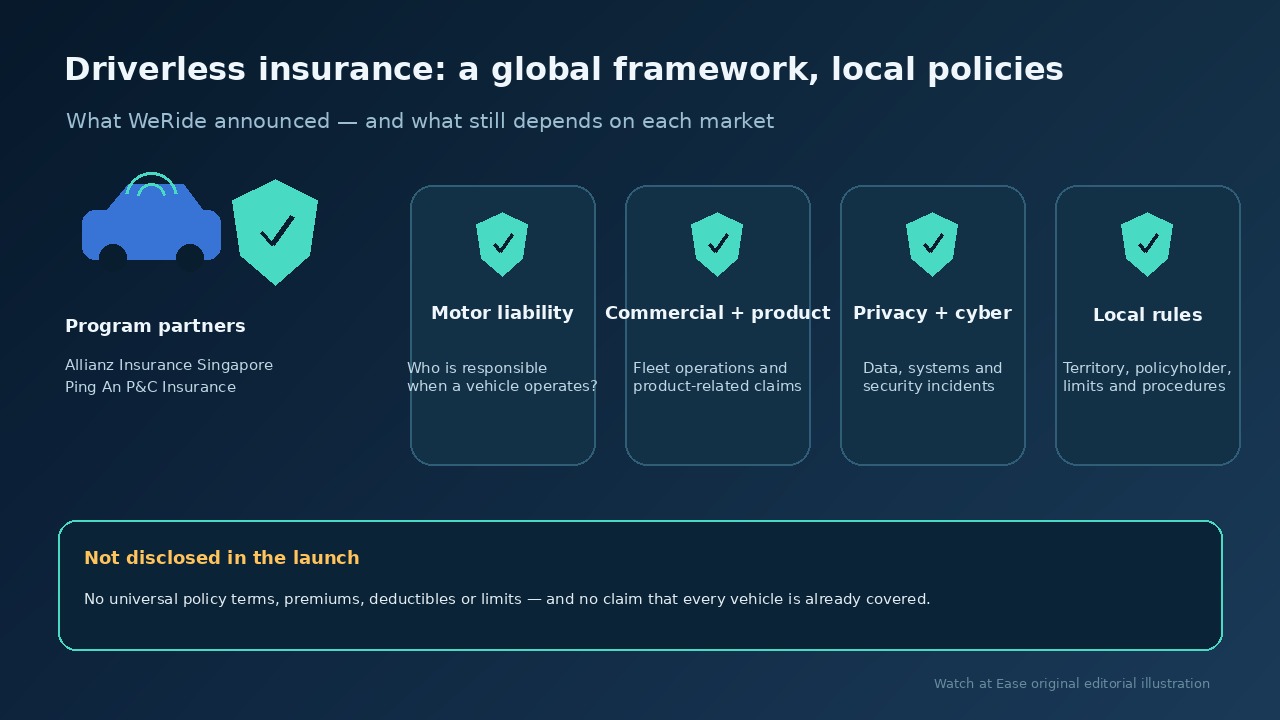
WeRide announced a global insurance partnership program on October 28 with Allianz Insurance Singapore and Ping An Property & Casualty Insurance as its first participants. The program is intended to support autonomous-vehicle operations across multiple markets, including robotaxi services.
The announcement identifies motor liability, commercial general and product liability, privacy and cyber risk, plus locally required coverage. It does not publish one policy that automatically applies worldwide, nor universal premiums, limits, deductibles or exclusions.
A framework for local policies, not one global contract
WeRide says the partners will combine insurance capacity, regional networks and autonomous-driving data to design coverage for deployments. That is a cooperation framework. A vehicle or service is protected only by the policy actually issued for its operator, territory, use and regulatory requirements.
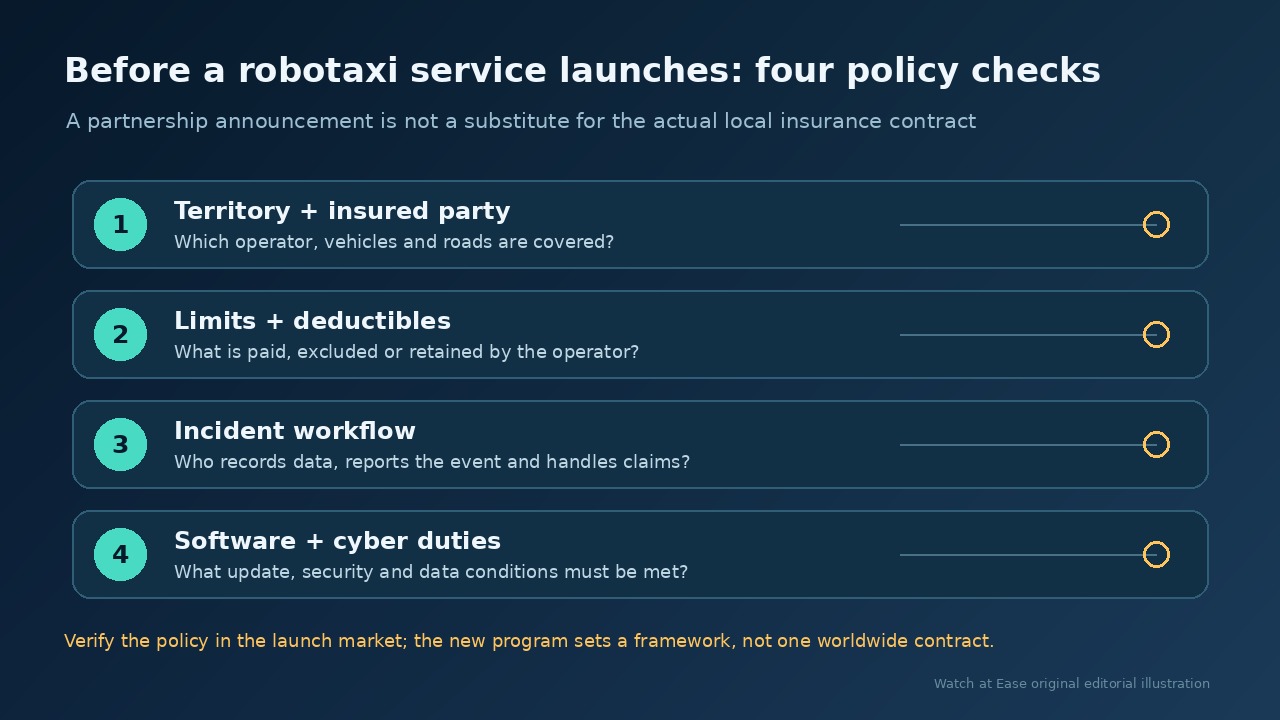
Before treating a launch as insured, identify the named insured, operating area, vehicle and service type. Then read the limit, deductible, exclusions and reporting duties. The companies did not disclose those terms in the announcement, so they cannot be inferred from the partner names.
The coverage categories span road, product and data risk
Motor liability addresses road incidents, while commercial general and product liability can address operational or product-related claims under their specific wording. Privacy and cyber coverage matters because autonomous fleets depend on software, sensors, communications and data handling.
Those categories can overlap during a real event. A collision may also trigger questions about software, a component, fleet operations or data. Operators therefore need a documented incident workflow that says who preserves logs, notifies the insurer and coordinates with authorities; the announcement does not supply that procedure.
Existing local experience does not guarantee identical terms elsewhere
Allianz Singapore has previously described insurance support for autonomous shuttles in Punggol, while WeRide points to insurance work in China, Singapore and the Middle East. Those examples show local experience, but they do not prove that a Singapore policy or claim process transfers unchanged to another jurisdiction.
For each new city, confirm local compulsory insurance, licensing conditions, public-road permissions and who bears responsibility across the operator, vehicle owner, technology supplier and safety personnel. Treat previous deployments as context, not a substitute for the new policy.
The fleet target is not a count of vehicles already covered
WeRide says its current fleet includes about 3,600 autonomous vehicles, including roughly 1,800 robotaxis, operating across 13 countries and more than 60 cities. The new program aims eventually to support tens of thousands of autonomous vehicles worldwide. The target should not be read as an already insured vehicle count.
A useful deployment check has four parts: verify territory and insured parties; read limits, deductibles and exclusions; test the incident and claims workflow; and map software, privacy and cyber duties. That turns a partnership announcement into evidence for the particular service a passenger, city or operator will actually use.