Business · NEWS EXPLAINER
Nasdaq loses 4.5% for the week, while the Dow keeps a gain
Friday’s decline hit all three major U.S. indexes, but the weekly results tell different stories. Here are the completed close and the limits of the market narrative.
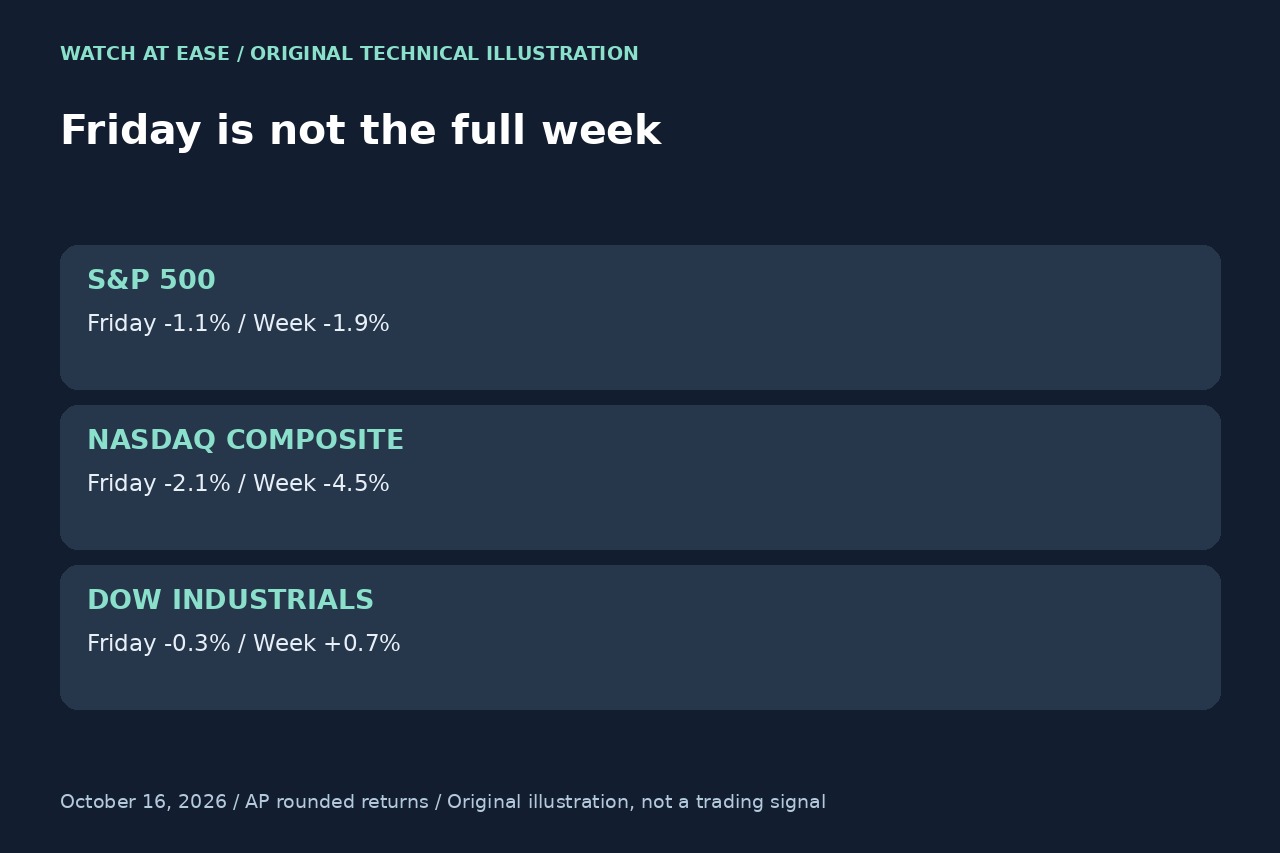
U.S. stocks finished lower on Friday, October 16, with the Nasdaq Composite falling 2.1% for the session and 4.5% for the week, according to the Associated Press closing table. The S&P 500 also fell for both periods, while the Dow Jones Industrial Average retained a 0.7% weekly gain despite losing ground on Friday.
The divergence matters when reading broad descriptions of a bad week for Wall Street. They capture pressure on major technology shares, but do not mean every benchmark had the same weekly result. Reuters separately reported concerns about AI financing and higher oil prices as context for the selling.
The closing table is the finished-session record
AP’s completed table places the Nasdaq’s Friday loss at 572.99 points and the S&P 500’s at 84.62 points. These are October 16 results, rather than a live quote or a forecast for the next session. AP describes both indexes as recording their worst week since June.
Keep the benchmark name attached to each figure. The Nasdaq Composite in this report is not the Nasdaq 100. Likewise, comparing raw point losses between indexes with different levels is less informative than comparing their percentage changes over the same period.
The Dow’s weekly gain changes the summary
The Dow lost 175.28 points on Friday, yet gained 347.46 points over the week in AP’s table. Reporting only the daily decline would omit that positive weekly result; describing all three major benchmarks as down for the week would be wrong.
The result also distinguishes the latest week from the year to date. AP still records gains for all three over 2026 through Friday. A weak week and a positive year can coexist. Neither observation, on its own, establishes what comes next.
AI financing and oil are reported context, not a complete explanation
Reuters reported pressure on AI-related companies alongside investor concerns about whether heavily indebted infrastructure businesses can become profitable in time to service debt. Its report also described an oil-price rise as another source of caution heading into the weekend.
Those are attributed explanations of market concern. A fall in a share price does not itself prove that a company will default, and a broad index decline does not identify one cause for every trade. We have not independently measured how much of the session’s movement came from each factor.
Read the quote’s clock as carefully as its percentage
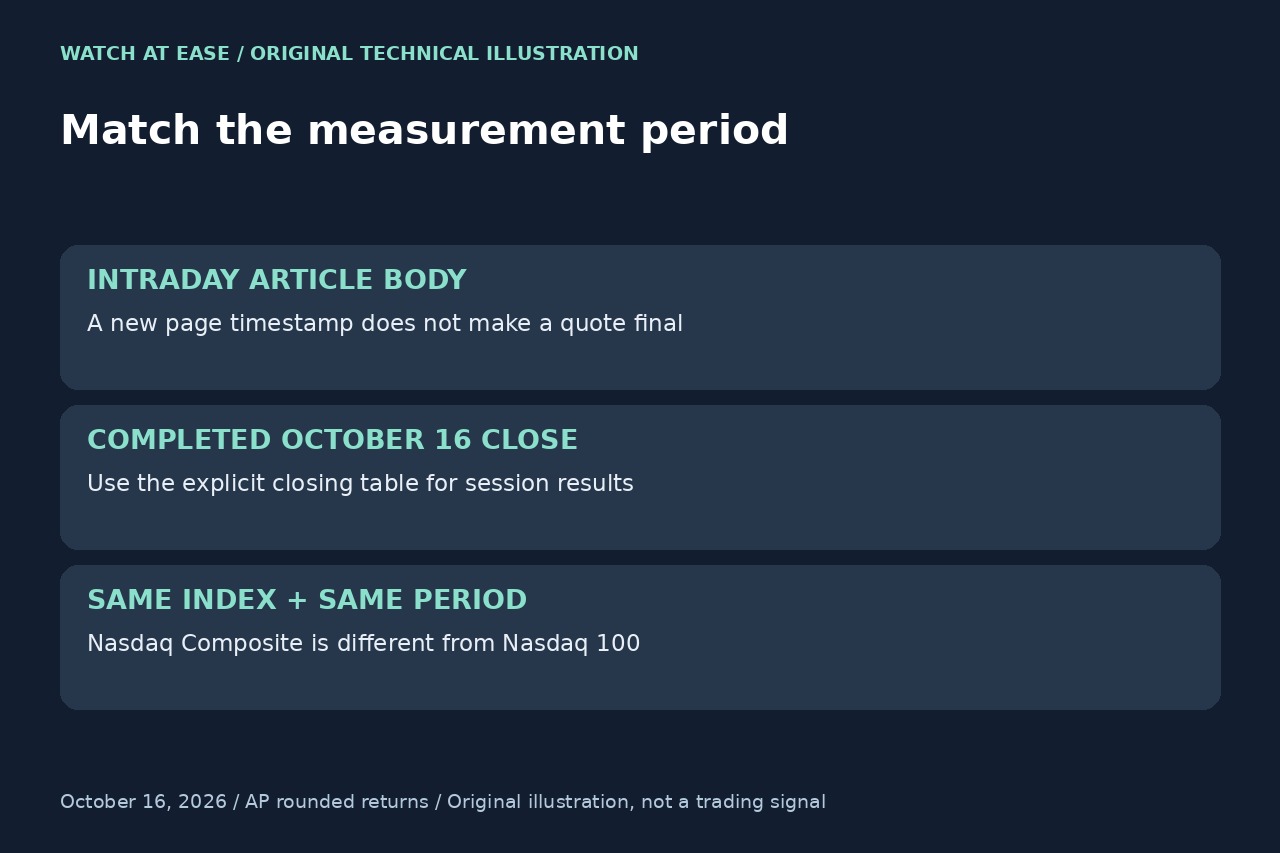
The Reuters copy we reviewed carries an updated page timestamp, while its article body still gives intraday index levels. We therefore use AP’s explicitly completed close for the final figures and Reuters for separately attributed context. An updated timestamp alone cannot turn a mid-session quote into a closing price.
When comparing reports, match the benchmark, session date and measurement period before judging a discrepancy. Friday’s change, the five-session change and an intraday snapshot are different records. Here, the completed outcome is a technology-heavy weekly retreat alongside a Dow that remained higher for the week.