Sports · NEWS EXPLAINER
Vikings beat Saints 23–13: the defense held, then Jones broke the tie
Minnesota reached 5–0 after New Orleans tied the game with an 87-yard fumble return. The decisive distinction: the Saints' defense created points, but their offense finished with only 142 yards.
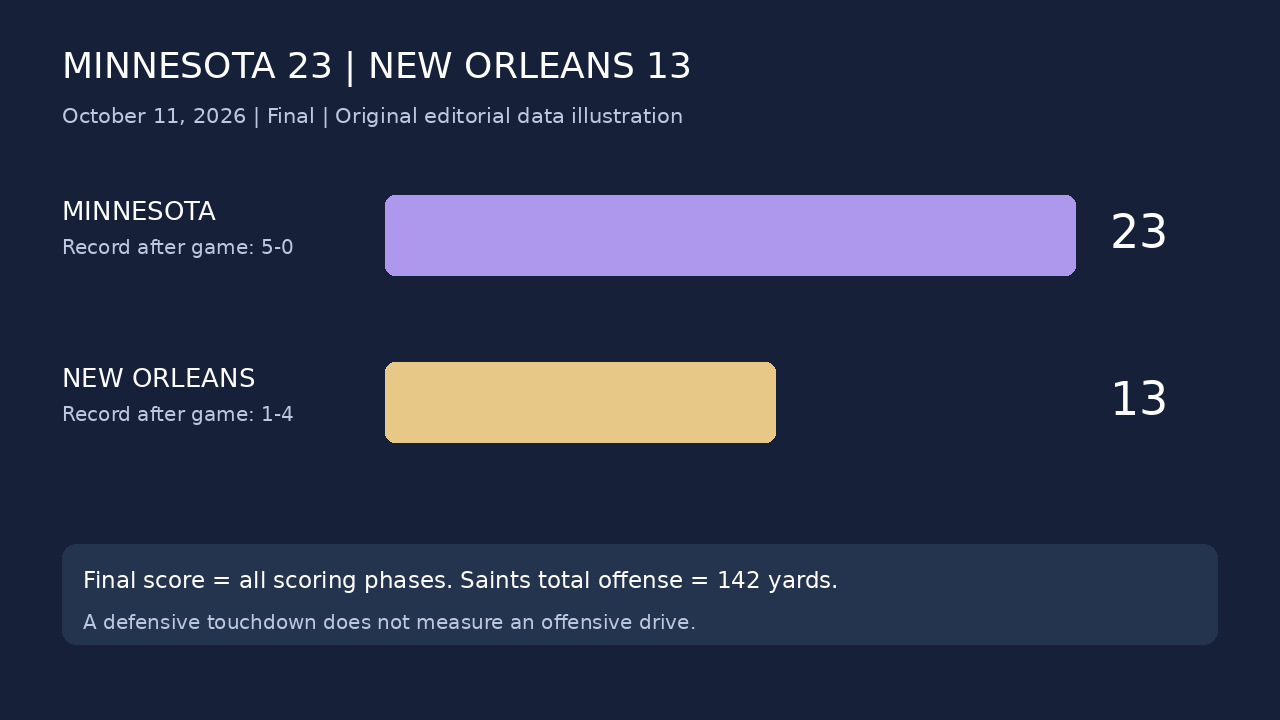
The Minnesota Vikings stayed unbeaten with a 23–13 win at New Orleans on October 11. Aaron Jones restored their lead early in the fourth quarter after Jonas Sanker’s 87-yard fumble return had pulled the Saints level at 13. Minnesota improved to 5–0; New Orleans fell to 1–4.
The tie made the game look more balanced than the Saints’ offensive production. New Orleans finished with 142 total yards and Tyler Shough threw for 96 with two interceptions. Separating a defensive touchdown from an offensive drive explains why Minnesota could lose a scoring opportunity and still control the final quarter.
The 13–13 score needs context
Sanker’s return gave New Orleans an immediate route back into the game. Daniel Carlson missed the extra point, leaving the teams tied rather than giving the Saints a one-point lead. It was a consequential defensive play, but it was not evidence that New Orleans had solved Minnesota’s defense.
For a reader watching highlights, that distinction matters. A long return can be the most dramatic clip while saying little about whether the offense can sustain its next possession. The final total-yardage figure supplies the missing context; the return and the offensive struggle can both be true.
Minnesota answered before the tie became a lead
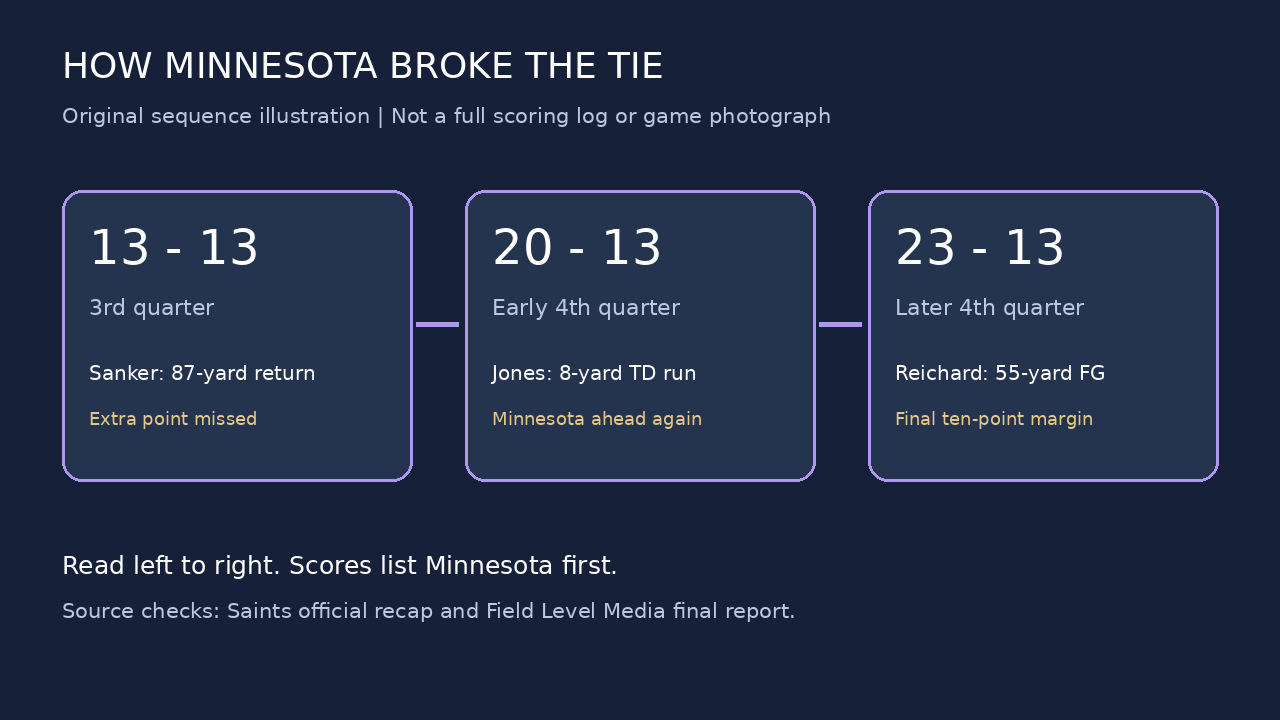
Jones scored from 8 yards on the second play of the fourth quarter, according to the independent Field Level Media account. The Vikings went ahead 20–13, and Will Reichard later made a 55-yard field goal to extend the margin to ten points.
That response is the clearest pivot in the result. Minnesota did not need the fumble return to disappear from the story; it needed a productive next answer. Moving ahead again and adding the field goal meant New Orleans needed more than one score to catch up.
A kickoff mistake changed the second half
The Saints’ Jayden Price fumbled the kickoff to begin the second half. Minnesota turned the possession into a 15-yard touchdown pass from Kyler Murray to Justin Jefferson, taking a 13–7 lead before Sanker’s later return brought the scores together.
The two turnovers worked in opposite directions. One supplied Minnesota with an attacking opportunity; the other immediately produced a New Orleans defensive score. Treating both as simply 'turnovers' hides how they changed field position and the scoreboard at different moments.
The passing totals point to different offensive days
Murray completed 24 of 30 passes for 229 yards and one touchdown. Shough’s official team recap lists 16 completions on 25 attempts for 96 yards and two interceptions. Jones added 113 rushing yards for Minnesota in the independent report.
These are passing and individual rushing figures, not an invitation to manufacture net team rushing or possession totals. Team offense accounts for categories differently, including sacks. The useful comparison here is the corroborated outcome: Minnesota had a repeatable offensive response, while New Orleans’ total production remained limited.
What this result establishes—and what it does not
The confirmed result gives Minnesota a 5–0 record and New Orleans a 1–4 record. The Saints’ own recap identifies this as their third consecutive home defeat. Those are completed outcomes; they do not establish a playoff place, the next game’s result or the full-season quality of either team.
Minnesota’s red-zone mistakes also remain part of the assessment. A win does not make lost possessions harmless. The narrower conclusion supported by this game is that its defense limited New Orleans, and its offense recovered the lead after the third-quarter setback.
How to read the final highlight sequence
Follow the second-half sequence in order: a Saints kickoff fumble, Jefferson’s touchdown for Minnesota, Sanker’s long defensive return and the missed extra point, Jones’s tie-breaking run, then Reichard’s field goal. This ordering prevents a dramatic individual clip from being mistaken for the final direction of the game.
The two original graphics summarize the final score and the tie-breaking sequence. They are editorial data illustrations, not game photographs, and do not show a particular formation or claim to reproduce a live broadcast.