Business/Consumer · PRACTICAL GUIDE
Buying a Used Phone: Check IMEI, Financing and Activation Locks
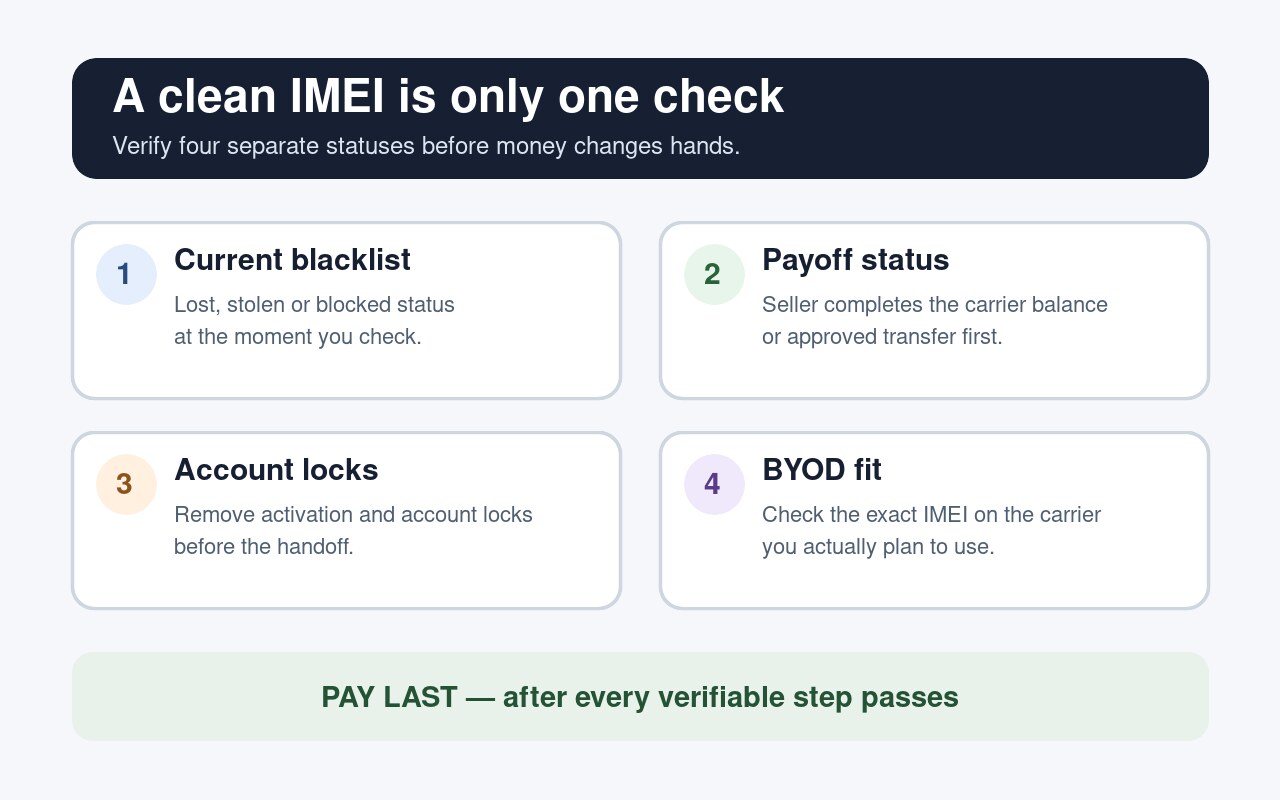
A clean blacklist result is only a current status check. Before paying a private seller, separately verify financing, account and activation locks, and compatibility with your carrier.
A phone can pass a public IMEI or blacklist check and still be tied to an installment agreement, an account, or a carrier policy that causes trouble later. No universal public lookup proves that a private seller has paid every balance or will never report the device lost. The safest rule is to release payment only after the seller completes the carrier-specific payoff or ownership steps and you can repeat the checks yourself.
Use four separate checks: current blacklist status, financing or installment status, account and activation locks, and BYOD compatibility. A green result in one category does not replace the other three.
1. Record the exact device identity before discussing payment
Open the phone’s settings and record the model, serial number and every IMEI shown; dual-SIM phones can have two IMEIs. Compare those identifiers with any box or receipt, but do not treat matching packaging as proof of ownership. Ask the seller in writing which carrier originally financed or sold the phone, whether any installment balance remains and whether the device is attached to an active account.
Run the original carrier’s current eligibility or unlock route and your intended carrier’s BYOD compatibility check. Save dated screenshots while covering unnecessary personal information. A clean blacklist result answers only the status visible at that moment; it does not reveal another customer’s private billing details or guarantee that the status cannot change.
2. Require payoff or transfer to finish before you pay
T-Mobile says a financed or leased postpaid device must be paid in full and the associated account must be in good standing before it qualifies for unlock. Verizon says a financed device unlocks after the agreement balance is paid in full, subject to payment posting and fraud, lost or stolen flags. AT&T says a phone tied to another account’s active installment plan may be blocked from use on a different AT&T account; the original owner must pay it off or complete an allowed billing-responsibility transfer.
Those rules lead to the same buyer decision: a promise to pay the balance after the sale is not proof. Ask the seller to complete payoff or an approved transfer first, then wait for the carrier’s resulting status to post. If the seller cannot or will not do that, stop the transaction. Do not use third-party unlock or blacklist-removal services as a substitute.
3. Separate financing, activation lock, carrier lock and compatibility
Treat these as four different checks: current blacklist status; financing or installment status; device account or activation locks; and BYOD compatibility for the exact model and IMEI on the buyer’s intended network. None is a substitute for the others.
Apple’s preowned-iPhone guidance tells buyers to reject a device that remains Activation Locked and to examine Carrier Lock status, but neither screen proves that a carrier installment balance is zero. Likewise, “No SIM restrictions” or a successful BYOD result does not certify a seller’s account balance.
4. Use different completion checks for an in-person or shipped sale
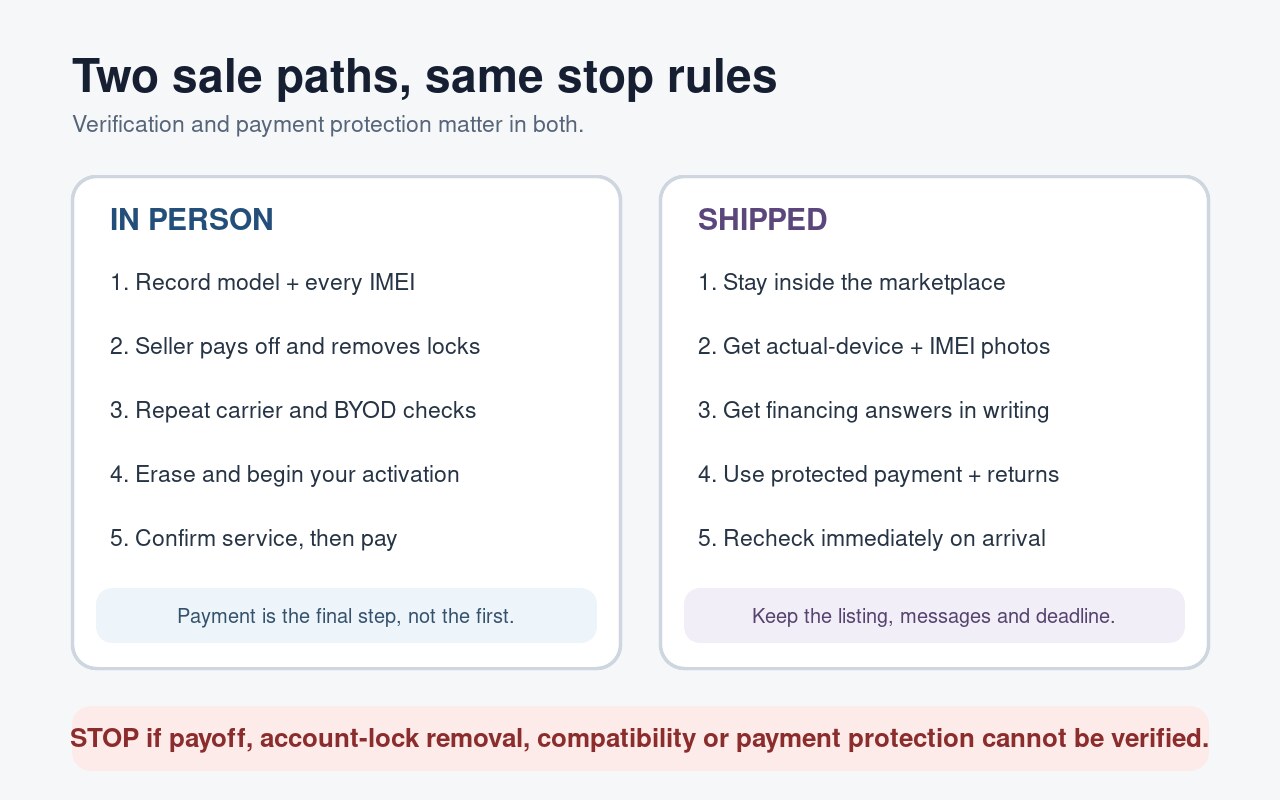
In person, have the seller finish payoff or transfer first, remove the device from their account, erase it, and let you begin activation with your own account or SIM/eSIM. Repeat the original-carrier status and intended-carrier BYOD checks after the seller’s change has posted. Payment comes last.
For a shipped sale, stay inside a marketplace that records the listing, messages, payment, delivery and return window. Require photos of the actual device and identifiers, written answers about financing and locks, and a return period long enough to activate and repeat the checks. Avoid wire, gift card, cryptocurrency or off-platform payment methods that remove normal dispute protection.
5. Build a small evidence packet and know the failure branch
Keep the listing, seller’s written answers, proof of payoff or transfer, carrier check results, IMEIs, payment receipt, delivery record, activation result and the marketplace deadline. The FTC recommends keeping marketplace communications and using protected payment.
Walk away before payment if the seller refuses to identify the original carrier, cannot finish payoff or transfer, will not remove activation or account locks, objects to a BYOD check, pressures you off-platform, or asks you to trust a clean IMEI screenshot as the only proof. If the phone later becomes blocked, contact the marketplace or payment issuer before its deadline and provide the records; a dispute is a process, not a guaranteed refund.