Travel/Public Service · PRACTICAL GUIDE
Canceled or Changed U.S. Flights: When Refunds Are Automatic
For a qualifying cancellation or change, decline replacement travel and vouchers if you want money back. Check who charged the ticket: airline refunds can be automatic, while an agent refund requires a request.
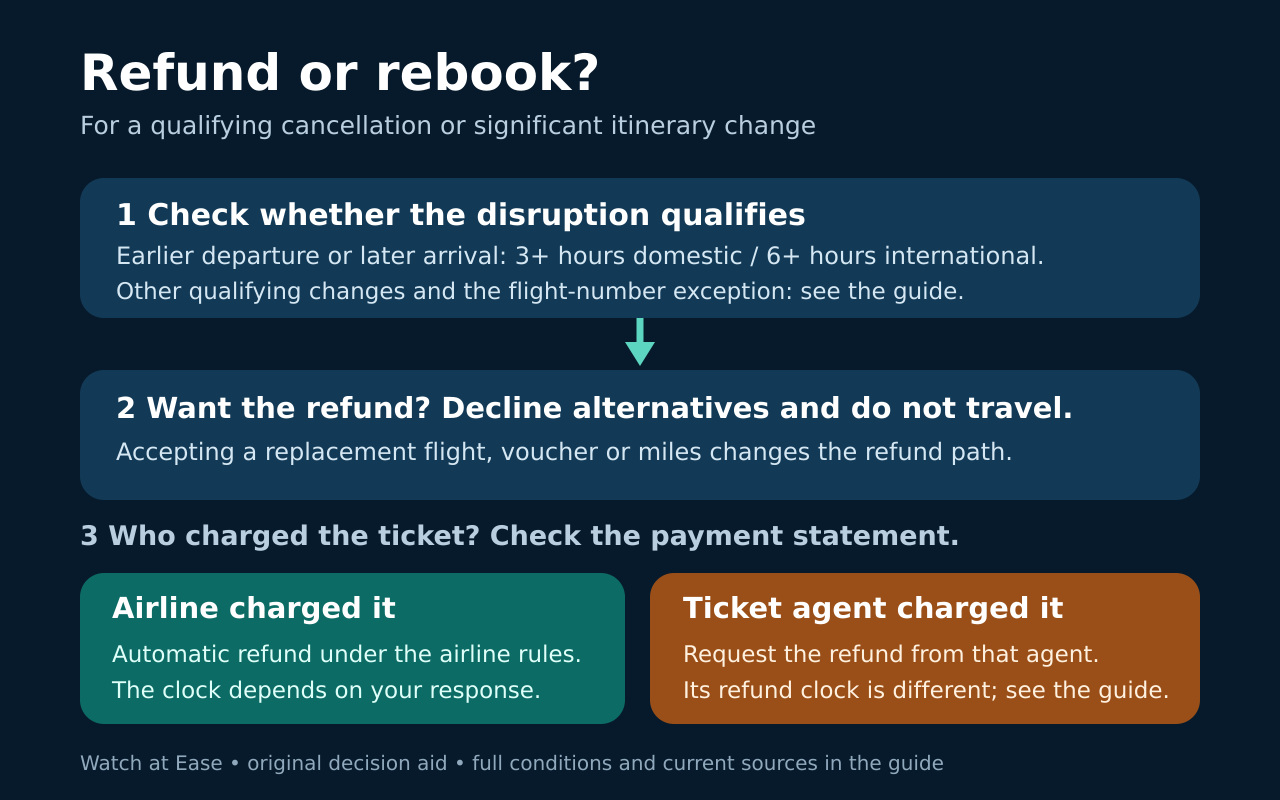
These U.S. rules cover flights to, from or within the United States, including covered foreign airlines. A cancellation or qualifying significant change can entitle you to a refund for the unused travel if you decline the changed flight, rebooking and alternative compensation. First decide whether you still want to travel, then identify who charged your ticket.
Use the decision below before accepting an offer. A ticket refund is separate from meals, hotels or extra cash, and a narrow 2026 DOT enforcement pause for flight-number-only changes does not erase the broader refund rule.
First decide whether the disruption qualifies
A cancellation qualifies regardless of whether the cause was weather, air traffic control or the airline. A schedule change also qualifies if it moves a domestic departure earlier or arrival later by at least 3 hours, or an international one by at least 6 hours. A different origin or destination airport, more connections, or an involuntary downgrade also counts.
For a traveler with a disability, a different connecting airport qualifies; substitute aircraft also qualifies if needed accessibility features are unavailable. Refunds cover the unused travel. If you already flew outbound but decline a canceled return, do not assume the flown outbound fare is refundable. If you continue flying after an involuntary downgrade, DOT requires the fare difference to be refunded rather than the full airfare.
Choose travel or the refund before accepting an offer
If the airline charged your ticket, a qualifying refund is automatic when no alternative is offered or you reject the changed flight, replacement flight and alternative compensation. You do not have to make a separate refund request. If you still want to travel, read the response deadline; a refund can end the remaining reservation, so check which legs you still need before choosing it. When a flight is canceled without an alternative offer, cancellation itself triggers the refund; there is no offer you must first reject.
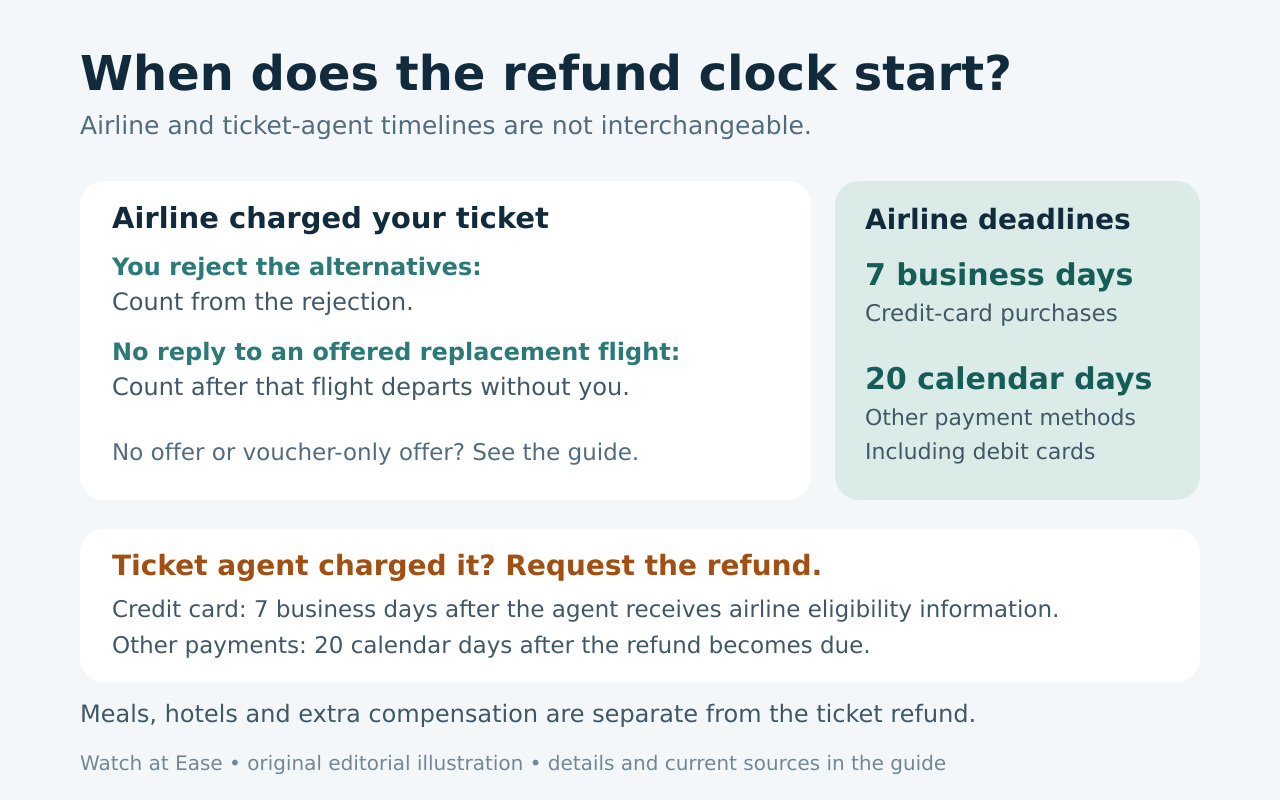
For an explicit rejection, count 7 business days for a credit-card payment or 20 calendar days for another payment method from the rejection. Business days exclude U.S. federal holidays and weekends. Debit cards follow the 20-calendar-day rule.
If you do not reply to a flight offer and do not fly, the clock starts when that offered flight departs without you. If you ignore only a voucher or other compensation offer, the trigger is the canceled flight’s scheduled departure date or the date the significantly changed flight departs. Save the offer, your response or nonresponse record, and the original itinerary.
Accepting a voucher, credit or miles as an explicit refund alternative can close the cash-refund route. Being automatically rebooked is not the same as affirmatively choosing compensation. If you want a refund, clearly reject the substitute and keep confirmation rather than accepting it and later simply not showing up.
Read the 2026 flight-number exception narrowly
DOT extended temporary enforcement discretion through July 7, 2027 for a technical cancellation created only by changing a flight number. The pause applies when the passenger is successfully rebooked under the new number and the trip operates without a significant change or delay.
That is not a general repeal of automatic refunds. If the revised itinerary also crosses the time threshold, changes an airport, adds connections, downgrades service or removes needed accessibility, test it under the ordinary significant-change rules rather than treating the new number alone as decisive.
Identify who owes the ticket money
Check the charge on your card or bank statement. That entity—the merchant of record—is responsible for the ticket refund. If it is a ticket agent or online travel agency, send a refund request to that agent; do not assume the airline’s automatic-refund process also starts an agency refund.
For an agent refund paid by credit card, the 7-business-day period runs from the agent receiving the airline’s eligibility information. For cash, check, debit or other payment methods, the rule allows 20 calendar days after the refund becomes due. Ask the agent to confirm receipt of your request and airline confirmation. An original agency service fee may remain nonrefundable only under the rule’s disclosure and service conditions.
Optional-service fees follow a different route. If paid Wi-Fi, a seat selection or another ancillary service was unavailable through no fault of yours, DOT assigns that refund to the airline—even when a ticket agent collected the fee. Keep separate totals for airfare and extras.
Separate a refund from meals, hotels and extra cash
A ticket refund is not general cash compensation for inconvenience. Meals, hotels and ground transport depend on the airline’s commitments and the cause of the disruption. These commitments are voluntary to adopt, but airlines must honor promises in their customer-service plans when the conditions apply; do not dismiss a promised benefit as mere goodwill.
On the U.S. DOT website, open “Airline Cancellation and Delay Dashboard” to check your carrier. If a refund is overdue, send the responsible airline or agent your booking reference, unused flights, qualifying change, decision date, payment method and requested amount. Ask it to confirm the refund issue date. If unresolved, open “File a Consumer Complaint” on the DOT website and follow its instructions; a complaint does not guarantee individual recovery. Keep notices, statements and receipts, and never post card numbers publicly.