Technology · NEWS EXPLAINER
Unconventional AI agrees to buy NeuReality; 1,000x efficiency remains a target
The October 26 agreement adds chip and systems expertise to the startup’s production plans. The price is undisclosed, and closing and measured performance are separate milestones.
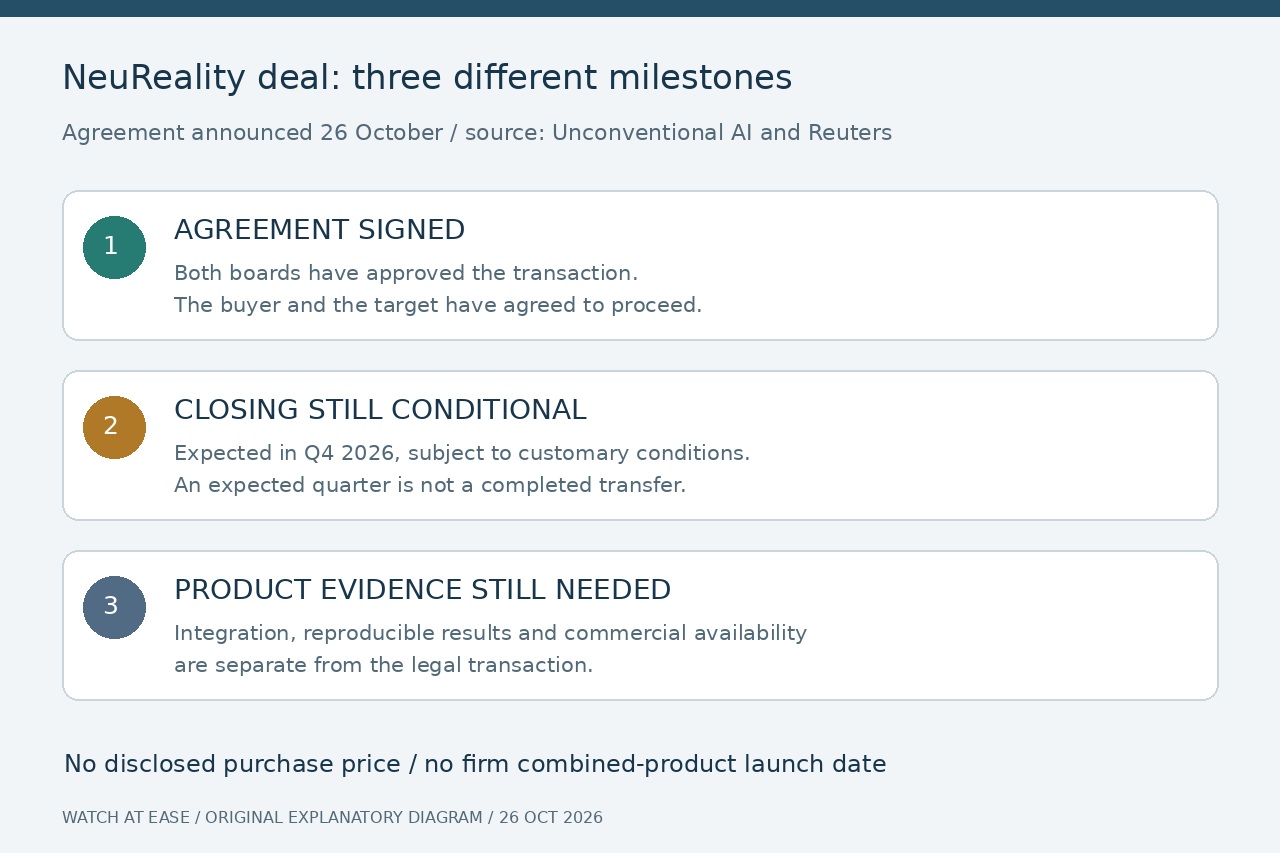
Unconventional AI said on October 26 that it had signed a definitive agreement to acquire Israeli AI infrastructure company NeuReality. The buyer expects the transaction to close in the fourth quarter of 2026, subject to customary conditions.
The planned addition is engineering experience. It does not establish that Unconventional has delivered its stated goal of a 1,000-fold improvement in AI computing efficiency. Agreement, integration and demonstrated performance remain different steps.
What is agreed, and what is still pending
The announcement confirms a signed agreement and board approvals. It gives an expected closing quarter, rather than saying all conditions have been satisfied. Readers should therefore distinguish the announced purchase from a completed transfer.
Neither the company announcement nor Reuters disclosed an agreed price. A valuation attached to the buyer or its earlier fundraising is not a price for NeuReality.
Why the team is central
NeuReality brings experience in silicon, system architecture and AI systems software. The buyer says that work includes reducing the coordination and data-movement overhead involved in running AI models. Those are system-level tasks around computing, rather than a promise of a particular chip’s speed.
Reuters reports that about 40 people will join. That is a reported headcount for the transaction, not a confirmed count of new manufacturing jobs or an independently measured productivity gain.
Research progress is not a commercial launch
Chief executive Naveen Rao told Reuters that the company had developed one test chip and was nearing completion of a second. He described a need for people experienced in building and scaling products.
A test chip is evidence of a development stage. The acquisition announcement does not give a firm date for a commercially available combined product, and the reported research progress does not supply one.
How to read the 1,000x ambition
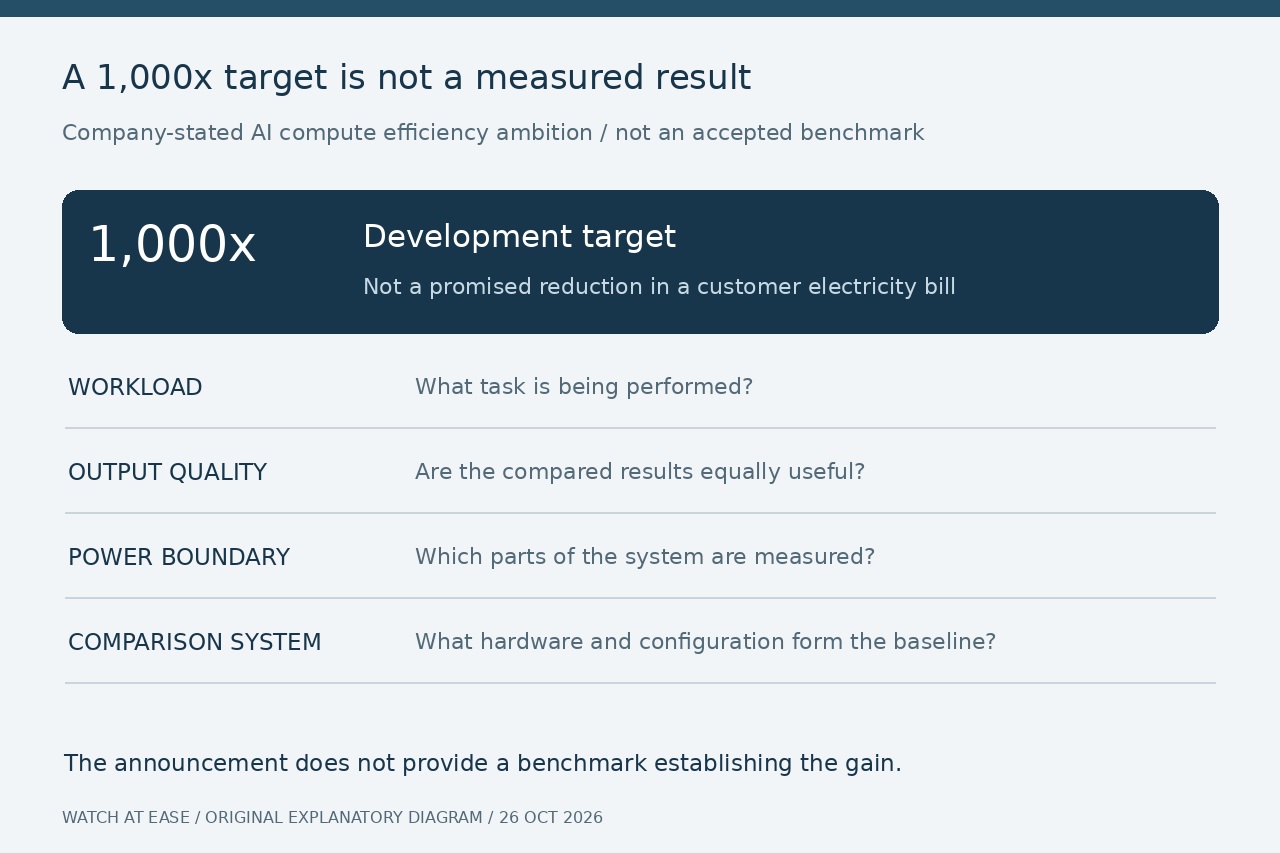
Unconventional describes a goal of improving AI compute efficiency by 1,000 times relative to conventional architectures. The announcement presents this as a target; it does not provide a comparative benchmark that establishes the gain.
An assessment would need the workload, output quality, power-measurement boundary and comparison system. Without those details, the target cannot be translated into a promised reduction in a customer’s electricity bill.
The next evidence to watch
A closing announcement would resolve the transaction milestone. Integration details would show how the engineering team is deployed. Reproducible performance results and a product release would address the technical and commercial milestones.
These are separate questions. The agreement can support a plan to move toward production without proving either its eventual timetable or its efficiency outcome.