Technology · PRACTICAL GUIDE
Fix Wrong Watch Dates on Imported Trakt Movies
Keep movies marked watched while replacing selected false dates with Unknown. Check for an exact import undo first; otherwise review individual plays and verify the replacement before removing the old record.
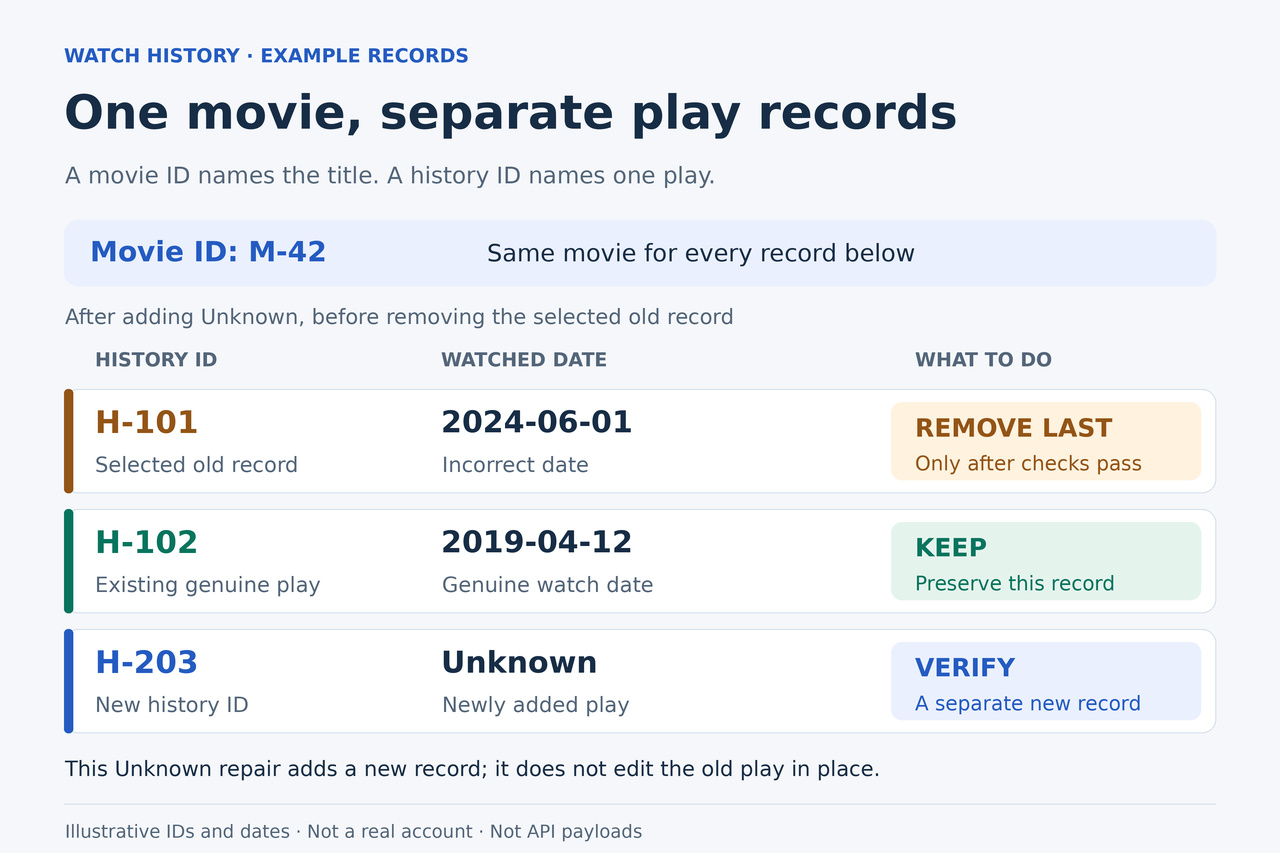
If an old IMDb or Letterboxd import made movies look as though you watched them all on one day, Trakt's Unknown date can preserve the fact that you have seen them without inventing a viewing date. Unknown plays count toward your play total but are excluded from date-based statistics. Adding Unknown by itself does not remove the old, falsely dated play.
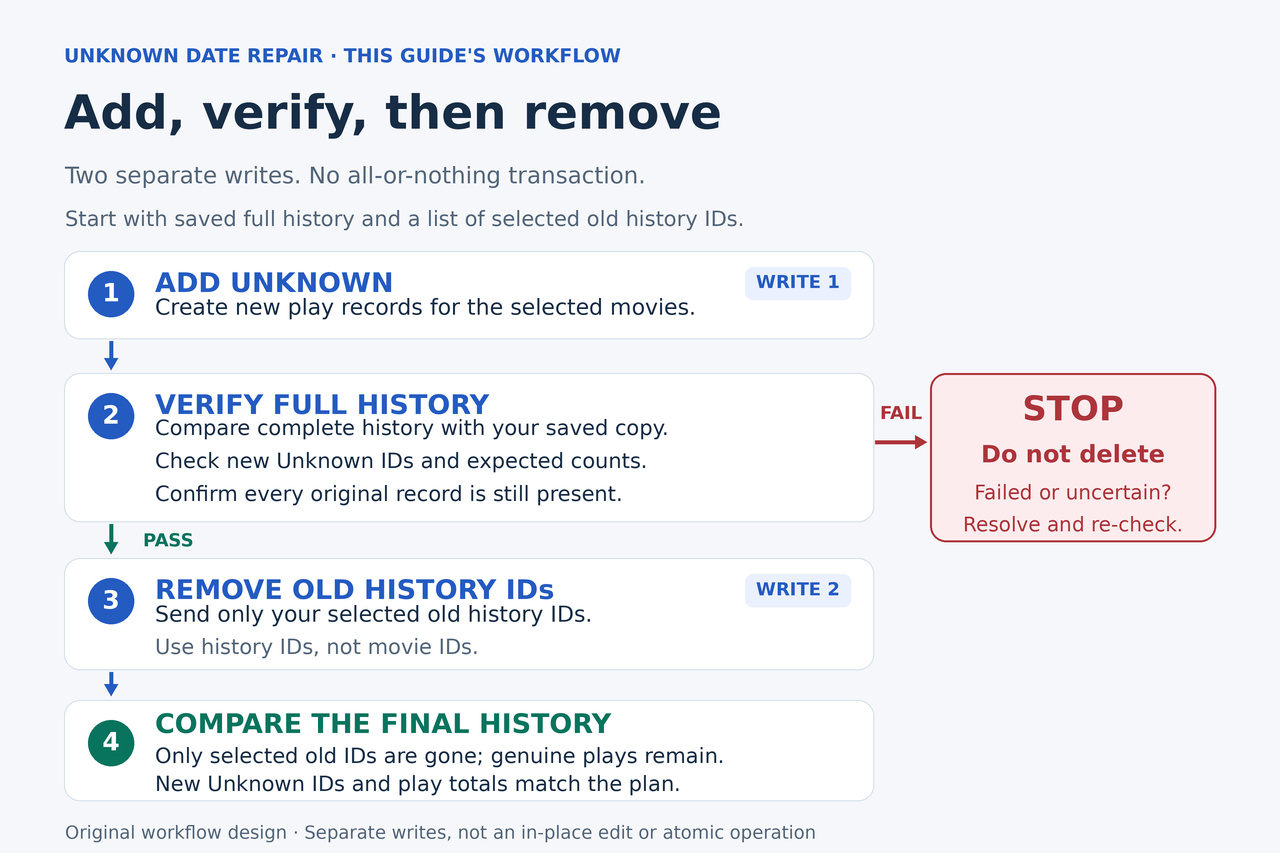
First check for an undo that identifies the exact unwanted import. For a selective correction, this guide supplies a complete local Python helper: you choose the false plays, add their Unknown replacements, verify the result, and only then remove the selected original history IDs. The helper reads data and prepares files; the two account changes are separate commands that you inspect and run yourself.
Decide which dates are actually false
Keep the original import alongside a fresh Trakt backup. A cluster of dates can identify candidates, but it does not prove that every play on that day is wrong. Check the movie, source record and what you remember. Leave genuine same-day viewings out of the repair.
Letterboxd distinguishes marking a film watched at some point from logging a particular viewing in the Diary. A source file's Date column is not automatically a viewing date. Keep a trustworthy diary date for a dated correction; this batch is specifically for plays whose true date is unknown.
Choose at most one false play per movie in a plan. Keep accurately dated rewatches. If a selected movie already has an Unknown play, stop and decide what the records represent. This helper does not merge such records or promise to represent several undated rewatches separately.
Check for an undo of the exact import
Trakt documents GET /users/syncs/import to list import syncs, GET /users/syncs/ID to inspect one, and DELETE /users/syncs/ID to undo it. A sync ID identifies an import operation; it is neither a movie ID nor a history ID. Read every returned page when looking for an older import.
Use this alternative only if the record reliably identifies the unwanted import and you want the whole import reversed. Undo can reverse imported history, ratings, paused items, Watchlist and collection. A matching day or similar count alone does not establish the match. If the available record cannot identify the batch, leave it alone and use the selective procedure.
Do not assume that every old file import has an identifiable sync record or an undo button in your current interface. If you undo a verified batch, read the results back, prepare corrected input from the original source, preview matches and selected data types, and verify the reimport. Start any later selective plan from a fresh post-undo baseline.
Prepare access, backups and a private working folder
Use Bash with Python 3.10 or later and curl 7.76.0 or later. Obtain access through your own permitted Trakt application and authorize your own account using the current official instructions linked below. App registration requires a verified GitHub connection and an available application slot; actual account and approval limits apply. This article does not assume a fixed free allowance or a universal VIP requirement.
Before using the helper, prepare a local request-header file following Trakt's required-headers and OAuth documentation. It must contain the Authorization, trakt-api-key, trakt-api-version, Content-Type and User-Agent fields, one per line; use API version 2 and JSON content type. Use your own authorized values, keep this file private and do not paste its contents into this website. The helper imports that existing file; it does not register an app or create authorization for you.
The current OAuth host is auth.trakt.tv; the data commands below use api.trakt.tv. Follow the returned polling interval and expiry if using device authorization. Keep the same valid credential file throughout a batch: the saved snapshots are bound to it. If access expires or the file changes midway, stop and preserve the batch files; this helper does not migrate a partly completed batch to new credentials.
Export your account before writing. In the current JSON ZIP, individual plays are in watched-history.json or numbered watched-history-N.json files. The watched-movies.json file is an aggregate. Inspect the export result and _errors.json if present; a downloaded ZIP can be partial. Resolve failures affecting the information you need before treating it as a usable backup.
Pause scrobblers and automatic imports, and avoid other history, rating or Watchlist edits until verification finishes. Create a new empty local folder for this batch and open Bash there. Keep your official export separately. Pagination is not an atomic account snapshot; pausing other writers and checking every page reduce errors, but cannot make the API transactional.
Install the helper, then read a complete baseline
The Full local helper section at the end contains one complete source-writing command. Copy that entire command into Bash in your empty working folder. It creates trakt_repair.py locally, makes no API request and refuses to overwrite an existing file. Open the resulting readable Python file before running it. Its comments, prompts and commands stay in English in every language edition.
Initialize the helper using the private header file you prepared from the official instructions. Replace the example file path in this command with your actual local path; quote a path containing spaces. Keep all subsequent commands in this same working folder. The imported credentials and working data are private files under trakt-repair.
python3 trakt_repair.py init trakt-headers.txt
Read the baseline. This command makes only authenticated GET requests for movie history, movie ratings and the movie Watchlist. It retains raw response bytes, pagination metadata and complete combined JSON files.
python3 trakt_repair.py fetch before
Proceed only when it reports a complete snapshot. The collector uses the returned page count, effective limit and item count, then checks the first page again. Missing pagination information, a short page, duplicate IDs, an unexpected movie shape or an observed change leaves the snapshot unusable. Do not delete INCOMPLETE to force it through. After resolving a read failure, fetch into a new snapshot name and use that name in the later preview and plan commands.
Create the review CSV from the complete baseline. Python retains the original large integer IDs; the review file uses h:, m:, t: and at: prefixes to keep identifiers, titles and timestamps as spreadsheet text.
python3 trakt_repair.py preview before
Select the false plays and inspect the plan
Open trakt-repair/before-review.csv. Mark exact YES in the choose column only for plays you have personally confirmed have false dates, then save the file as UTF-8 CSV. Leave every other cell and prefix unchanged. The timestamps are API timestamps; a Today label in your Trakt interface can reflect a different display time zone. The helper saves another copy of your selected CSV when the plan is created.
python3 trakt_repair.py plan before trakt-repair/before-review.csv
The plan checks each selected history ID against the raw baseline and verifies the movie, title and original timestamp. It refuses duplicate selected movies or any selected movie that already has Unknown. It prints the proposed replacements and requires exact YES before saving the plan. Trakt has announced minute-level timestamp normalization and item-plus-time deduplication; changing seconds is not a way to preserve separate undated rewatches.
If selected movies are on your built-in Watchlist, the plan shows their movie IDs and asks separately whether you accept their removal. Trakt can remove an item from that list when it is marked watched; the checked sources establish no Unknown exemption. Enter YES, REMOVE FROM WATCHLIST only if you accept this outcome. Otherwise stop, exclude those titles and review again. The checks cover Watchlist membership, not preservation of its notes, rank or original listed date.
Inspect trakt-repair/plan.json and trakt-repair/add.json in a text editor. The addition uses movie IDs and sets watched_at to the literal string unknown. Do not substitute null, omit the value or use a made-up old date. No deletion request exists yet. Start with one confirmed false play; after it passes the final check, create a new empty parent working folder and obtain a fresh baseline for a larger batch. Existing plans are deliberately not overwritten.
Add Unknown and verify the replacements
The following command is the first account change. After inspecting add.json, run it once. Keep the response body and headers. Each write command requires unused response filenames, disables hidden curl configuration and has no automatic retry or redirect option. A refusal because a response file already exists is a reason to inspect the saved state, not delete the file and repeat the write.
test ! -e trakt-repair/add-response.json && test ! -e trakt-repair/add-response-headers.txt && curl -q --fail-with-body --silent --show-error --request POST --header @trakt-repair/auth.headers --data-binary @trakt-repair/add.json --dump-header trakt-repair/add-response-headers.txt --output trakt-repair/add-response.json --write-out 'HTTP %{http_code}\n' https://api.trakt.tv/sync/history
When the request has returned, including after an error or uncertain response, read a complete new snapshot and run the middle check. An added count or successful HTTP result does not establish which play IDs now exist.
python3 trakt_repair.py fetch after-add
python3 trakt_repair.py verify-add after-add
The check requires exactly one new Unknown history ID per selected movie, while every original movie play remains with the same movie, timestamp normalized to a minute and action. Movie ratings and their rating timestamps must match. Only Watchlist removals accepted in the plan are allowed; additions or unrelated losses stop it.
For read-back, Unknown is the exact UTC instant 1970-01-01T00:00:00Z; an equivalent .000Z representation means the same instant. The helper compares parsed instants, not a whole date or year. Requests still use the literal string unknown. It stores the verified new IDs separately from the original selected IDs.
Only a passing middle check creates trakt-repair/add-verified.json and trakt-repair/remove.json. Inspect the latter: its top-level ids array must contain only your selected original history IDs. A movies array would have a wider deletion scope and must not replace it. The new Unknown IDs must not be in this request.
There is temporarily an extra play for each selected movie. The procedure verifies the replacement before removing the old record, avoiding a deliberate zero-play interval. These remain two separate API writes, with possible account-side effects; they are not an in-place date edit.
Remove only the old IDs and verify completion
Run this second account-changing command only after the middle check passes and you have inspected remove.json. Preserve the response, including deleted and not_found information.
test ! -e trakt-repair/remove-response.json && test ! -e trakt-repair/remove-response-headers.txt && curl -q --fail-with-body --silent --show-error --request POST --header @trakt-repair/auth.headers --data-binary @trakt-repair/remove.json --dump-header trakt-repair/remove-response-headers.txt --output trakt-repair/remove-response.json --write-out 'HTTP %{http_code}\n' https://api.trakt.tv/sync/history/remove
Read a new complete snapshot and check the final result:
python3 trakt_repair.py fetch final
python3 trakt_repair.py verify-final final
Success means the original movie history minus the selected old IDs plus the specific new Unknown IDs verified earlier. Every unselected original play and each replacement must still have its expected movie, normalized timestamp and action. Movie ratings must remain unchanged, and movie Watchlist membership must match the snapshot taken after the addition. A matching total alone cannot pass.
The helper writes final-verified-final.json when these conditions hold. With one replacement for each selected play, the movie play count returns to its baseline total and genuine dated rewatches remain. Open several repaired movies in Trakt as a separate visual check: they should remain watched with an Unknown play, while the selected false dates no longer appear. Unknown is intended to be excluded from date-based graphs.
Keep the original source, official export, raw snapshots, selected CSV, plan, requests, responses and verification files privately. The replacement has a new history ID; the process does not preserve the removed play's original scrobble or check-in identity. Resume paused imports only after accepting the final result.
If a read or addition stops, preserve the saved stage
A failed read does not establish a complete baseline or result. For HTTP errors, the helper saves response status, relevant response headers and body in timestamped get-error files; it does not save request credentials there. The snapshot stays INCOMPLETE. Resolve the reported problem, then choose a new snapshot name. Never overwrite the failed evidence.
If the addition is only partly observed, verify-add writes an add-incomplete report identifying the new Unknown IDs and missing movies. It does not create remove.json. Do not resend the entire addition or remove originals. After the pending request has settled, fetch a later snapshot under a new name and run verify-add on that name. If the complete expected result then appears, continue from its verified stage.
This helper does not generate an automatic request for missing additions. If the result stays partial, keep the report and stop that repair attempt, or use the abandonment branch below after a fresh check. Unexpected new plays, missing originals, changed ratings or unaccepted Watchlist changes require investigation; do not edit manifests or remove checks to force acceptance.
Trakt documents one authenticated write per second and 500 authenticated GET requests per five minutes. Honor Retry-After on 429 responses; other applications can share account limits. Authentication, application approval, account limits and invalid data are different errors. Replacing a token does not fix every 403, 420, 422 or 426 response, and this helper binds an active batch to its existing credential file.
If removal is partial, retry only the remaining selected IDs
After an uncertain removal response, first fetch a new snapshot and run verify-final. If all retained records are correct and only some selected original IDs remain, the helper creates a remaining-remove file containing just those IDs. It stops instead of reporting completion. It never solves a count mismatch by deleting all plays for a movie.
The following example applies only when verify-final final created trakt-repair/remaining-remove-final.json. Inspect that exact file before using it. If your snapshot has another name, use the remaining-remove filename that the helper actually reported and new response filenames.
test ! -e trakt-repair/remove-retry-response.json && test ! -e trakt-repair/remove-retry-response-headers.txt && curl -q --fail-with-body --silent --show-error --request POST --header @trakt-repair/auth.headers --data-binary @trakt-repair/remaining-remove-final.json --dump-header trakt-repair/remove-retry-response-headers.txt --output trakt-repair/remove-retry-response.json --write-out 'HTTP %{http_code}\n' https://api.trakt.tv/sync/history/remove
Then take another fresh snapshot and check the same final conditions. Do not repeat the addition as part of removal recovery.
python3 trakt_repair.py fetch final-2
python3 trakt_repair.py verify-final final-2
Optional: abandon added Unknown plays before deleting originals
Use this branch only to abandon an addition while every original play still exists. Let pending requests settle and keep other writers paused. The helper must establish that the only new plays are at most one Unknown for each selected movie, with original history and ratings intact. Accepted Watchlist removals may remain; this is not a complete account rollback.
python3 trakt_repair.py fetch undo-check
python3 trakt_repair.py prepare-undo-add undo-check
Only if the helper generates undo-add-undo-check.json, inspect it and confirm that it contains the newly added Unknown history IDs, never original IDs. The next command explicitly removes those newly added plays. If the helper refuses, preserve the files and investigate instead of constructing a broader request.
test ! -e trakt-repair/undo-add-response.json && test ! -e trakt-repair/undo-add-response-headers.txt && curl -q --fail-with-body --silent --show-error --request POST --header @trakt-repair/auth.headers --data-binary @trakt-repair/undo-add-undo-check.json --dump-header trakt-repair/undo-add-response-headers.txt --output trakt-repair/undo-add-response.json --write-out 'HTTP %{http_code}\n' https://api.trakt.tv/sync/history/remove
Read again and verify that original movie history and ratings are present. Review any previously accepted Watchlist loss separately.
python3 trakt_repair.py fetch undone
python3 trakt_repair.py verify-undo undone
Retire this batch after abandonment. Do not run its old add.json or remove.json later. Any new attempt requires a new empty working folder and a new baseline. If snapshots cannot establish exactly what happened, preserve the remaining records and seek help using a redacted plan rather than guessing which IDs to delete.
Full local helper
Copy the complete command in the next paragraph as a single Bash command. It writes the readable source file only, without executing the helper or contacting Trakt. Open trakt_repair.py afterward, then return to Install the helper, then read a complete baseline. Keep straight quotes and backslashes unchanged; do not translate this command.
python3 -c 'from pathlib import Path; import hashlib,sys; p=Path("trakt_repair.py"); source="#!/usr/bin/env python3\n\"\"\"Movie-history repair helper: local files and authenticated GET requests only.\n\nThis program NEVER sends POST, DELETE or PUT requests. Inspect its generated\nJSON, then use separate explicit curl commands. Python 3.10+; Bash examples.\nAPI response contracts were checked against the Trakt authors'"'"' published code.\nNo live account or device was used to test this helper. Pause other imports,\nscrobblers and history edits until the final check. Pagination is not atomic.\n\"\"\"\nimport argparse\nimport csv\nimport datetime as dt\nimport hashlib\nimport io\nimport json\nimport os\nfrom pathlib import Path\nimport re\nimport sys\nimport time\nimport urllib.error\nimport urllib.parse\nimport urllib.request\n\nROOT = Path(\"trakt-repair\")\nAPI = \"https://api.trakt.tv\"\nENDPOINTS = {\"history\": \"/users/me/history/movies\", \"ratings\": \"/users/me/ratings/movies\", \"watchlist\": \"/users/me/watchlist/movies/rank\"}\nEPOCH = dt.datetime(1970, 1, 1, tzinfo=dt.timezone.utc)\nLAST_GET = 0.0\n\n\ndef check(ok, why):\n if not ok:\n raise ValueError(why)\n\n\ndef sha(data):\n return hashlib.sha256(data).hexdigest()\n\n\ndef encoded(value):\n return (json.dumps(value, ensure_ascii=False, indent=2) + \"\\n\").encode(\"utf-8\")\n\n\ndef read_json(path):\n return json.loads(path.read_bytes())\n\n\ndef write_new(path, data):\n with path.open(\"xb\") as f:\n f.write(data)\n\n\ndef write_same(path, data):\n if path.exists():\n check(path.read_bytes() == data, \"Existing output differs; it will not be overwritten: \" + str(path))\n else:\n write_new(path, data)\n\n\ndef now():\n return dt.datetime.now(dt.timezone.utc).isoformat()\n\n\ndef number(v):\n return type(v) is int and 0 < v <= 9223372036854775807\n\n\ndef date(v):\n check(isinstance(v, str), \"Missing or non-string timestamp; null is not Unknown.\")\n d = dt.datetime.fromisoformat(v.replace(\"Z\", \"+00:00\"))\n check(d.tzinfo is not None, \"Timestamp has no timezone.\")\n return d.astimezone(dt.timezone.utc)\n\n\ndef mid(row):\n check(isinstance(row, dict) and row.get(\"type\") == \"movie\", \"Unexpected non-movie row.\")\n m = row.get(\"movie\")\n check(isinstance(m, dict) and isinstance(m.get(\"ids\"), dict), \"Missing/null movie: stop, do not skip it.\")\n i = m[\"ids\"].get(\"trakt\")\n check(number(i), \"Invalid Trakt movie ID.\")\n return i\n\n\ndef validate(kind, rows):\n check(isinstance(rows, list), \"Expected a JSON array.\")\n seen = set()\n for r in rows:\n movie = mid(r)\n if kind == \"history\":\n key = r.get(\"id\")\n check(number(key), \"Invalid history ID; require an exact positive int64.\")\n date(r.get(\"watched_at\"))\n check(isinstance(r.get(\"action\"), str) and bool(r[\"action\"]), \"Missing history action.\")\n else:\n key = movie\n if kind == \"ratings\":\n check(type(r.get(\"rating\")) is int and 1 <= r[\"rating\"] <= 10, \"Invalid rating.\")\n date(r.get(\"rated_at\"))\n elif kind == \"watchlist\":\n date(r.get(\"listed_at\"))\n else:\n raise ValueError(\"Unexpected dataset.\")\n check(key not in seen, \"Duplicate ID: incomplete or changing snapshot.\")\n seen.add(key)\n return rows\n\n\ndef signature(r):\n return (mid(r), date(r[\"watched_at\"]).replace(second=0, microsecond=0).isoformat(), r[\"action\"])\n\n\ndef hist(rows):\n return {r[\"id\"]: signature(r) for r in rows}\n\n\ndef ratings(rows):\n return {mid(r): (r[\"rating\"], date(r[\"rated_at\"]).isoformat()) for r in rows}\n\n\ndef watchlist(rows):\n return {mid(r) for r in rows}\n\n\ndef label(value):\n check(bool(re.fullmatch(r\"[a-z][a-z0-9_-]{0,40}\", value)), \"Use a short lowercase snapshot name, for example before or after-add.\")\n return value\n\n\ndef parse_headers(raw):\n text = raw.decode(\"ascii\")\n check(\"\\r\" not in text.replace(\"\\r\\n\", \"\"), \"Use LF or CRLF header lines, not a bare carriage return.\")\n lines = text.replace(\"\\r\\n\", \"\\n\").split(\"\\n\")\n if lines and lines[-1] == \"\":\n lines.pop()\n check(lines and all(lines), \"Empty header lines are not accepted.\")\n headers = {}\n for line in lines:\n check(not any(ord(c) < 32 or ord(c) == 127 for c in line), \"Folded lines and control characters are not accepted.\")\n name, separator, value = line.partition(\":\")\n check(separator and re.fullmatch(r\"[A-Za-z0-9-]+\", name), \"Malformed local header file; use one complete header per line.\")\n key = name.lower()\n check(key not in headers, \"Duplicate header name in local file.\")\n value = value.strip(\" \")\n check(value and not any(ord(c) < 32 or ord(c) == 127 for c in value), \"Header values must be nonempty and contain no control characters.\")\n headers[key] = value\n check(set(headers) == {\"authorization\", \"trakt-api-key\", \"trakt-api-version\", \"content-type\", \"user-agent\"}, \"The local file must contain exactly the five header names listed in this guide and Trakt'"'"'s authentication reference.\")\n check(headers[\"trakt-api-version\"] == \"2\", \"The API version header must be 2.\")\n # The reader prepares all values using the official authentication reference.\n # This helper does not create, infer, inspect a scheme, or refresh credentials.\n return headers\n\n\ndef auth():\n raw = (ROOT / \"auth.headers\").read_bytes()\n return parse_headers(raw), sha(raw)\n\n\ndef init(headers_file):\n raw = Path(headers_file).expanduser().read_bytes()\n parse_headers(raw)\n ROOT.mkdir(exist_ok=True, mode=0o700)\n check(not (ROOT / \"auth.headers\").exists(), \"Credentials already exist; do not change accounts within a repair batch.\")\n ROOT.chmod(0o700)\n write_new(ROOT / \"auth.headers\", raw)\n (ROOT / \"auth.headers\").chmod(0o600)\n print(\"Imported your existing complete header file byte-for-byte into a private local working directory. No authentication value was created or displayed. Keep both local copies private; do not share this directory.\")\n\n\ndef get(path, headers):\n global LAST_GET\n delay = 0.65 - (time.monotonic() - LAST_GET)\n if delay > 0:\n time.sleep(delay)\n LAST_GET = time.monotonic()\n request = urllib.request.Request(API + path, headers=headers, method=\"GET\")\n # No retry and no redirect: do not forward credentials to another location.\n class NoRedirect(urllib.request.HTTPRedirectHandler):\n def redirect_request(self, req, fp, code, msg, response_headers, newurl):\n return None\n try:\n with urllib.request.build_opener(NoRedirect).open(request, timeout=45) as response:\n check(response.status == 200, \"GET did not return HTTP 200.\")\n return response.read(), {k.lower(): v for k, v in response.headers.items()}\n except urllib.error.HTTPError as exc:\n body = exc.read()\n public_headers = {k.lower(): v for k, v in exc.headers.items() if k.lower() in (\"retry-after\", \"date\", \"content-type\", \"x-request-id\") or k.lower().startswith(\"x-ratelimit\")}\n stem = \"get-error-\" + dt.datetime.now(dt.timezone.utc).strftime(\"%Y%m%dT%H%M%S%fZ\")\n write_new(ROOT / (stem + \"-body.bin\"), body)\n write_new(ROOT / (stem + \".json\"), encoded({\"method\": \"GET\", \"path\": path, \"status\": exc.code, \"response_headers\": public_headers, \"response_body\": stem + \"-body.bin\"}))\n retry = public_headers.get(\"retry-after\", \"not supplied\")\n raise ValueError(\"GET HTTP \" + str(exc.code) + \"; Retry-After: \" + retry + \". Saved response metadata/body at \" + str(ROOT / stem) + \". Snapshot stays INCOMPLETE. No automatic retry.\") from None\n\n\ndef page_meta(headers, page):\n keys = (\"page\", \"page-count\", \"item-count\", \"limit\")\n check(all(\"x-pagination-\" + k in headers for k in keys), \"Pagination headers missing: completeness is unproved, so stop.\")\n d = {k: int(headers[\"x-pagination-\" + k]) for k in keys}\n check(d[\"page\"] == page and d[\"limit\"] > 0 and d[\"item-count\"] >= 0, \"Invalid pagination metadata.\")\n if d[\"item-count\"] == 0:\n check(d[\"page-count\"] in (0, 1) and page == 1, \"Invalid empty-list pagination.\")\n else:\n check(d[\"page-count\"] == (d[\"item-count\"] + d[\"limit\"] - 1) // d[\"limit\"], \"Inconsistent page count.\")\n return d\n\n\ndef collect(kind, endpoint, destination, headers, fetcher=get):\n rawdir = destination / (kind + \"-raw\")\n rawdir.mkdir()\n all_rows, pages, stamp, first = [], [], None, None\n p, limit = 1, 100\n while True:\n path = endpoint + \"?\" + urllib.parse.urlencode({\"page\": p, \"limit\": limit})\n body, response_headers = fetcher(path, headers)\n name = \"page-%04d.json\" % p\n write_new(rawdir / name, body)\n meta = page_meta(response_headers, p)\n current = (meta[\"page-count\"], meta[\"item-count\"], meta[\"limit\"])\n stamp = current if stamp is None else stamp\n check(stamp == current, \"Dataset changed during pagination.\")\n rows = validate(kind, json.loads(body))\n count = max(0, min(meta[\"limit\"], meta[\"item-count\"] - (p - 1) * meta[\"limit\"]))\n check(len(rows) == count, \"Short page: the snapshot is incomplete.\")\n first = rows if first is None else first\n all_rows.extend(rows)\n pages.append({\"file\": name, \"sha256\": sha(body), \"pagination\": meta})\n if p >= max(1, meta[\"page-count\"]):\n break\n p, limit = p + 1, meta[\"limit\"]\n validate(kind, all_rows)\n check(len(all_rows) == stamp[1], \"Wrong total row count.\")\n body, response_headers = fetcher(endpoint + \"?\" + urllib.parse.urlencode({\"page\": 1, \"limit\": stamp[2]}), headers)\n write_new(rawdir / \"first-page-recheck.json\", body)\n final_meta = page_meta(response_headers, 1)\n check(tuple(final_meta[k] for k in (\"page-count\", \"item-count\", \"limit\")) == stamp and validate(kind, json.loads(body)) == first, \"First page or pagination changed: pause other writers and fetch again using a NEW snapshot name.\")\n data = encoded(all_rows)\n write_new(destination / (kind + \".json\"), data)\n return {\"endpoint\": endpoint, \"total\": len(all_rows), \"pages\": pages, \"first_page_recheck_sha256\": sha(body), \"sha256\": sha(data)}\n\n\ndef fetch(name):\n name = label(name)\n headers, auth_hash = auth()\n destination = ROOT / name\n destination.mkdir()\n write_new(destination / \"INCOMPLETE\", b\"Do not use this snapshot until manifest.json is complete.\\n\")\n manifest = {\"version\": 1, \"started_at\": now(), \"auth_sha256\": auth_hash, \"datasets\": {}}\n for kind, endpoint in ENDPOINTS.items():\n print(\"Fetching \" + kind + \"...\")\n manifest[\"datasets\"][kind] = collect(kind, endpoint, destination, headers)\n manifest.update({\"finished_at\": now(), \"complete\": True})\n write_new(destination / \"manifest.json\", encoded(manifest))\n (destination / \"INCOMPLETE\").unlink()\n print(\"Complete read-only snapshot: \" + str(destination) + \". Raw JSON and pagination metadata retained.\")\n\n\ndef snapshot(name):\n destination = ROOT / label(name)\n check(not (destination / \"INCOMPLETE\").exists(), \"Incomplete snapshot; no plan may use it.\")\n manifest_path = destination / \"manifest.json\"\n manifest = read_json(manifest_path)\n check(manifest.get(\"complete\") is True and manifest.get(\"version\") == 1, \"Invalid snapshot manifest.\")\n check(manifest[\"auth_sha256\"] == auth()[1], \"Credentials changed since this snapshot; use one account/token per batch.\")\n result = {\"name\": name, \"manifest_sha256\": sha(manifest_path.read_bytes())}\n for kind, endpoint in ENDPOINTS.items():\n metadata = manifest[\"datasets\"][kind]\n check(metadata[\"endpoint\"] == endpoint, \"Wrong source endpoint.\")\n body = (destination / (kind + \".json\")).read_bytes()\n check(sha(body) == metadata[\"sha256\"], \"Snapshot file was changed.\")\n rows = validate(kind, json.loads(body))\n check(len(rows) == metadata[\"total\"], \"Snapshot row count mismatch.\")\n raw_rows = []\n for page in metadata[\"pages\"]:\n raw = (destination / (kind + \"-raw\") / page[\"file\"]).read_bytes()\n check(sha(raw) == page[\"sha256\"], \"Raw page was changed.\")\n raw_rows.extend(json.loads(raw))\n check(raw_rows == rows, \"Combined snapshot differs from raw responses.\")\n raw = (destination / (kind + \"-raw\") / \"first-page-recheck.json\").read_bytes()\n check(sha(raw) == metadata[\"first_page_recheck_sha256\"], \"Raw recheck was changed.\")\n result[kind] = rows\n return result\n\n\ndef preview(name):\n s = snapshot(name)\n check(s[\"history\"], \"No movie history to repair.\")\n out = io.StringIO(newline=\"\")\n writer = csv.writer(out)\n writer.writerow([\"choose\", \"history_id\", \"movie_id\", \"title\", \"year\", \"watched_at\", \"unknown\"])\n for r in s[\"history\"]:\n m = r[\"movie\"]\n writer.writerow([\"\", \"h:\" + str(r[\"id\"]), \"m:\" + str(mid(r)), \"t:\" + str(m.get(\"title\", \"\")), m.get(\"year\"), \"at:\" + r[\"watched_at\"], \"YES\" if date(r[\"watched_at\"]) == EPOCH else \"NO\"])\n path = ROOT / (name + \"-review.csv\")\n write_new(path, (\"\\ufeff\" + out.getvalue()).encode(\"utf-8\"))\n print(\"Review \" + str(path) + \". Put exact YES only in choose for plays you personally identify as false dates. Leave all other cells unchanged. h:, m:, t:, at: keep spreadsheet cells as text.\")\n\n\ndef select(s, path):\n raw = path.read_bytes()\n choices = list(csv.DictReader(io.StringIO(raw.decode(\"utf-8-sig\"))))\n check(choices and all(c.get(\"choose\") in (\"\", \"YES\") for c in choices), \"choose must be blank or exact YES.\")\n by_id = {\"h:\" + str(r[\"id\"]): r for r in s[\"history\"]}\n unknown = {mid(r) for r in s[\"history\"] if date(r[\"watched_at\"]) == EPOCH}\n selected = []\n for c in choices:\n if c[\"choose\"] != \"YES\":\n continue\n r = by_id.get(c.get(\"history_id\"))\n check(r is not None, \"Selected history ID is missing or changed; retain h:.\")\n check(c.get(\"movie_id\") == \"m:\" + str(mid(r)), \"Movie/history mismatch; retain m:.\")\n check(c.get(\"title\") == \"t:\" + str(r[\"movie\"].get(\"title\", \"\")) and c.get(\"watched_at\") == \"at:\" + r[\"watched_at\"], \"Selected title/date cell was changed; recheck the CSV.\")\n check(mid(r) not in unknown, \"Selected movie already has an Unknown play; this workflow stops.\")\n selected.append(r)\n check(selected and len({mid(r) for r in selected}) == len(selected), \"Select exactly one false play per selected movie, and at least one movie.\")\n return selected, sha(raw)\n\n\ndef plan(name, review):\n check(not (ROOT / \"plan.json\").exists() and not (ROOT / \"add.json\").exists(), \"This working directory already has a plan; do not overwrite a repair batch.\")\n s = snapshot(name)\n selected, selection_hash = select(s, Path(review))\n for r in selected:\n print(json.dumps({\"history_id\": \"h:\" + str(r[\"id\"]), \"movie_id\": \"m:\" + str(mid(r)), \"title\": r[\"movie\"].get(\"title\"), \"old_date\": r[\"watched_at\"], \"new_date\": \"Unknown\"}, ensure_ascii=False))\n affected = watchlist(s[\"watchlist\"]) & {mid(r) for r in selected}\n accepted = False\n if affected:\n print(\"These selected movie IDs are on your Watchlist and marking watched may remove them: \" + \", \".join(\"m:\" + str(i) for i in sorted(affected)))\n check(input(\"Accept those Watchlist removals? Type YES, REMOVE FROM WATCHLIST: \") == \"YES, REMOVE FROM WATCHLIST\", \"Watchlist removal not accepted; no plan written.\")\n accepted = True\n check(input(\"Confirm only the selected false-date plays above. Type YES: \") == \"YES\", \"No plan written.\")\n review_bytes = Path(review).read_bytes()\n check(sha(review_bytes) == selection_hash, \"The selected CSV changed during confirmation; no plan written.\")\n addition = {\"movies\": [{\"ids\": {\"trakt\": mid(r)}, \"watched_at\": \"unknown\"} for r in selected]}\n p = {\"version\": 1, \"created_at\": now(), \"before\": name, \"before_manifest_sha256\": s[\"manifest_sha256\"], \"auth_sha256\": auth()[1], \"selection_sha256\": selection_hash, \"selected_history_ids\": [r[\"id\"] for r in selected], \"watchlist_accepted\": accepted, \"add_sha256\": sha(encoded(addition))}\n write_new(ROOT / \"selected-review.csv\", review_bytes)\n write_new(ROOT / \"plan.json\", encoded(p))\n write_new(ROOT / \"add.json\", encoded(addition))\n print(\"Created plan.json and add.json. No API change made. No old-play removal file exists yet. Inspect both files before the separate ADD request.\")\n\n\ndef load_plan():\n p = read_json(ROOT / \"plan.json\")\n check(p.get(\"version\") == 1 and p[\"auth_sha256\"] == auth()[1], \"Plan/authentication mismatch.\")\n s = snapshot(p[\"before\"])\n check(p[\"before_manifest_sha256\"] == s[\"manifest_sha256\"], \"The plan'"'"'s baseline was changed.\")\n by_id = {r[\"id\"]: r for r in s[\"history\"]}\n ids = p[\"selected_history_ids\"]\n check(isinstance(ids, list) and ids and all(number(i) and i in by_id for i in ids), \"Invalid selected history IDs.\")\n selected = [by_id[i] for i in ids]\n saved_selection = ROOT / \"selected-review.csv\"\n check(sha(saved_selection.read_bytes()) == p[\"selection_sha256\"], \"Saved selected CSV changed.\")\n selected_again, selection_hash = select(s, saved_selection)\n check([r[\"id\"] for r in selected_again] == ids, \"Plan history IDs differ from the exact saved CSV selection.\")\n wanted = {mid(r) for r in selected}\n check(len(wanted) == len(selected), \"More than one selected play per movie.\")\n check(not any(mid(r) in wanted and date(r[\"watched_at\"]) == EPOCH for r in s[\"history\"]), \"Baseline contains a preexisting Unknown for a selected movie.\")\n check(not watchlist(s[\"watchlist\"]) & wanted or p[\"watchlist_accepted\"] is True, \"Watchlist acceptance is absent.\")\n addition = {\"movies\": [{\"ids\": {\"trakt\": mid(r)}, \"watched_at\": \"unknown\"} for r in selected]}\n check(sha((ROOT / \"add.json\").read_bytes()) == p[\"add_sha256\"] == sha(encoded(addition)), \"ADD request differs from the bound plan.\")\n return p, s, selected, sha((ROOT / \"plan.json\").read_bytes())\n\n\ndef common(before, current, wanted, accepted):\n check(ratings(before[\"ratings\"]) == ratings(current[\"ratings\"]), \"Movie ratings or rating timestamps changed; stop.\")\n old_w, new_w = watchlist(before[\"watchlist\"]), watchlist(current[\"watchlist\"])\n allowed = old_w & wanted if accepted else set()\n check(new_w <= old_w and old_w - new_w <= allowed, \"Unexpected movie Watchlist membership change; stop.\")\n\n\ndef added_state(p, before, selected, current):\n check(current[\"name\"] != before[\"name\"], \"Use a NEW snapshot taken after the ADD request.\")\n old, new = hist(before[\"history\"]), hist(current[\"history\"])\n wanted = {mid(r) for r in selected}\n check(set(old) <= set(new) and all(new[i] == old[i] for i in old), \"An original play is missing or changed; no removal request generated.\")\n common(before, current, wanted, p[\"watchlist_accepted\"])\n added = [r for r in current[\"history\"] if r[\"id\"] not in old]\n added_m = {mid(r) for r in added}\n check(added_m <= wanted and len(added_m) == len(added) and all(date(r[\"watched_at\"]) == EPOCH for r in added), \"Unexpected new plays or duplicate Unknowns; no removal request generated.\")\n return added, wanted\n\n\ndef verify_add(name):\n p, before, selected, plan_hash = load_plan()\n current = snapshot(name)\n added, wanted = added_state(p, before, selected, current)\n added_m = {mid(r) for r in added}\n if added_m != wanted:\n report = {\"plan_sha256\": plan_hash, \"snapshot\": name, \"snapshot_manifest_sha256\": current[\"manifest_sha256\"], \"new_unknown_ids\": [r[\"id\"] for r in added], \"missing_movie_ids\": sorted(wanted - added_m)}\n write_new(ROOT / (\"add-incomplete-\" + name + \".json\"), encoded(report))\n raise ValueError(\"ADD is only partly observed (or no new play is observed). Original plays remain. Do NOT resend ADD and do NOT remove originals. Keep this report; fetch a later NEW snapshot and re-run verify-add. To abandon the attempt after requests have settled, use prepare-undo-add on a fresh snapshot. Watchlist removals are not restored by undoing new plays.\")\n removal = {\"ids\": [r[\"id\"] for r in selected]}\n certificate = {\"plan_sha256\": plan_hash, \"after_add\": name, \"after_add_manifest_sha256\": current[\"manifest_sha256\"], \"unknown_plays\": added, \"remove_sha256\": sha(encoded(removal))}\n certificate_path = ROOT / \"add-verified.json\"\n if certificate_path.exists():\n saved = read_json(certificate_path)\n check(all(saved.get(k) == v for k, v in certificate.items()), \"Existing ADD certificate belongs to different evidence; do not overwrite it.\")\n else:\n check(not (ROOT / \"remove.json\").exists(), \"An unbound REMOVE file already exists; stop.\")\n certificate[\"verified_at\"] = now()\n write_new(certificate_path, encoded(certificate))\n write_same(ROOT / \"remove.json\", encoded(removal))\n print(\"ADD verified: every original play remains unchanged to its movie/date-minute/action, ratings are unchanged, and each target has exactly one new Unknown. Created remove.json containing only selected ORIGINAL history IDs. Inspect it before the separate REMOVE request.\")\n\n\ndef verify_final(name):\n p, before, selected, plan_hash = load_plan()\n certificate = read_json(ROOT / \"add-verified.json\")\n check(certificate[\"plan_sha256\"] == plan_hash, \"ADD verification is bound to a different plan.\")\n after_add = snapshot(certificate[\"after_add\"])\n check(certificate[\"after_add_manifest_sha256\"] == after_add[\"manifest_sha256\"], \"Verified ADD snapshot changed.\")\n actual_added, wanted = added_state(p, before, selected, after_add)\n check({mid(r) for r in actual_added} == wanted and certificate[\"unknown_plays\"] == actual_added, \"ADD certificate does not match the bound raw snapshot.\")\n removal = {\"ids\": [r[\"id\"] for r in selected]}\n check(sha((ROOT / \"remove.json\").read_bytes()) == certificate[\"remove_sha256\"] == sha(encoded(removal)), \"REMOVE request changed.\")\n current = snapshot(name)\n check(name not in (before[\"name\"], after_add[\"name\"]), \"Use a NEW snapshot taken after the REMOVE request.\")\n removed = {r[\"id\"] for r in selected}\n unknown = certificate[\"unknown_plays\"]\n validate(\"history\", unknown)\n expected = {i: sig for i, sig in hist(before[\"history\"]).items() if i not in removed}\n expected.update(hist(unknown))\n actual = hist(current[\"history\"])\n allowed_originals = {r[\"id\"]: signature(r) for r in selected}\n check(set(expected) <= set(actual) and all(actual[i] == expected[i] for i in expected), \"A retained or newly verified play is missing/changed; stop.\")\n remaining = set(actual) - set(expected)\n check(remaining <= removed and all(actual[i] == allowed_originals[i] for i in remaining), \"Unexpected final history change; stop.\")\n check(ratings(before[\"ratings\"]) == ratings(current[\"ratings\"]), \"Movie ratings or rating timestamps changed; stop.\")\n check(watchlist(after_add[\"watchlist\"]) == watchlist(current[\"watchlist\"]), \"Movie Watchlist membership changed during removal; stop.\")\n if remaining:\n path = ROOT / (\"remaining-remove-\" + name + \".json\")\n write_new(path, encoded({\"ids\": sorted(remaining)}))\n raise ValueError(\"REMOVE is incomplete. Fresh snapshot confirms only these selected original IDs remain; \" + str(path) + \" contains ONLY those IDs. Inspect it before any explicit retry of REMOVE; never resend ADD. Then fetch and verify a NEW final snapshot.\")\n report = {\"plan_sha256\": plan_hash, \"final_snapshot\": name, \"final_manifest_sha256\": current[\"manifest_sha256\"], \"verified_at\": now(), \"condition\": \"H0 minus S plus verified U; movie ratings unchanged; Watchlist membership unchanged since verified ADD\"}\n write_new(ROOT / (\"final-verified-\" + name + \".json\"), encoded(report))\n print(\"FINAL VERIFIED: original history minus only selected false-date plays plus their verified Unknown replacements. Existing real rewatches retained; movie ratings unchanged. Watchlist acceptance, if any, still applies.\")\n\n\ndef prepare_undo(name):\n p, before, selected, plan_hash = load_plan()\n current = snapshot(name)\n added, wanted = added_state(p, before, selected, current)\n check(added, \"No new Unknown plays observed to undo. Do not issue an empty removal request.\")\n payload = {\"ids\": [r[\"id\"] for r in added]}\n path = ROOT / (\"undo-add-\" + name + \".json\")\n write_new(path, encoded(payload))\n report = {\"plan_sha256\": plan_hash, \"snapshot\": name, \"snapshot_manifest_sha256\": current[\"manifest_sha256\"], \"payload_sha256\": sha(encoded(payload)), \"new_unknown_ids\": payload[\"ids\"]}\n write_new(ROOT / (\"undo-plan-\" + name + \".json\"), encoded(report))\n print(\"Optional abandonment request: \" + str(path) + \" removes ONLY new Unknown plays verified against the baseline. All original plays still exist. Inspect it, then use a separate explicit REMOVE request. This does not restore removed Watchlist membership. Afterward fetch a NEW snapshot and run verify-undo.\")\n\n\ndef verify_undo(name):\n p, before, selected, plan_hash = load_plan()\n current = snapshot(name)\n check(name != before[\"name\"], \"Use a NEW snapshot after the undo request.\")\n check(hist(before[\"history\"]) == hist(current[\"history\"]), \"History is not restored to the original IDs/movie/date-minute/action; stop.\")\n common(before, current, {mid(r) for r in selected}, p[\"watchlist_accepted\"])\n report = {\"plan_sha256\": plan_hash, \"snapshot\": name, \"snapshot_manifest_sha256\": current[\"manifest_sha256\"], \"verified_at\": now(), \"condition\": \"Original movie history and ratings restored; accepted Watchlist removals may remain\"}\n write_new(ROOT / (\"undo-verified-\" + name + \".json\"), encoded(report))\n print(\"UNDO VERIFIED: original movie history and ratings are present. Accepted Watchlist removals may remain. Abandon this batch; do not run its old add.json or remove.json. Use a fresh working directory for any later attempt.\")\n\n\ndef main():\n os.umask(0o077)\n parser = argparse.ArgumentParser(description=__doc__)\n sub = parser.add_subparsers(dest=\"command\", required=True)\n sub.add_parser(\"init\").add_argument(\"headers_file\")\n for command in (\"fetch\", \"preview\", \"verify-add\", \"verify-final\", \"prepare-undo-add\", \"verify-undo\"):\n sub.add_parser(command).add_argument(\"snapshot\")\n p = sub.add_parser(\"plan\")\n p.add_argument(\"snapshot\")\n p.add_argument(\"review_csv\")\n args = parser.parse_args()\n try:\n if args.command == \"init\":\n init(args.headers_file)\n elif args.command == \"fetch\":\n fetch(args.snapshot)\n elif args.command == \"preview\":\n preview(args.snapshot)\n elif args.command == \"plan\":\n plan(args.snapshot, args.review_csv)\n elif args.command == \"verify-add\":\n verify_add(args.snapshot)\n elif args.command == \"verify-final\":\n verify_final(args.snapshot)\n elif args.command == \"prepare-undo-add\":\n prepare_undo(args.snapshot)\n elif args.command == \"verify-undo\":\n verify_undo(args.snapshot)\n except (ValueError, KeyError, TypeError, OSError, csv.Error, urllib.error.HTTPError, urllib.error.URLError) as exc:\n print(\"STOP: \" + str(exc) + \"\\nNo mutation request was sent by this helper. Preserve existing files; do not overwrite snapshots or blindly repeat a POST.\", file=sys.stderr)\n raise SystemExit(2)\n\n\nif __name__ == \"__main__\":\n main()\n"; p.open("x",encoding="utf-8",newline="").write(source); hashlib.sha256(p.read_bytes()).hexdigest()=='"'"'21c8f1a918bd1b8d818476f57b2f7cab9ccfa56504da40fc1c586325d8aa2ded'"'"' or sys.exit("STOP: source SHA mismatch"); print("Complete source written locally. SHA-256: 21c8f1a918bd1b8d818476f57b2f7cab9ccfa56504da40fc1c586325d8aa2ded. Open and inspect trakt_repair.py before running it. No API request made.")'
The source-writing command prints the SHA-256 of the file it created. The reviewed source SHA-256 for this edition is 21c8f1a918bd1b8d818476f57b2f7cab9ccfa56504da40fc1c586325d8aa2ded. If the displayed value differs, stop and recopy the complete command into a new empty working folder.