Technology/Science · NEWS EXPLAINER
TakeMe2Space MOI-1A Orbital AI Computer Targets October 1 Launch
MOI-1A is a sub-50 kg orbital edge computer, not a full data center: customers can upload AI models, process selected data on Nvidia Orin NX hardware in orbit and downlink analysis instead of every raw frame.
Indian startup TakeMe2Space plans to launch MOI-1A on SpaceX’s Transporter-18 rideshare mission on October 1. Reuters reports that 23 customers have signed up to use the spacecraft, including organizations in agriculture, mining, supply-chain management, insurance and U.S.-based space-data company Little Place Labs.
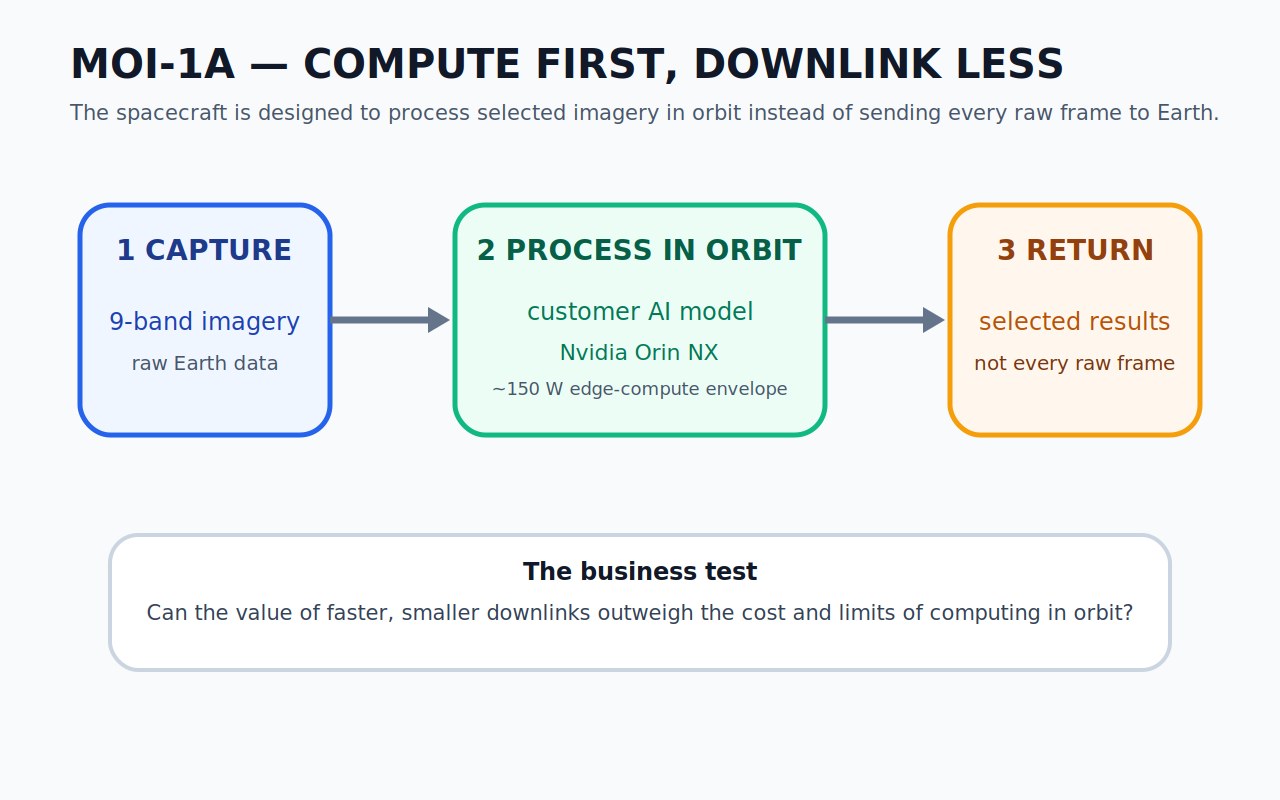
The more useful way to understand MOI-1A is as an edge-computing satellite, not a rack-scale data center in space. Reuters and The Next Web describe a sub-50 kg spacecraft using Nvidia Orin NX edge-computing processors with roughly 150 watts available. Customers are meant to upload their own models, process selected data during a pass and bring back the analysis rather than the full underlying raw dataset.
What actually happens in orbit
Traditional Earth-observation workflows often downlink large image files first and analyze them later on ground infrastructure. MOI-1A is designed to move part of that pipeline onto the spacecraft. Reuters reports that customers can upload containerized AI models, run them as the satellite passes over a selected area and transmit the analysis rather than the full underlying dataset.
The practical output can therefore be much smaller than the input. Founder Ronak Samantray told Reuters that the value case is strongest for customers who otherwise pay to download large amounts of raw data before computing on the ground. The claimed savings are a company argument, not an independently measured result from MOI-1A operations.
Why this is edge computing, not yet a full orbital data center
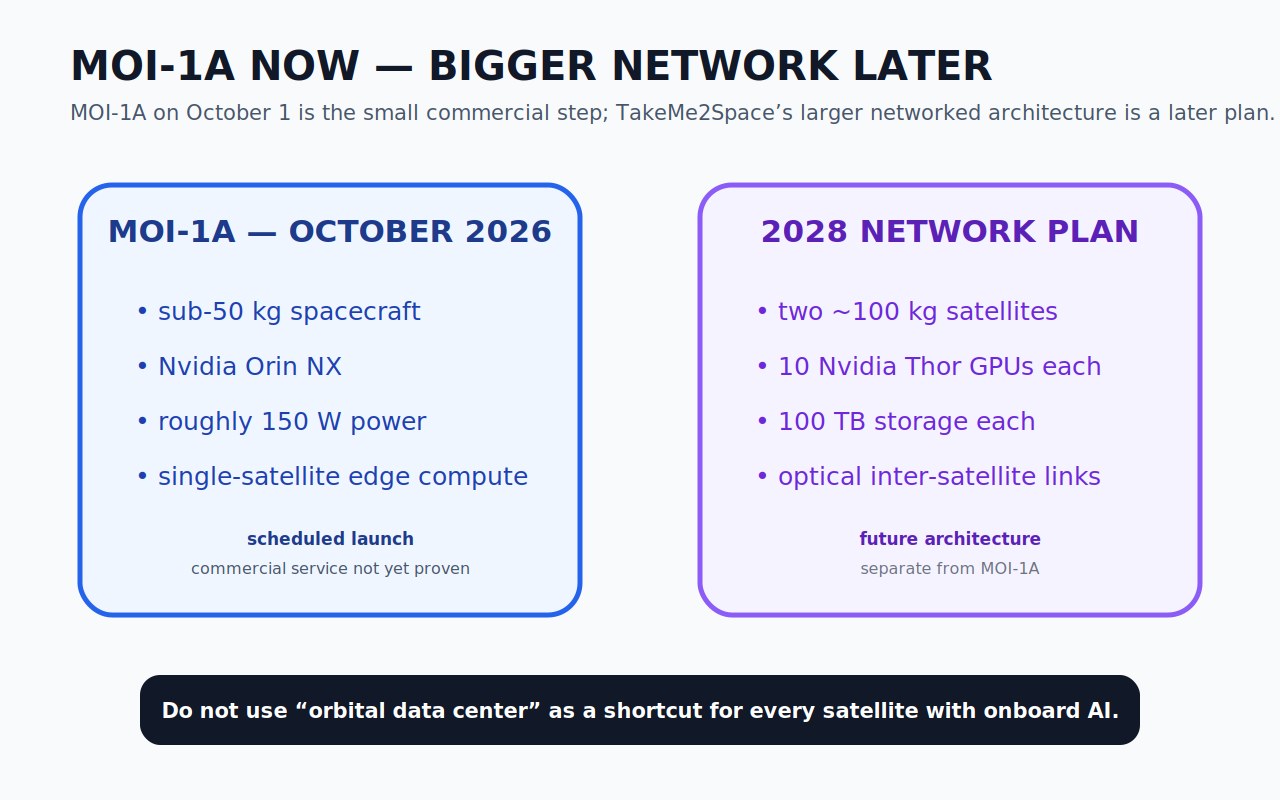
The label matters because orbital computing now covers very different scales. Reuters and The Next Web describe MOI-1A as a sub-50 kg spacecraft using Nvidia Orin NX edge-computing processors and roughly 150 watts of power. Both frame it as an onboard edge computer rather than a conventional data center.
Times of India separately reports that TakeMe2Space is planning a much larger networked orbital data-center mission for 2028, with two roughly 100 kg satellites, optical inter-satellite links and far more compute and storage. That later architecture is the closer match for the 'data center in space' label. The October 1 mission is the smaller edge-compute step.
The customer workflow is the real experiment
Reuters says 23 customers have signed up for MOI-1A, spanning geographic-information, education and commercial sectors. Rather than buying a dedicated satellite, customers are expected to upload their own AI models and use the spacecraft during passes over areas they select.
That makes the mission a test of a service model as much as a spacecraft. The question is whether customers can reliably schedule useful workloads within the satellite’s small power envelope and receive timely results at a price that beats the cost and delay of downlinking raw data for ground processing.
What October 1 can prove—and what it cannot
A successful launch would put the hardware in orbit, but it would not by itself prove the economics or reliability of orbital AI processing. Those depend on how the spacecraft performs over time, how many workloads run successfully and whether customers find the reduced downlink worth paying for.
Reuters and The Next Web report that an earlier technology-demonstration mission validated onboard application uploads and AI inference, while a subsequent MOI-1 satellite was lost after a launch-vehicle third-stage failure. MOI-1A therefore follows prior in-orbit experimentation, but this specific commercial service still has to prove itself.