Technology/Science · NEWS EXPLAINER
SpaceX Starship Flight 14 Reaches Orbit, Then Ends Test Early
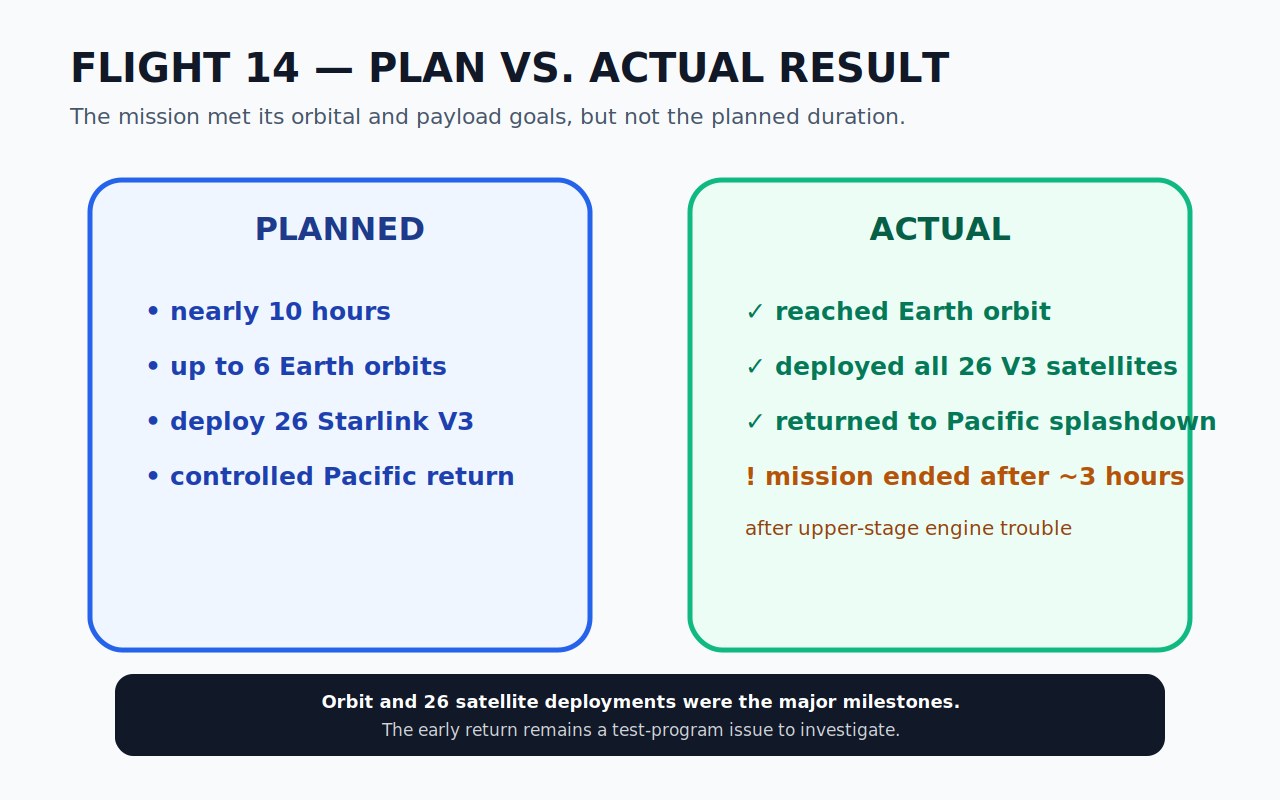
Starship achieved its first Earth orbit and deployed 26 operational Starlink V3 satellites, but upper-stage engine trouble shortened the planned nearly 10-hour test to about three hours before a Pacific splashdown.
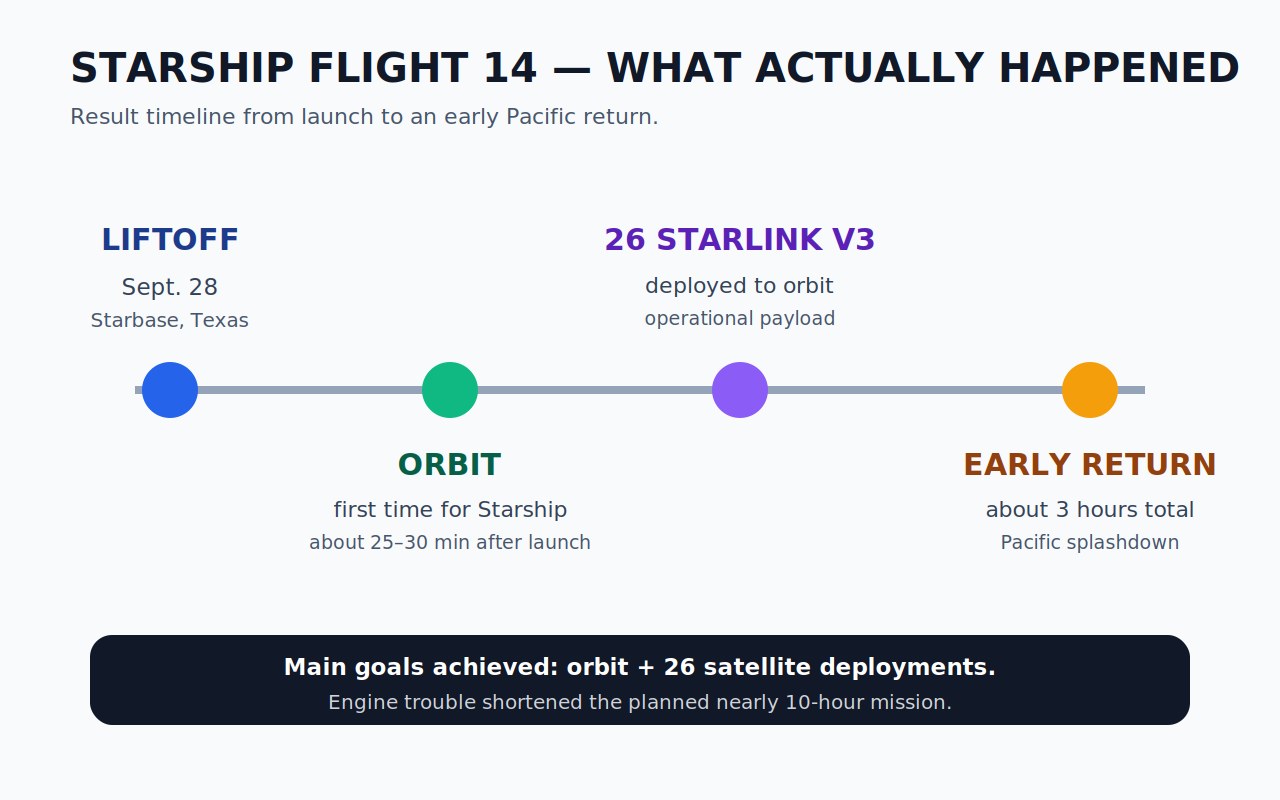
Starship Flight 14 crossed a milestone SpaceX had not reached in the vehicle’s first 13 integrated tests: the Ship upper stage entered Earth orbit and deployed 26 operational Starlink V3 satellites. Reuters and AP report that the satellite deployment succeeded even after an upper-stage engine shut down prematurely during the flight.
The mission did not complete its planned nearly 10-hour, six-orbit profile. SpaceX brought Starship home after about three hours, with the Ship splashing down in the Pacific. The result is therefore both a major orbital-and-payload success and another test-flight problem for engineers to investigate.
Flight 14 crossed the orbital line previous tests did not
Space.com reports that Ship performed an orbital insertion burn about 25 to 30 minutes after liftoff, after which mission control confirmed Starship was in orbit. That is the core result that changes this page from a pre-launch explainer into a completed-flight report.
Reaching orbit does not make Starship operational, but it expands the test envelope beyond the suborbital trajectories used on the first 13 integrated flights. SpaceX can now evaluate payload operations and an orbital return profile using data from an actual orbital mission.
The 26 Starlink V3 satellites made this a real payload mission
All three result reports say Starship deployed 26 next-generation Starlink V3 satellites. Space.com notes that earlier Starship tests had released next-generation spacecraft on suborbital trajectories, while Flight 14 placed operational satellites into low Earth orbit.
That distinction matters for SpaceX’s launch business: Flight 14 demonstrated that Starship can carry a useful payload through orbital insertion and release it where the satellites can continue their own missions, rather than treating payload deployment only as a short-lived test.
Engine trouble cut the planned six-orbit mission to about three hours
Reuters reports that an upper-stage engine shut down prematurely, but Starship continued with other engines, reached orbit and completed the satellite deployment. AP likewise describes early engine trouble followed by a decision to bring the vehicle back sooner than planned.
Instead of remaining aloft for nearly 10 hours and as many as six orbits, the flight ended after roughly three hours with a Pacific splashdown. That early return leaves SpaceX with an engine-and-duration issue to analyze even though the mission achieved its most consequential new objectives: orbit and operational payload deployment.