Science · NEWS EXPLAINER
SpaceX CRS-35 launches: Thursday’s docking is the next milestone to watch
Dragon has lifted off with more than 6,300 pounds of cargo. NASA’s October 15 arrival and broadcast times remain scheduled milestones, not a completed delivery.
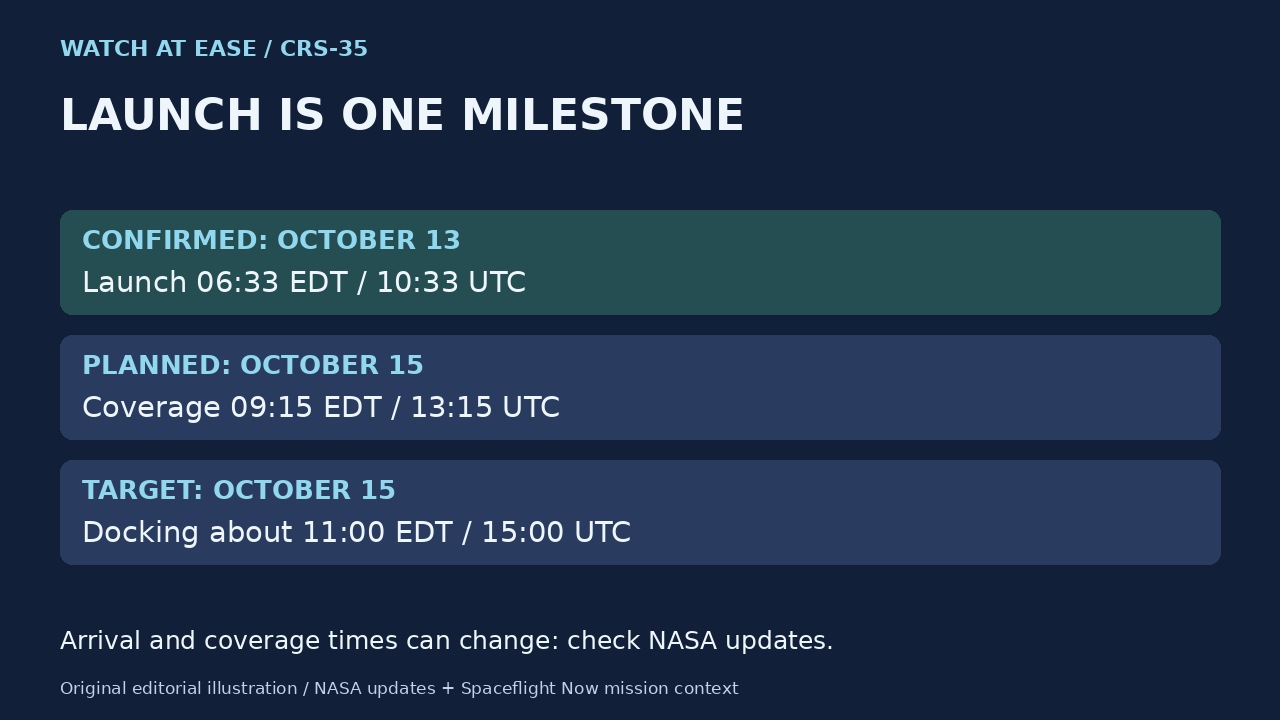
SpaceX’s CRS-35 cargo mission lifted off from Cape Canaveral Space Force Station at 6:33 a.m. EDT on October 13, NASA confirmed in its post-launch update. Dragon is carrying more than 6,300 pounds of scientific investigations and cargo toward the International Space Station.
The next public milestone is its planned arrival on Thursday, October 15. For viewers, that means switching from a launch countdown to rendezvous and docking coverage, while keeping the difference between an achieved launch and a still-scheduled arrival clear.
What has happened, and what has not
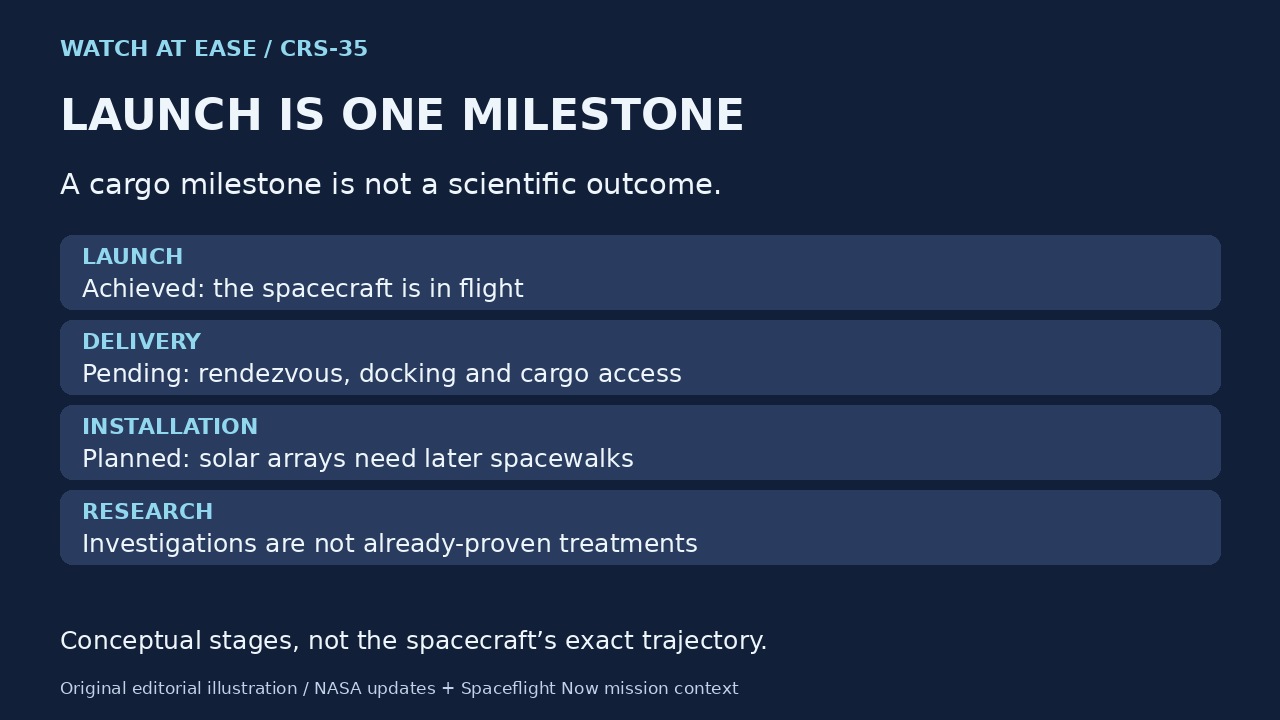
NASA’s completed-launch account says Falcon 9 lifted off from Space Launch Complex 40. About nine minutes later, Dragon separated from the second stage, opened its nosecone and began the manoeuvres needed to reach the station. This changes the mission’s status from an intended departure to an actual flight.
It does not mean the cargo has already reached the crew. NASA still describes the October 15 arrival as scheduled. Avoid treating a launch replay or a celebratory liftoff image as evidence of docking, unloading or completion of the experiments aboard. Those are separate milestones requiring their own confirmation.
Put the Thursday broadcast in your own clock
NASA’s post-launch update targets arrival at approximately 11 a.m. on Thursday and coverage from 9:15 a.m.; these are Eastern daylight times in the mission coverage. For October 15, that is a planned 15:00 UTC arrival and 13:15 UTC broadcast start. On the U.S. West Coast, the corresponding times are 8 a.m. and 6:15 a.m. PDT.
These are a target and a viewing start, not two descriptions of the same event. Coverage begins before the expected arrival. Use NASA’s linked live-coverage page and latest station updates before watching, because operational timing can change. This article does not promise an unchanged timetable or that every platform carries an identical programme.
The manifest matters beyond the launch spectacle
NASA’s same-day countdown article identifies the final pair of ISS Roll-Out Solar Arrays among the cargo. It says astronauts will install them during spacewalks planned for later in the fall, to augment the station’s power system. Delivery and installation are therefore distinct; launch does not mean the new arrays are already operating.
The independent Spaceflight Now preview adds mission context, identifying the cargo spacecraft as C211 on its fourth flight and describing its previous CRS-26, CRS-29 and CRS-33 runs. Its article was written as a launch preview, so we use it for vehicle history rather than as proof of today’s liftoff. NASA’s later update is the source for the completed launch.
Read research cargo as an experiment, not a result
The countdown account also describes hardware for artificial-retina manufacturing, 3D heart-tissue models, glass formation and brain-organoid research in microgravity. These are investigations being sent to the orbital laboratory. Their possible applications explain why the cargo is interesting; carrying them into space is not evidence of a successful treatment or a finished scientific finding.
When following the mission, look for the next confirmed step rather than inferring it from an earlier one: docking, cargo access, equipment installation or an experiment update. Our timeline and cargo graphics keep achieved and planned stages separate. They are original explanatory illustrations, not photographs of this flight or diagrams of the spacecraft’s exact trajectory.