Science · NEWS EXPLAINER
SpaceX CRS-35 launches final ISS solar arrays and new retina and heart research
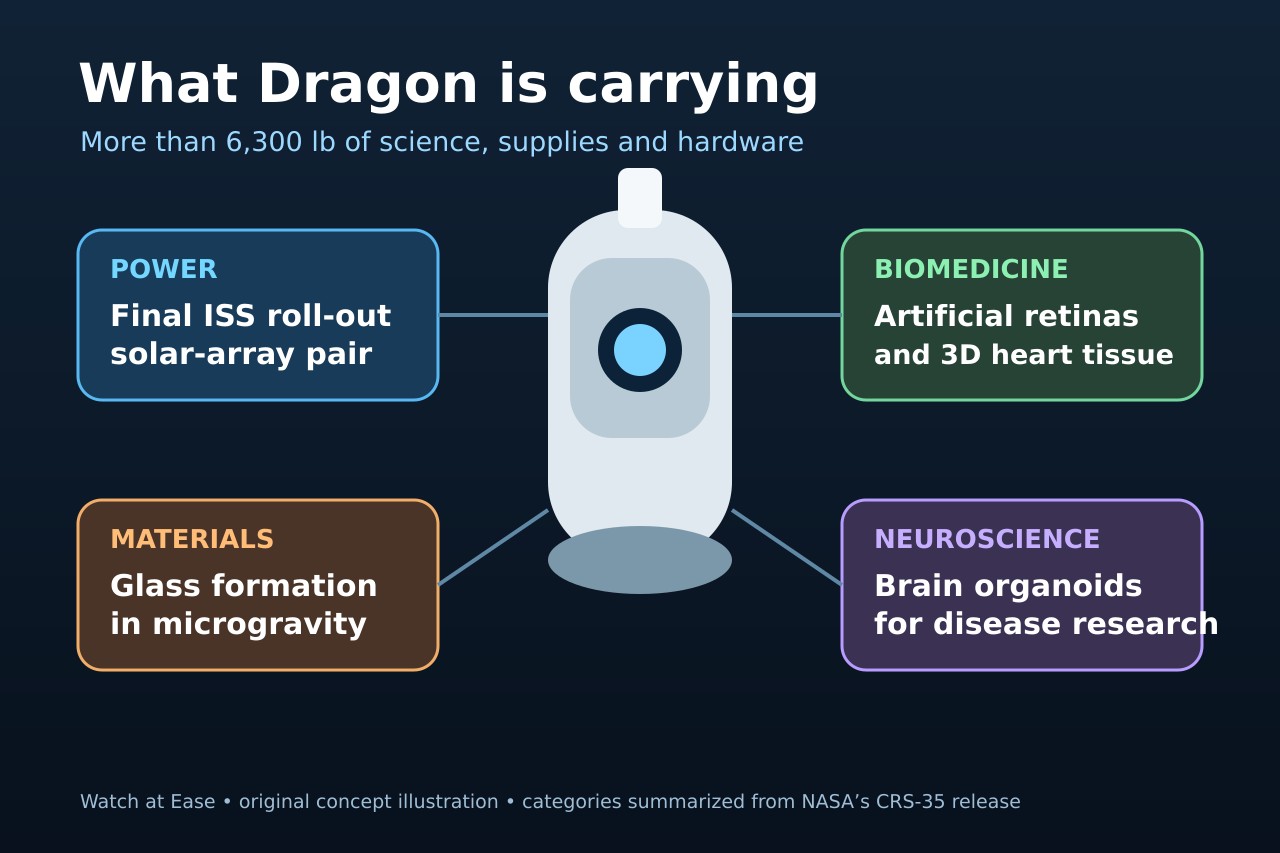
Cargo Dragon is carrying more than 6,300 pounds to the International Space Station. Launch is complete, while docking, installation and the research results are still ahead.
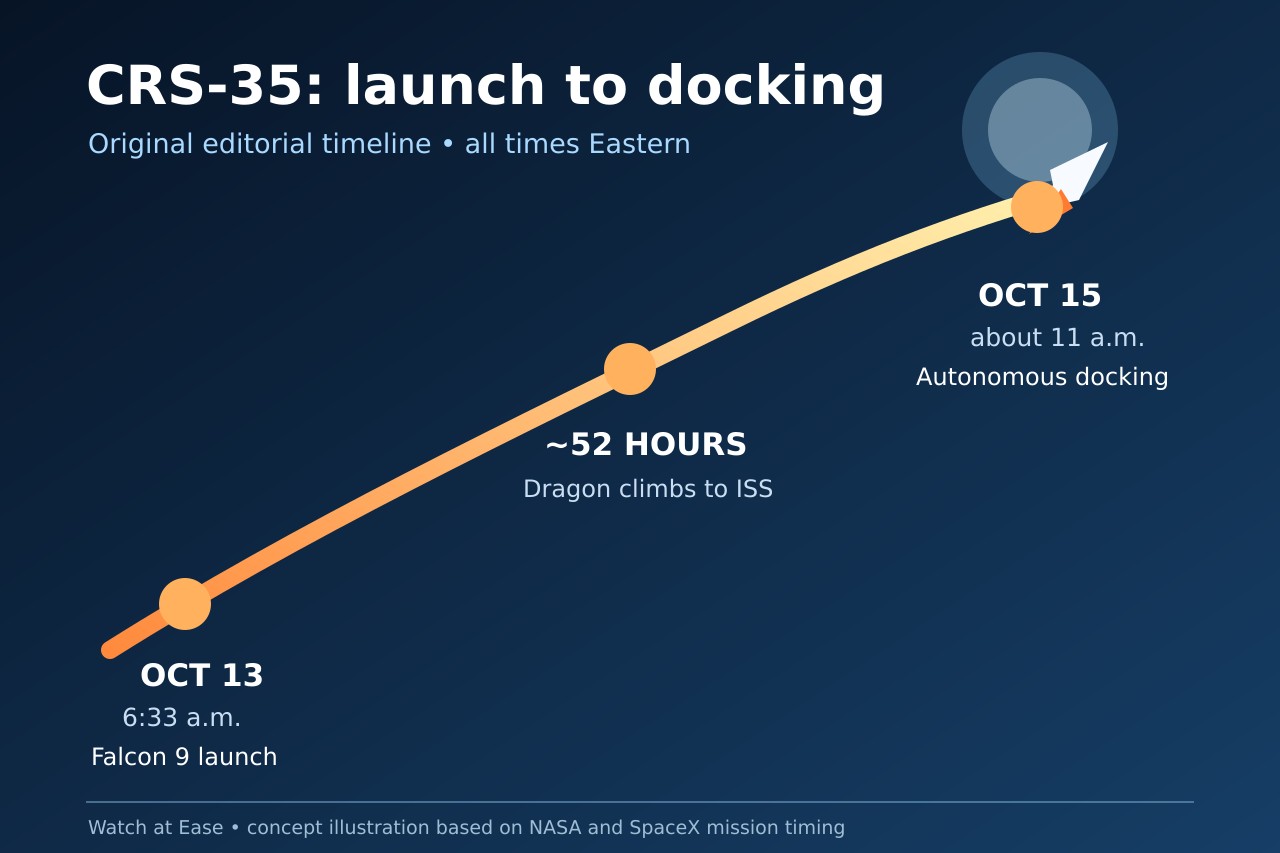
A SpaceX Falcon 9 launched the CRS-35 Cargo Dragon from Cape Canaveral at 6:33 a.m. EDT on October 13, 2026. NASA says the spacecraft carries more than 6,300 pounds of supplies, research and hardware, including the final pair of ISS Roll-Out Solar Arrays. The launch succeeded; docking is scheduled for about 11 a.m. EDT on October 15.
The most useful distinction is between cargo delivered and outcomes still unknown. The mission includes artificial-retina work, three-dimensional heart tissue models, glass manufacturing and brain organoids, but none of those studies has produced a result merely because the spacecraft launched.
Launch is complete; docking is the next milestone
NASA’s release and SpaceX’s mission page identify launch at 10:33 GMT, or 6:33 a.m. EDT, from Space Launch Complex 40 in Florida. SpaceX says this Dragon capsule previously supported CRS-26, CRS-29 and CRS-33. It is now on an approximately 52-hour flight, with autonomous docking targeted for the space-facing port of the station’s Harmony module on October 15.
The final roll-out solar arrays are aboard
NASA describes the hardware as the final pair of ISS Roll-Out Solar Arrays. After installation, the pair will augment the station’s existing power system. Their arrival is a concrete station-upgrade milestone, but the launch announcement does not mean installation or deployment has already occurred.
Retina and heart projects test work that is difficult on Earth
One project will examine whether artificial retinas can be manufactured more effectively in microgravity, while another uses three-dimensional heart tissue models to study how spaceflight affects cardiac tissue. NASA frames both as research with possible longer-term value. They are experiments, not established treatments, and the reviewed sources do not report clinical outcomes.
Glass and brain organoids broaden the research mix
Another investigation studies glass made in microgravity, where reduced gravity can change how materials form. The mission also carries brain organoids—small laboratory models derived from cells—to examine biological processes in space. These payload descriptions explain the research questions; they do not establish that manufacturing or medical applications will succeed.
A bright plume was visible, but the operational story is cargo
The Washington Post independently confirms the successful launch, the more-than-three-ton payload and the roughly 52-hour trip, while reporting that the expanding exhaust plume produced a “space jellyfish” effect visible across parts of Florida. That spectacle was a launch-side effect, not a separate object or mission failure. The next checks are docking, hardware installation, experiment operations and Dragon’s planned mid-November return.