Business · NEWS EXPLAINER
Schneider Electric posted a record €11.46 billion quarter—but triple-digit data-center demand is not triple-digit sales
The company raised its 2026 organic revenue and adjusted EBITA targets after a record third quarter. Here is what the figures measure, what changed in guidance, and why demand, sales and future results should not be treated as the same thing.
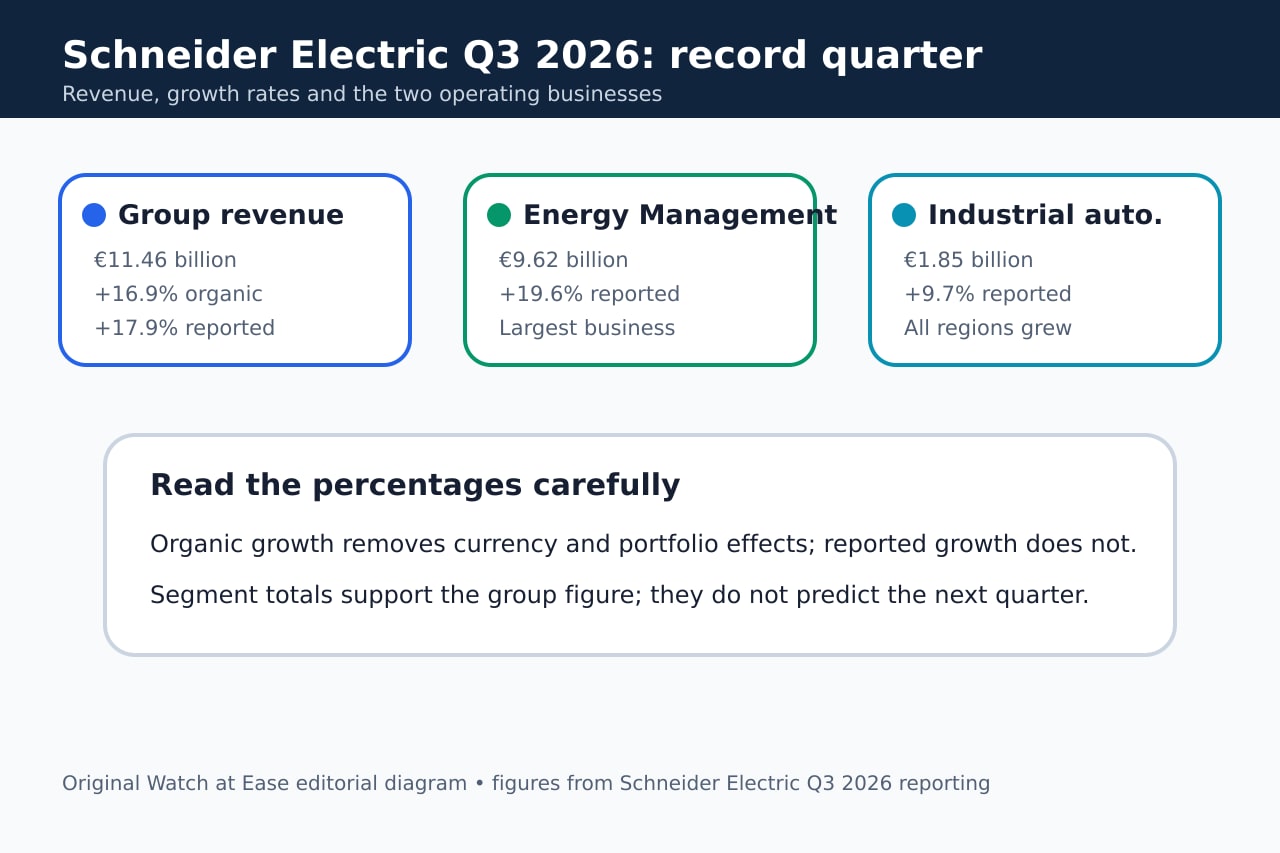
Schneider Electric reported record third-quarter revenue of €11.46 billion and raised its 2026 financial target for the second time this year. Revenue grew 16.9% organically and 17.9% on a reported basis, with every region contributing growth.
The headline about data centers needs a boundary. Schneider said demand from that end market rose at a triple-digit rate, while the company described data-center sales as strong double-digit growth. Orders, backlog conversion and revenue are related, but they are not interchangeable—and management guidance remains a target, not a guarantee.
A record quarter, measured two ways
The official quarterly release rounds organic growth to 17% and revenue to €11.5 billion; the detailed figures reported by Reuters and RTTNews are €11.46 billion, 16.9% organic growth and 17.9% reported growth. Organic growth adjusts for currency and portfolio changes, while reported growth reflects the accounts as published.
Energy Management generated about €9.62 billion, up 19.6% on a reported basis, and Industrial Automation generated about €1.85 billion, up 9.7%. China and East Asia led regional organic growth at 26%, followed by North America at 20%.
What changed in the 2026 target
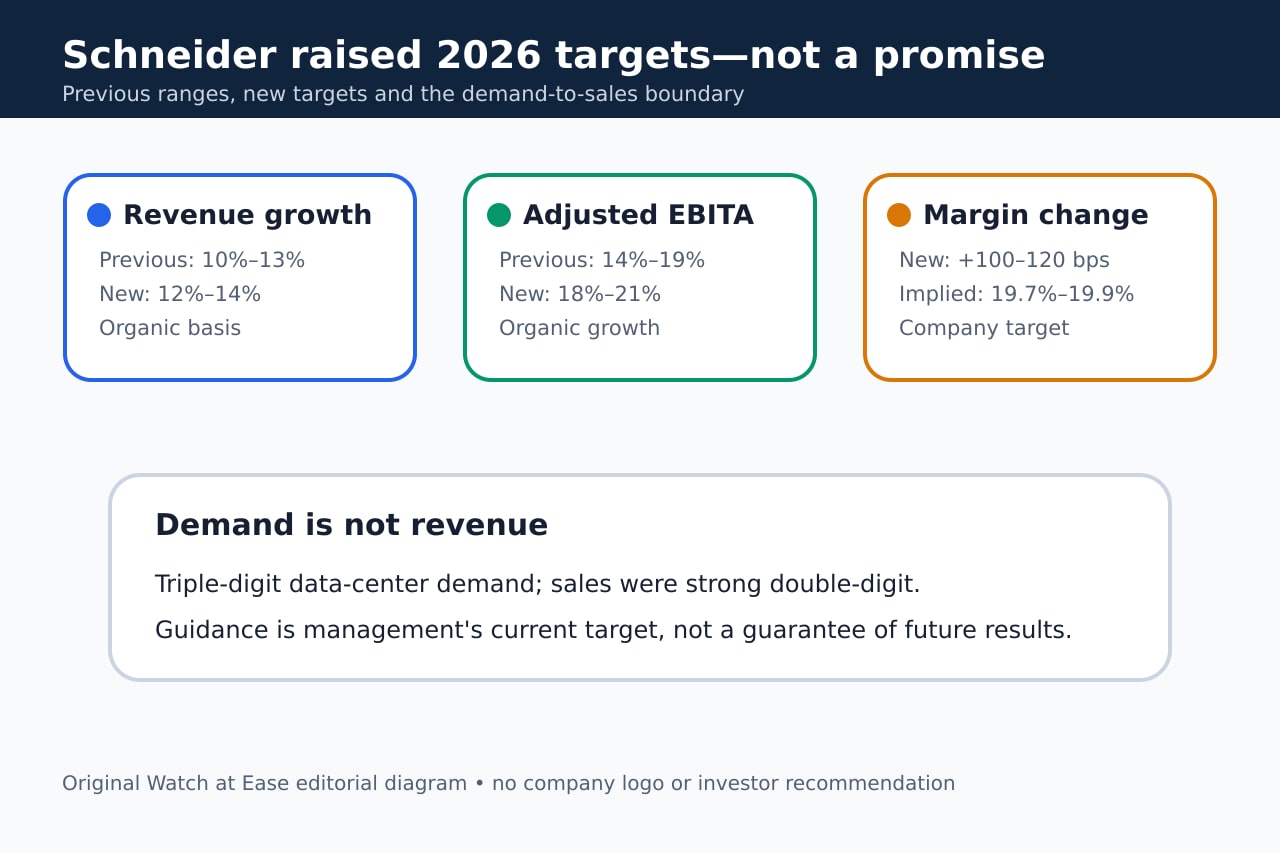
Schneider now expects organic revenue growth of 12% to 14% for 2026, up from its earlier 10% to 13% range. The company also raised its organic adjusted EBITA growth target to 18% to 21%, from 14% to 19%.
The new target includes an organic adjusted EBITA margin improvement of 100 to 120 basis points, implying a margin of roughly 19.7% to 19.9%. Those figures describe management’s current full-year target; they are not an audited fourth-quarter result.
Why the data-center headline needs care
Schneider said data-center demand increased at a triple-digit rate during the quarter, supported by hyperscalers and customers building AI and cloud infrastructure. The official statement separately described sales in the end market as strong double-digit growth.
That gap is normal: demand can include orders and backlog that convert into revenue later. It also means readers should not turn a triple-digit demand figure into a triple-digit sales claim. The company says its backlog provides more visibility into 2027 and 2028, but timing and delivery still matter.
What the numbers do—and do not—tell readers
The quarter confirms broad growth across products, systems, software and services, with data centers a major driver rather than the only one. It also shows why organic and reported percentages should be kept separate when comparing performance.
The update does not guarantee the top of the new ranges, predict share-price performance or remove execution risks around backlog conversion, pricing, currencies and acquisitions. For readers, the useful takeaway is the changed operating target and the boundary between demand, booked sales and realized revenue—not an investment recommendation.