Technology · NEWS EXPLAINER
Samsung expands Galaxy AI and Bixby languages: what arrives now and what comes later
Bixby starts adding Polish, Thai and Vietnamese on October 14. Hungarian and Malay for four Galaxy AI tools follow over the coming weeks, while Now Nudge has a separate eight-language expansion.
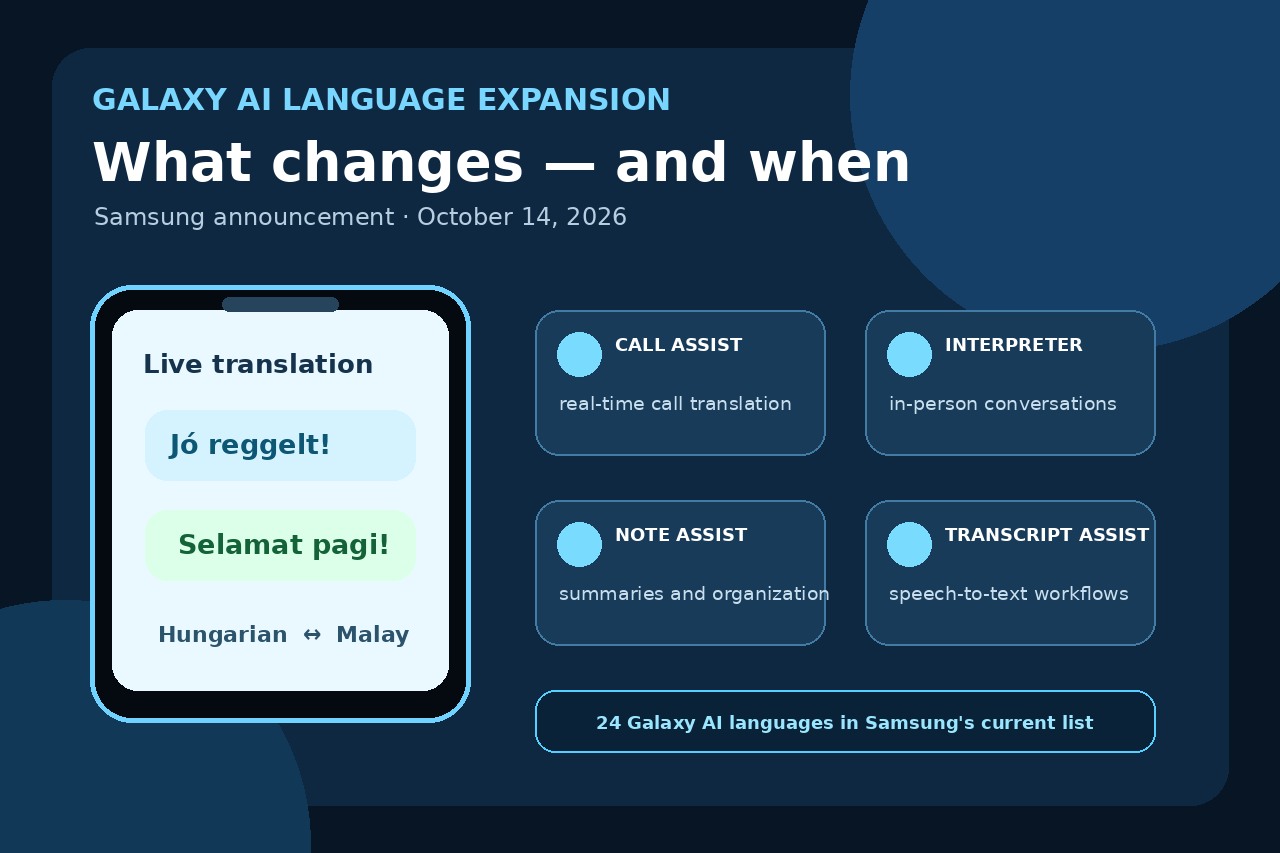
Samsung is expanding language support across Galaxy AI, Now Nudge and Bixby, but the changes do not arrive as one universal update. The practical distinction is timing: Bixby begins first, while the new Hungarian and Malay Galaxy AI packs follow over the coming weeks.
One announcement, three different rollout tracks
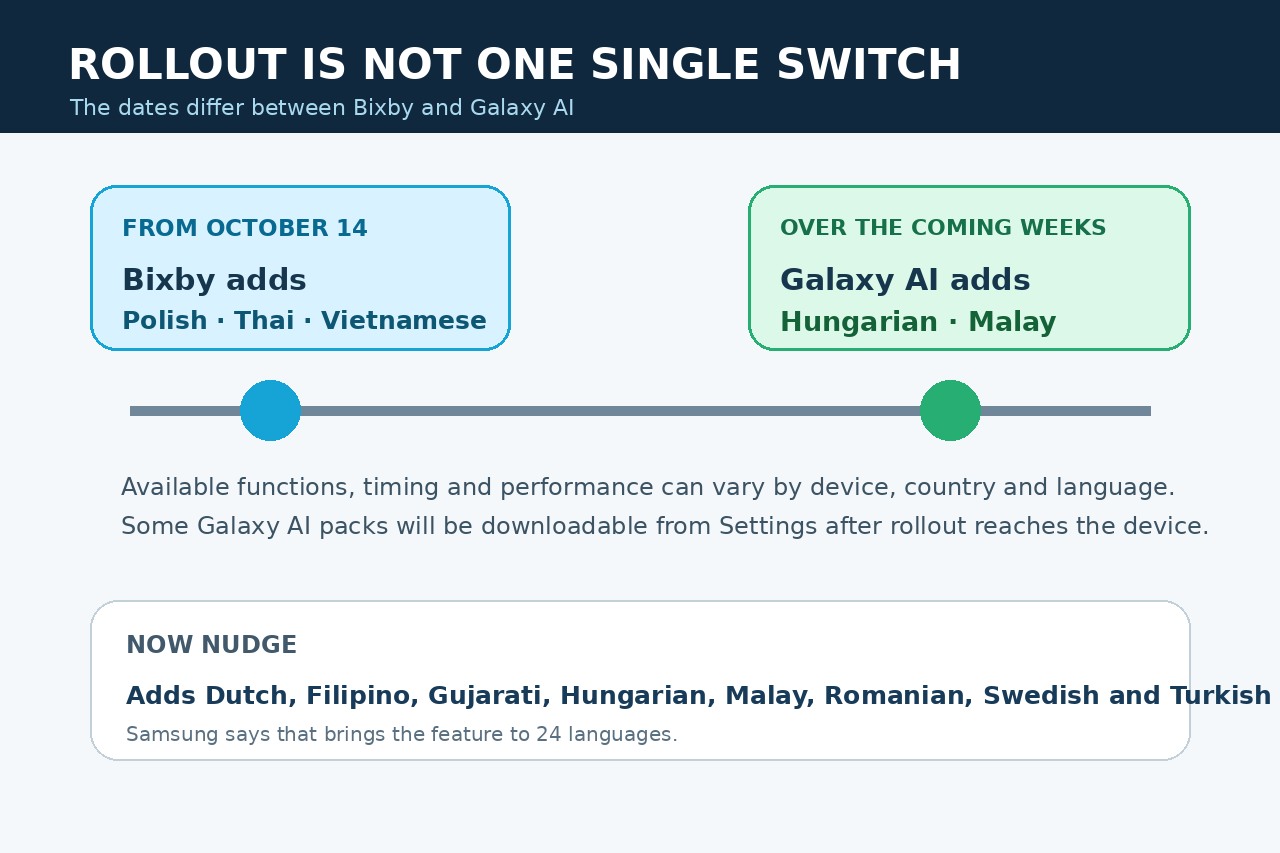
Samsung’s October 14 announcement is easiest to understand as three separate changes, not one universal language switch. Bixby begins adding Polish, Thai and Vietnamese from October 14. Four Galaxy AI tools—Call Assist, Note Assist, Interpreter and Transcript Assist—are adding Hungarian and Malay over the coming weeks. Now Nudge has its own eight-language expansion. Samsung and two independent reports agree on that split, which matters because a Bixby language appearing now does not mean every Galaxy AI function is already available in that language.
Hungarian and Malay are coming to four Galaxy AI tools
Call Assist, Note Assist, Interpreter and Transcript Assist are the four named tools gaining Hungarian and Malay. Their jobs are different: Call Assist handles translated phone conversations, Interpreter supports face-to-face exchanges, Note Assist organizes and summarizes notes, and Transcript Assist turns recordings into text-based workflows. Samsung says the additions bring features such as Live Translate to 24 supported languages. That number is a language-list total, not a promise that every function, model, carrier or region receives identical capability on the same day.
Now Nudge gets a broader eight-language list
Now Nudge—the feature that suggests a relevant next action based on what is shown on screen—adds Dutch, Filipino, Gujarati, Hungarian, Malay, Romanian, Swedish and Turkish. Samsung says that also brings Now Nudge to 24 languages. This list should not be merged with the two-language expansion for the translation and transcription tools: Dutch or Turkish support for Now Nudge, for example, does not by itself establish new Call Assist or Transcript Assist support.
Bixby’s new languages start first
Bixby adds Polish, Thai and Vietnamese, taking Samsung’s device agent to 12 languages. Samsung says this rollout begins October 14, while the new Galaxy AI language packs follow over the coming weeks. The distinction is practical: someone checking a device immediately may see a new Bixby option before Hungarian or Malay appears in a Galaxy AI download list. Bixby also requires a Samsung Account and data connection, and available functions can vary by country, region and language.
How to check availability without assuming too much
First update the phone software and relevant Samsung apps, then inspect the language settings for the specific feature you intend to use. Samsung says some new Galaxy AI languages can be downloaded as language packs from Settings. If the language is missing, the announcement does not establish that the device is faulty: schedules and supported functions can vary by device and country, and the Galaxy AI portion is explicitly staged over the coming weeks. For a multilingual call or meeting, test the exact language pair and feature before relying on it in a time-sensitive situation.
What the announcement does not promise
Samsung does not provide a model-by-model deployment calendar in this announcement, and it does not say that all accents, dialects or expressions will be recognized equally. The company warns that performance can vary with pronunciation, voice level and the surrounding environment. It also lists situations in which Bixby use may be limited, including media recording, calls, Maximum Power Saving mode, Emergency mode and Samsung Kids. The useful takeaway is therefore narrower than “all Galaxy phones now support more languages”: specific features are expanding, on different schedules, with device and regional conditions still attached.