Technology · PRACTICAL GUIDE
Python SSLCertVerificationError: identify the certificate owner before changing trust
Keep verification on. Capture the requested name, SNI, peer SANs, issuer, proxy path and active CA bundle, then fix the component that actually owns the mismatch.
SSLCertVerificationError is a verdict, not a single root cause. The same exception family can report an untrusted chain, expired certificate, wrong clock, hostname/SAN mismatch, IP-literal request, unintended virtual host, corporate HTTPS proxy, or a CA bundle that the current Python client never loaded.
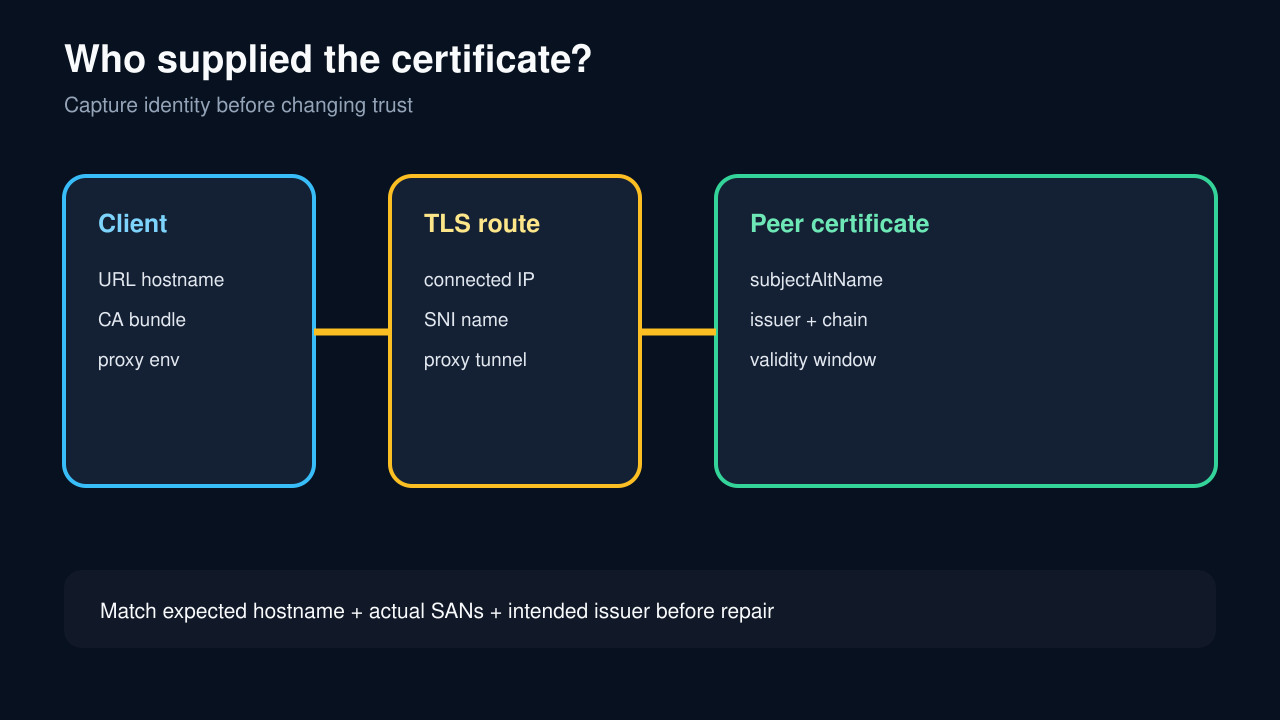
The safe first move is not verify=False. Reproduce once with verification enabled and record who was asked for, who answered, which identity the certificate asserts, and which trust store the client used. That ownership evidence selects the repair and preserves TLS authentication.
Freeze the exact failing request
Record the complete URL host and port, Python version, OpenSSL version, library and version, proxy environment variables, explicit verify or CA settings, and the full exception including verification message. Do not refresh source dates or reduce the evidence to CERTIFICATE_VERIFY_FAILED.
Run from the same process identity and network path as the failure. A browser, curl, container, scheduled job, and Python virtual environment can use different proxies or trust stores, so success in one is only a comparison point.
Name the endpoint before inspecting the chain
Write four values separately: URL hostname, resolved or connected IP, SNI hostname, and HTTP Host header. In ordinary library use they align. An IP-literal URL, manual connection pool, proxy tunnel, or custom adapter can split them.
TLS certificate selection and hostname verification occur before the HTTP request is handled. Setting only a Host header cannot make a certificate for example.org valid when the TLS layer expected an IP address.
Classify the verification failure
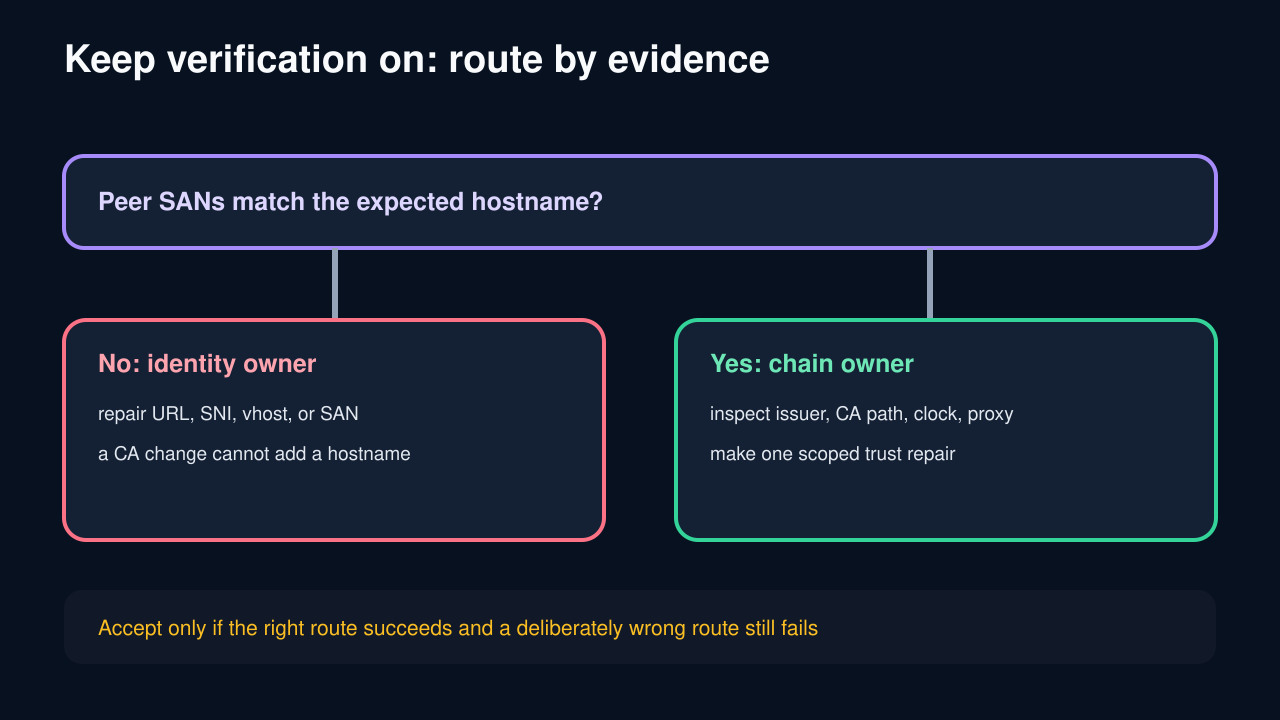
For a hostname mismatch, compare the expected name with the peer certificate subjectAltName entries; adding a CA does not repair a missing name. For unable-to-get-issuer or self-signed-chain errors, inspect the issuer path and the exact CA bundle loaded by this client. For expiry or not-yet-valid errors, check certificate validity and the runtime clock.
If the issuer belongs to a corporate security product rather than the origin, confirm whether an approved HTTPS proxy is active. Trusting that enterprise CA is a policy decision scoped to the managed environment, not proof that the public origin certificate is correct.
Apply one owner-scoped repair
Fix the service certificate when its SANs omit the production DNS name. Fix the URL or SNI configuration when the client asked for the wrong identity. Fix proxy routing or install the approved enterprise CA only when the proxy is the intended certificate owner. Fix the Requests CA path when the process did not load the intended trust bundle.
Do not combine several changes at once. Preserve verify=True and prefer a dedicated Session or PoolManager for a private CA rather than changing global trust for unrelated hosts. Never distribute a server leaf certificate as a general-purpose CA unless that is the explicitly reviewed private-PKI design.
Prove both the success and rejection paths
Repeat the exact request and record the negotiated peer subject, SANs, issuer, expected hostname, selected CA source, and proxy state. Confirm the response belongs to the intended service, not merely that a TLS socket opened.
Add a negative test: use a wrong hostname, an unapproved root, or the proxy-disabled path that should fail. The repair is complete only when the intended route succeeds with verification enabled and the deliberately wrong route is still rejected.