Technology · PRACTICAL GUIDE
Python multiprocessing.Queue hangs on join? Map the feeder and drain order first
Distinguish process, feeder-thread and unfinished-task waits before reordering shutdown—or accepting deliberate queue loss.
A child can finish its target function and still refuse to exit because its Queue feeder is blocked flushing buffered bytes into a pipe that no process is draining. The visible join is the end of the wait chain, not necessarily the cause.
First name the exact join, draw the writer–feeder–pipe–reader ownership graph, and preserve record counts. Then reorder drain and close operations and prove both clean exit and complete delivery.
1. Name the exact join that is blocked
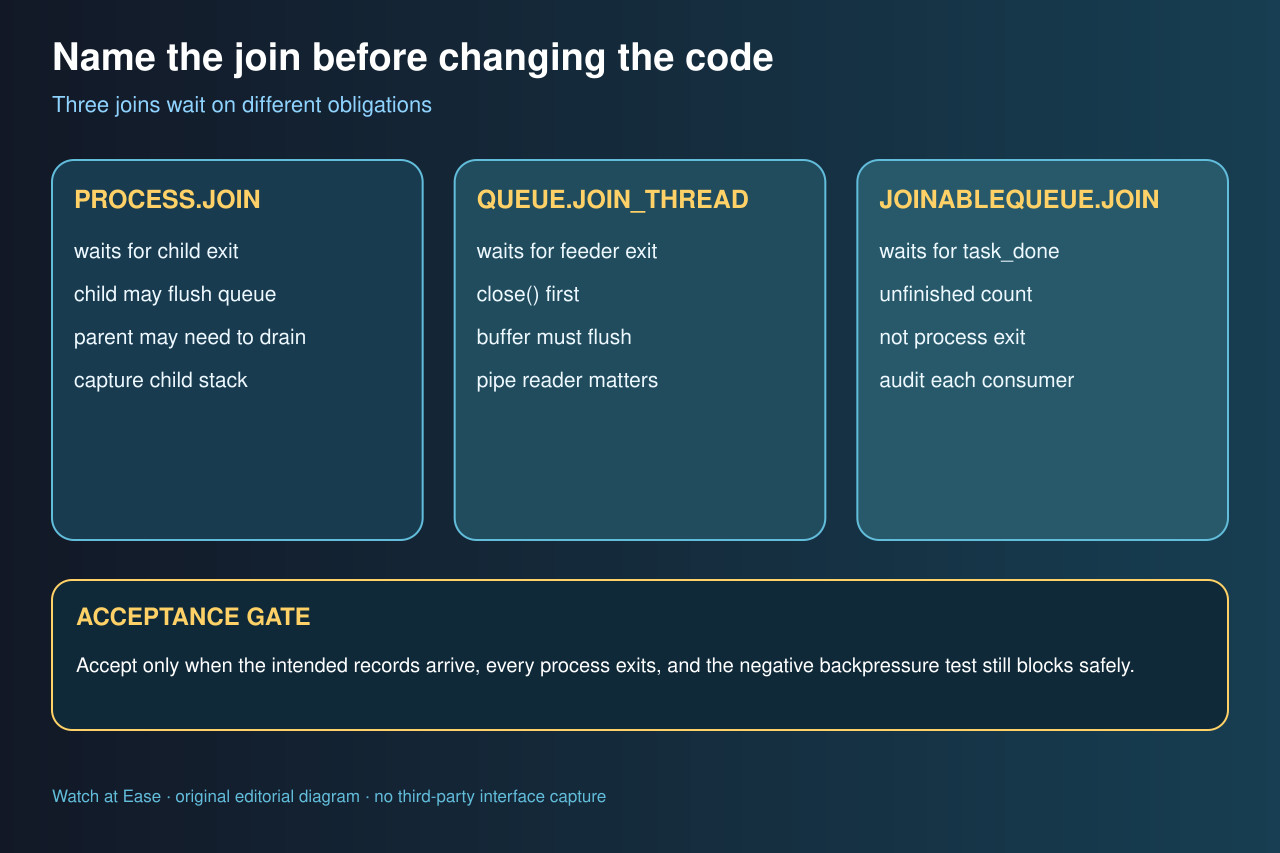
Capture a stack trace or diagnostic dump before terminating anything. Distinguish Process.join(), which waits for child exit; Queue.join_thread(), which waits for the feeder thread after close(); and JoinableQueue.join(), which waits for every queued task to receive task_done(). They share a word, not an obligation.
Record the start method, Python version, operating system, queue type, producer and consumer processes, which process created the queue, and the last successful put/get/task_done event. Preserve counts and record sizes rather than guessing from qsize().
2. Draw the writer–feeder–pipe–reader wait graph
A multiprocessing.Queue put serializes later: a background feeder thread moves buffered objects into a pipe. If the pipe is full and the reader is not consuming, the feeder blocks. A producer process can then remain alive during shutdown because it normally waits for that feeder to flush.
List every write end and read end, including inherited descriptors. Mark who closes each end, who sends the terminal sentinel, and who must continue reading while another component waits. On Linux, pipe capacity is finite and should never be treated as a correctness guarantee.
3. Repair the ordering around the ownership contract
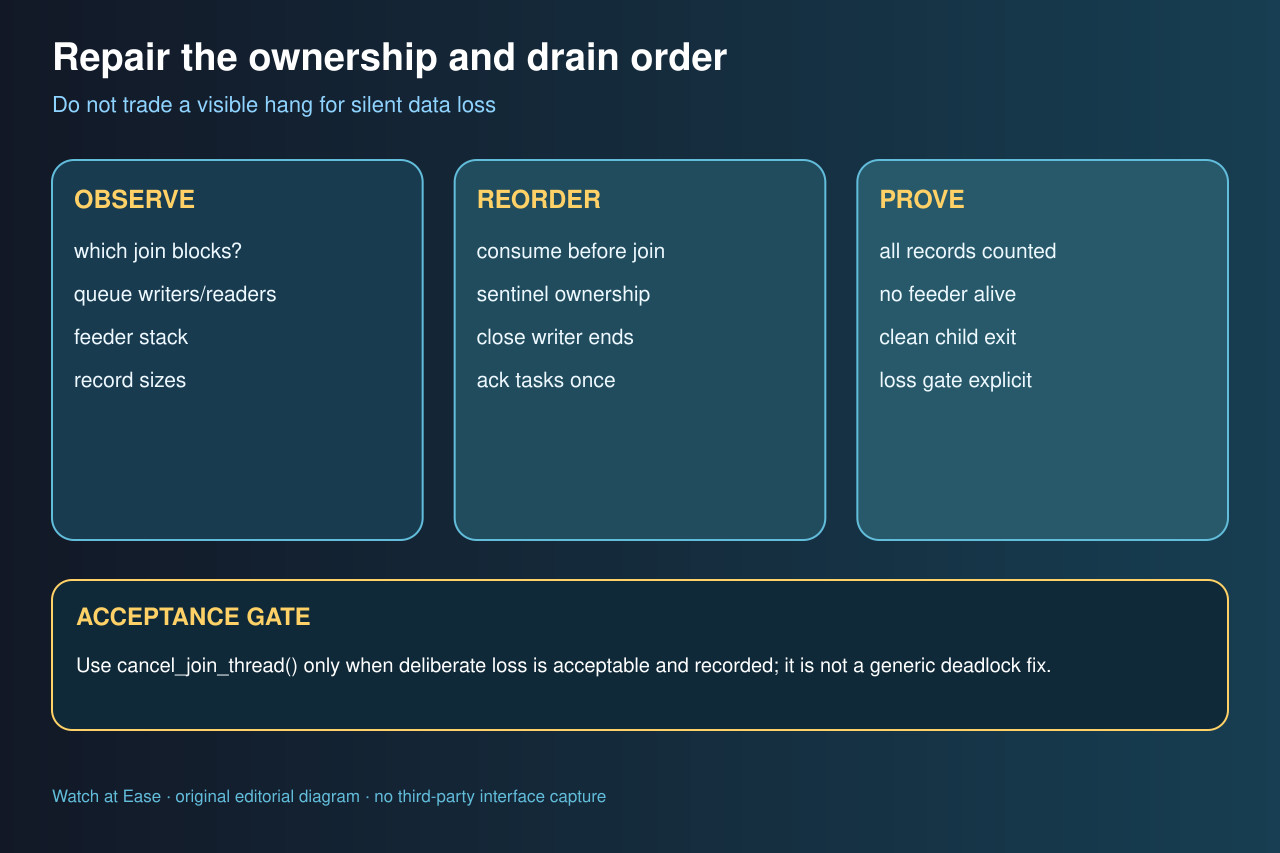
For result queues, keep consuming results while workers are alive; do not join every producer before starting to drain. For orderly shutdown, stop creating new work, send one well-defined sentinel per consumer when appropriate, drain required results, close the writer side, then join feeder threads and processes in the order implied by the graph.
For JoinableQueue, pair each successfully received task with exactly one task_done(), including exception paths, and place join() only where no actor needed to reduce the unfinished-task count is itself waiting behind it. Use timeouts for diagnostics, not as proof the protocol is correct.
4. Treat cancel_join_thread and terminate as loss decisions
cancel_join_thread() lets a process exit without waiting for the feeder to flush. The Python documentation explicitly warns that this can lose queued data; use it only when discard is intentional, documented and tested. It is not a generic deadlock fix.
Likewise, terminate() or kill() can interrupt a queue user while it holds internal state or while bytes are in flight. If recovery may use force, define which records may be replayed, deduplicated or abandoned before adopting that path.
5. Prove clean exit and complete delivery
Run a payload large enough to exceed ordinary pipe capacity, count produced and consumed record IDs, and repeat under the deployment start method. The success gate is not merely “the program exits”: all required IDs arrive exactly once, feeder threads disappear, process exit codes are expected and no queue-corruption warning appears.
Add a negative test that pauses or removes the reader. The system should expose bounded backpressure or a controlled timeout without silently dropping records. If deliberate loss is allowed, assert and report that policy separately from the no-loss path.