Technology · PRACTICAL GUIDE
Python E2BIG on one large payload? Verify the input route before batching
Linux limits a single argument as well as the total argument space. Move data only to a route the consumer supports, then check that the same bytes arrived.
OSError with errno E2BIG can occur even when one payload is smaller than the reported ARG_MAX. Before splitting a command or raising limits, identify the failed launch and whether it carries many independent items or one indivisible input.
Prove the launch failure, not just the displayed path
Keep the exact executable, Python version, platform and argument boundaries. Record the numeric errno, argument byte lengths and aggregate environment size without dumping payloads. Compare a small synthetic input with the same executable in the same launch context.
Python distinguishes an OSError during launch from a child process that starts and returns a nonzero exit status. E2BIG also has aggregate and other documented causes, so the executable named in the message is not a diagnosis by itself. Do not rerun a whole multi-step job merely because this particular launch failed.
Classify one payload separately from a list of jobs
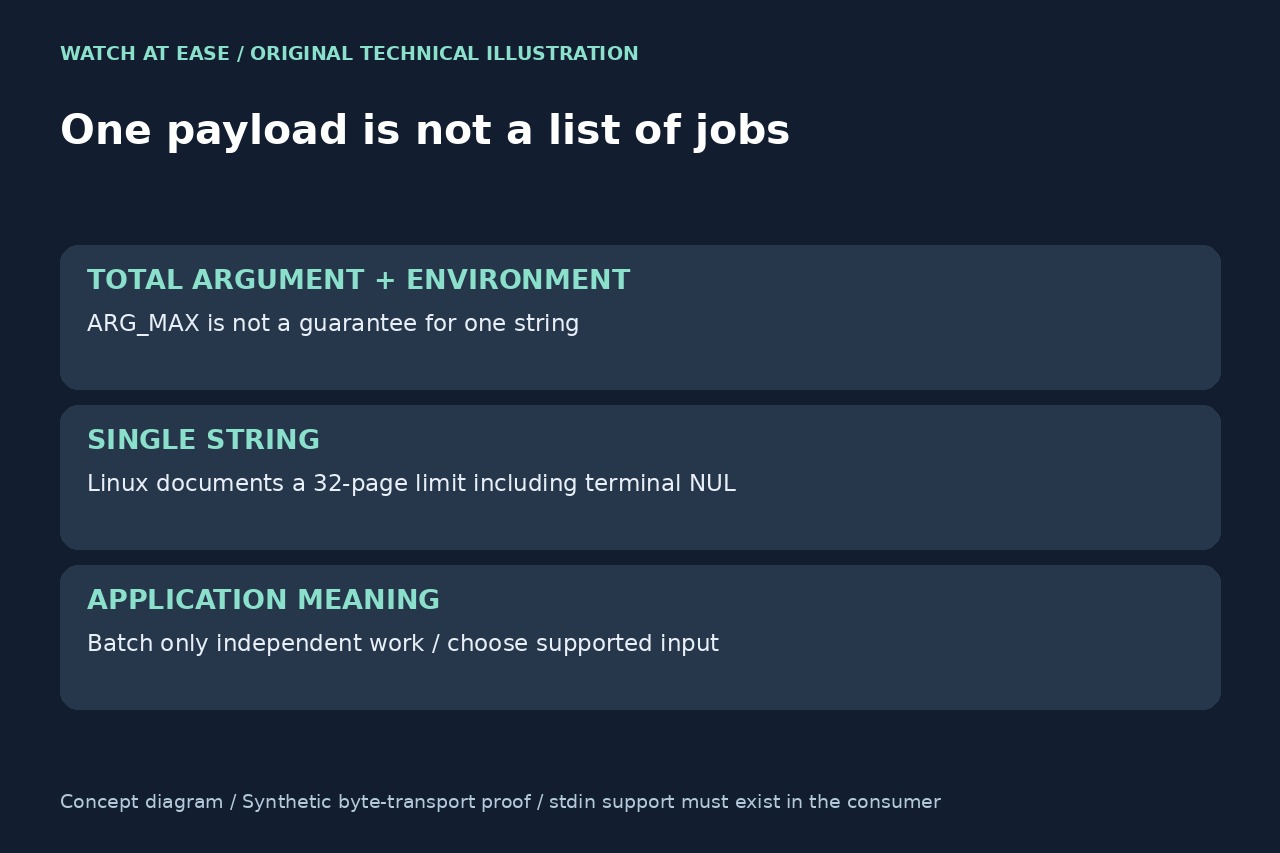
The Linux manual describes a per-string limit of 32 pages, in addition to combined argument/environment limits; a terminating NUL counts. Page size and platform matter. Replacing a shell string with an argument list avoids shell parsing, but one oversized list element can still fail.
Putting the same large value in an environment variable is not a general escape. Nor does a larger aggregate limit remove the per-string restriction. Batching is appropriate only for independent work whose combined meaning remains unchanged; splitting one JSON document or application transaction can change the operation.
Use a supported route and verify identical data
For a consumer documented to read stdin, a bounded Python call can use subprocess.run([executable, ...], input=payload_bytes, capture_output=True, check=True). Keep large data out of a generated -c argument. A file or response-file option is another route only if that exact tool supports its format and lifetime requirements.
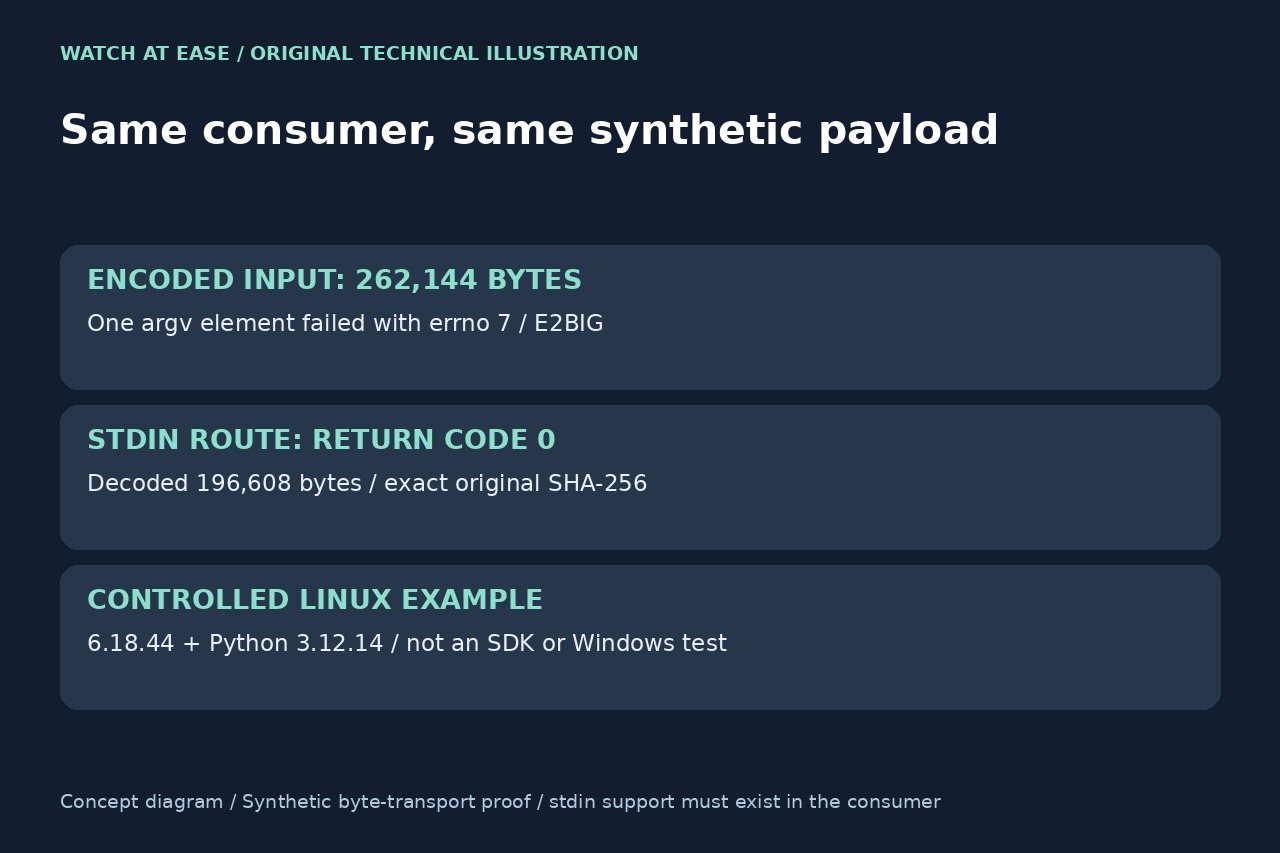
We tested the same custom Python consumer on Linux 6.18.44 with Python 3.12.14. Base64 encoding 196,608 synthetic bytes produced 262,144 bytes. Passing that as one argument raised errno 7 despite ARG_MAX reporting 2,097,152. Sending it through stdin returned zero and decoded all 196,608 original bytes, with an identical SHA-256. This is a controlled transport test, not an SDK or cross-platform test.
Separate transport success from application success
The demonstration consumer explicitly implemented both routes and used base64.b64decode(..., validate=True). It does not prove an arbitrary CLI accepts piped JSON, raw bytes or a response file. Check encoding, delimiters, framing and the receiving program’s actual contract before changing transport.
Capture errors and compare expected byte counts or hashes where appropriate, then verify the application result separately. The bounded example buffers output; large streams need suitable file handles or streaming design. Once a child starts, its failures need their own review. Preserve records of earlier successful steps so a retry does not duplicate them.