Technology · PRACTICAL GUIDE
Decimal.quantize raises InvalidOperation? Check the result's digits before changing precision
Decimal precision counts the whole coefficient, not decimal places. Use a small isolated test to separate rounding carry, zero padding and non-finite input.
An InvalidOperation at quantize can reflect the size of the requested result, not the number of decimal places in the input. Preserve the operands and active context before raising precision or switching off the trap.
1. Capture the operation, not just the exception name
Save the exact traceback, both Decimal operands and their origins. Record repr(value), value.as_tuple(), repr(quantum), getcontext().prec, rounding, Emin, Emax, traps and existing flags at the failing call. Check whether a library passed an explicit context. DefaultContext inspected elsewhere may not be the context actually used.
Separate construction from quantization. A Decimal made from a float preserves that float's value; it does not recover the original decimal text. Prefer original text when the input contract requires it. Keep malformed text, unsupported magnitude and a later quantize failure as different branches rather than applying one precision setting to all of them.
2. Count the result after carry and padding
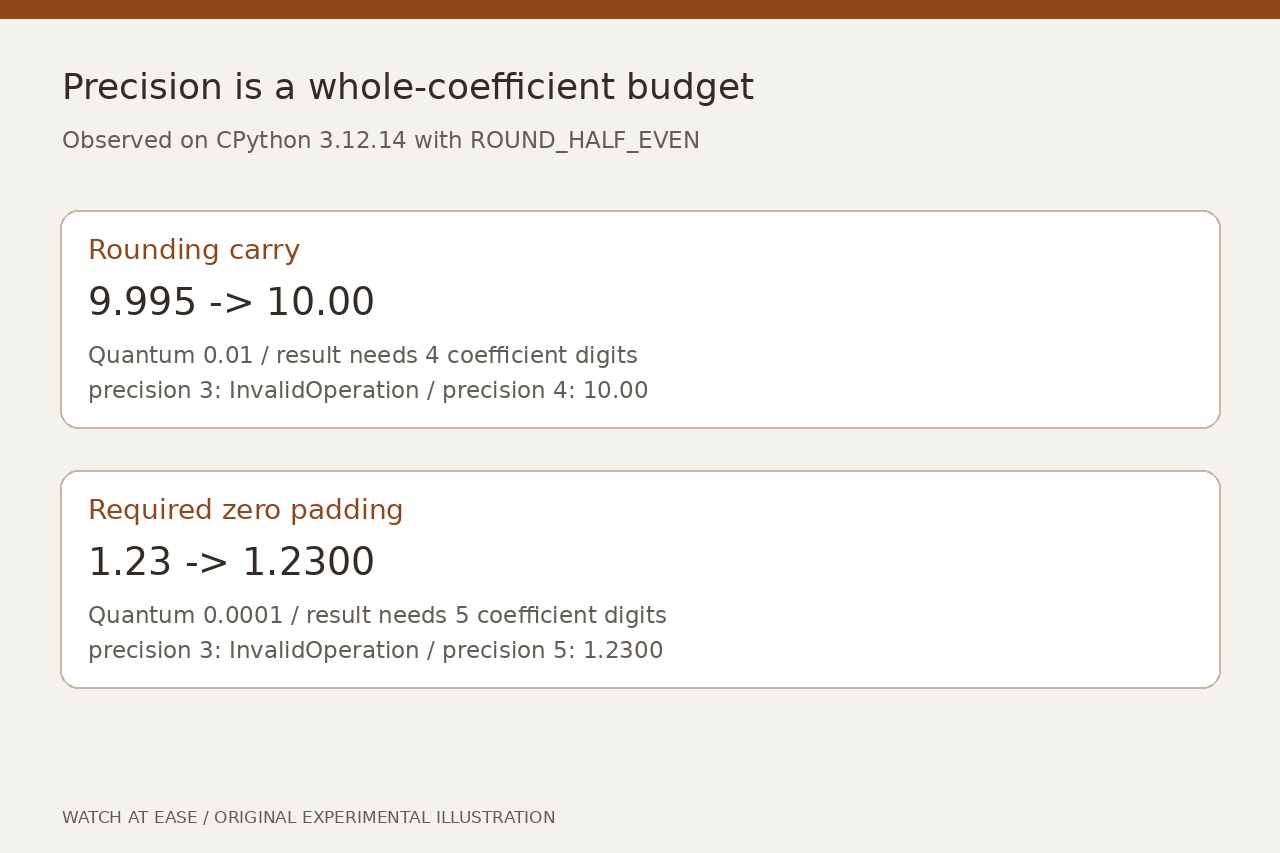
Precision limits total coefficient digits, not digits after the decimal point. In our CPython 3.12.14 tests with ROUND_HALF_EVEN, Decimal('9.995').quantize(Decimal('0.01')) failed at precision 3 but returned 10.00 at precision 4. The rounded result needs four coefficient digits; budgeting one integer digit and two decimal places misses the carry.
Padding matters too: Decimal('1.23').quantize(Decimal('0.0001')) failed at precision 3 and returned 1.2300 at precision 5. Required trailing zeros consume coefficient capacity even though the numerical value is unchanged. Base the working precision on the supported magnitude, required exponent and possible carry; also check the configured exponent bounds. No single precision value is a universal repair.
3. Keep invalid values visible and isolate the change
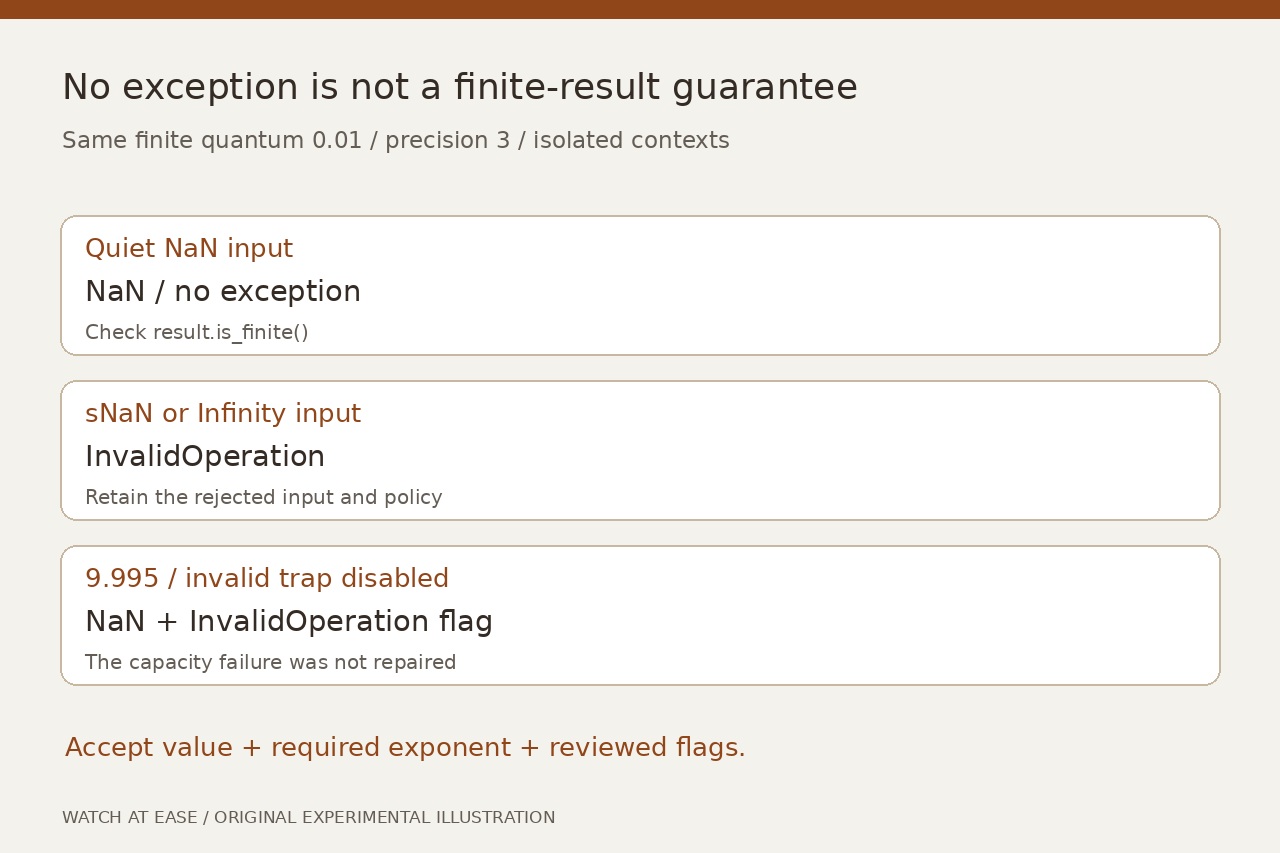
Check value.is_finite() and quantum.is_finite() before applying a finite-data policy. In the same tests, quiet NaN propagated as NaN without an exception, while sNaN and Infinity with a finite quantum raised InvalidOperation. A pipeline that only catches exceptions can therefore still accept a non-finite result unless it checks the value.
Disabling the InvalidOperation trap changed the failed 9.995/precision 3 case into NaN with the InvalidOperation flag set; it did not make 10.00 fit. Use with localcontext() as ctx for a bounded calculation and set only the reviewed precision, rounding and trap policy there. Preserve the surrounding application context. If a library replaces that context internally, inspect its documented behavior rather than repeatedly changing a global default.
4. Require a value, exponent and signal acceptance test
Clear flags in the isolated context immediately before the monitored operation, then inspect them afterward. For a finite-output contract, require result.is_finite(), the expected value and result.as_tuple().exponent equal to the quantum's exponent. Decide explicitly whether Inexact and Rounded are permitted. Our 10.00 case set both flags, while the 1.2300 padding case set neither; no exception is not the same as exact arithmetic.
Retest ordinary inputs, a carry across an integer boundary, required zero padding, negative and zero values, the largest supported magnitude and rejected special values under your actual application rules. Our eight synthetic cases covered the branches described here and confirmed the outer precision was restored; they did not validate your production dataset, financial rules or a third-party library. If the bounded test still fails, retain operands, context and flags and diagnose that specific branch instead of swallowing the exception.