Technology · PRACTICAL GUIDE
Python says “field larger than field limit”? Diagnose the CSV record before raising the cap
Preserve the bytes, separate Sniffer from reader, and prove whether the record is genuinely wide, malformed, or detection-only before changing csv.field_size_limit.
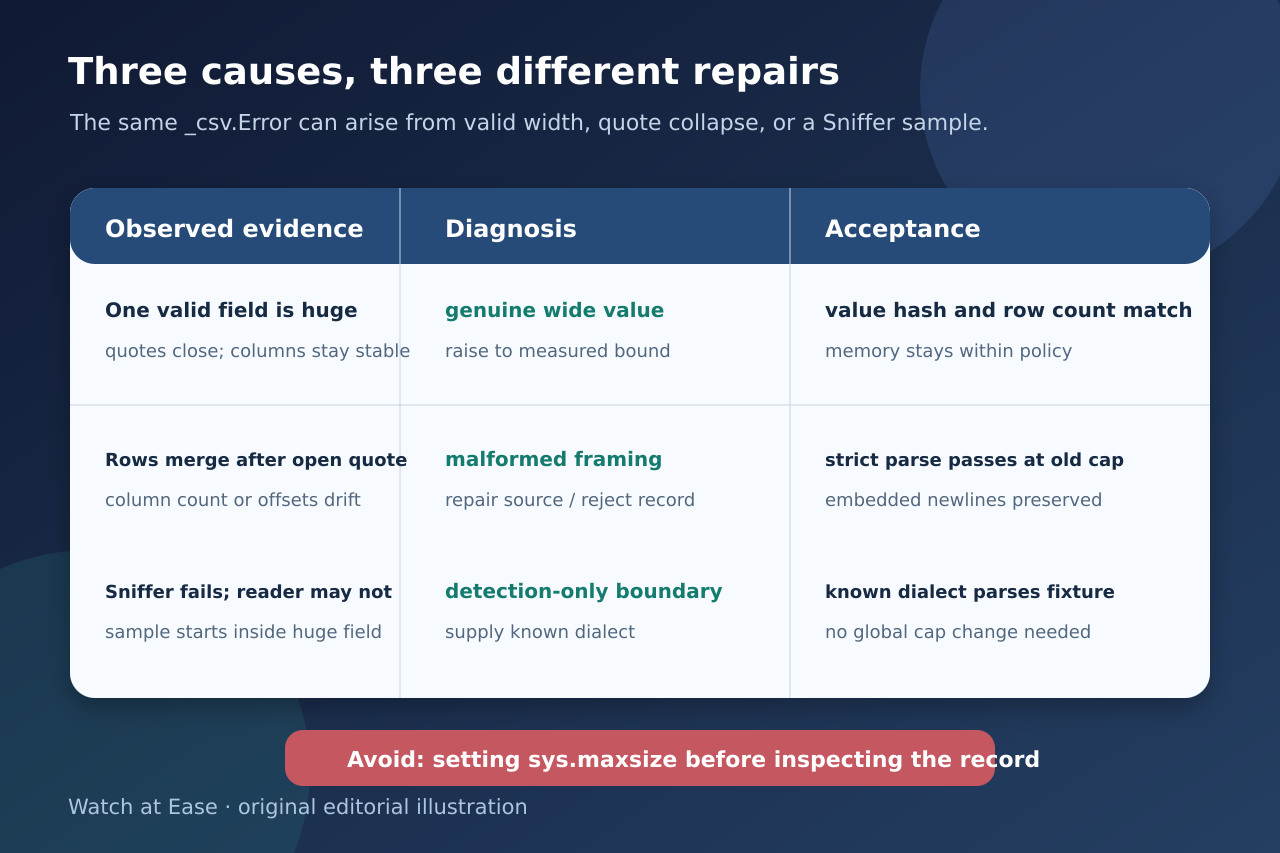
_csv.Error: field larger than field limit is a boundary signal, not a root-cause diagnosis. The same message can describe a valid wide value, an unterminated quoted field that absorbs later records, or a csv.Sniffer sample that fails before normal reading begins.
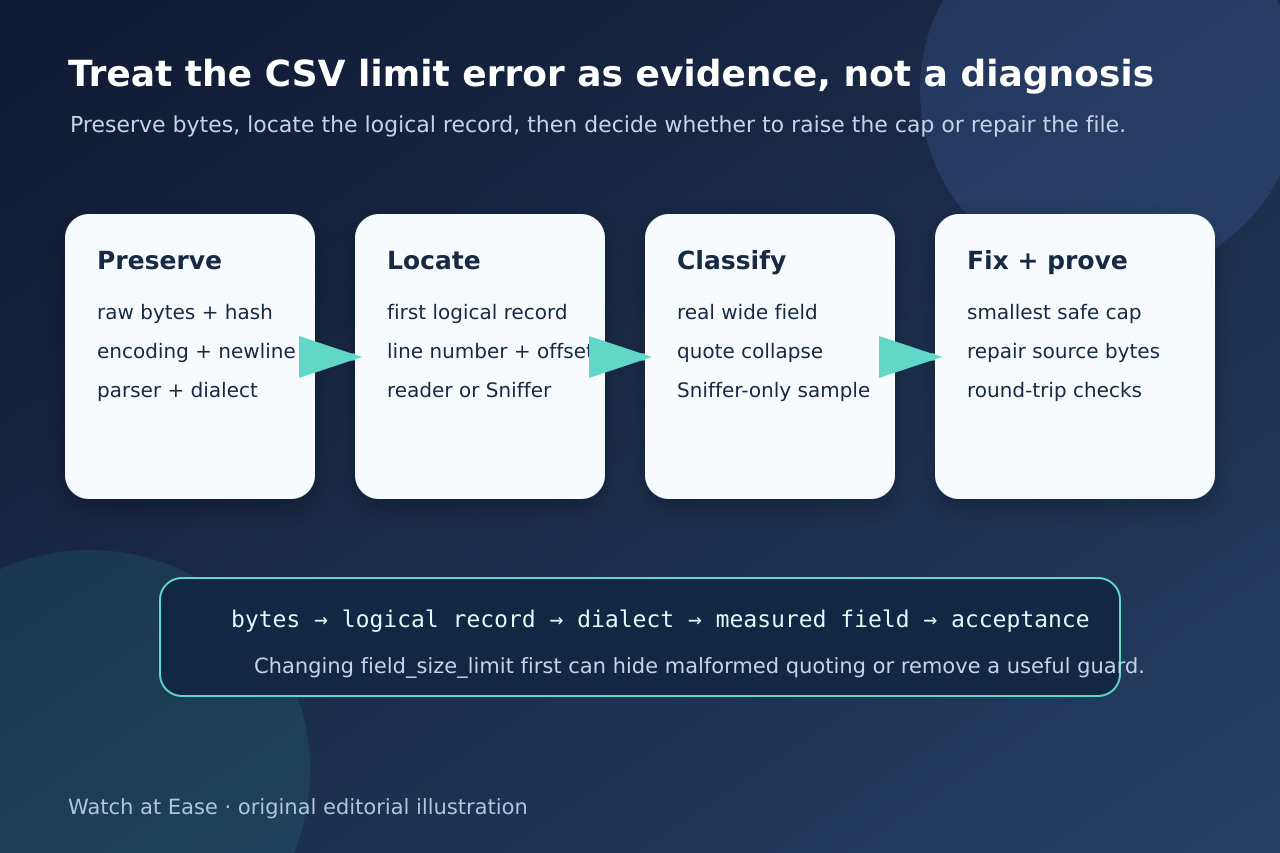
Preserve the bytes and parser contract, isolate detection from reading, locate the first failing logical record, choose the smallest cause-specific fix, and prove both data semantics and resource bounds.
1. Preserve the failing bytes and parser contract
Copy the exact input before opening it in a spreadsheet or normalizing line endings. Record a cryptographic hash, byte length, encoding decision, whether a BOM is present, and the exact csv module or pandas engine. Open text input with newline="" so the csv module receives the original newline structure.
Record delimiter, quotechar, doublequote, escapechar, quoting, strict mode and the current csv.field_size_limit() value. A field limit is process-wide module state, so save and later restore the previous value in tests and shared workers.
2. Reproduce the reader and Sniffer paths separately
If the application already knows the dialect, bypass csv.Sniffer and parse a small fixture with those explicit settings. Sniffer consumes a sample and can fail because the sample itself contains an oversized first field even when a known dialect is otherwise correct.
Run detection and reading as separate checks. Label the failure Sniffer-only only when explicit-dialect reading succeeds on the same preserved bytes. Do not treat a guessed delimiter as proof that the records are valid.
3. Locate the first failing logical record
Stream from a fresh file handle and track reader.line_num after every successful record. Save the previous successful logical record number and a bounded window of raw byte offsets around the next candidate; redact sensitive values rather than pasting the full field into logs.
A quoted field may legally contain commas and line breaks. Therefore a physical line number is not necessarily a CSV record number. Check whether quotes close according to the configured dialect and whether column counts suddenly drift across what should be later records.
4. Classify width, quote collapse, or a detection boundary
A genuine wide field has balanced framing, stable record structure and a value whose measured byte or character size matches the source contract. Raise the limit only to a reviewed ceiling above that observed maximum, with headroom justified by the producer schema and memory budget.
If an open quote causes later rows to merge, fix or reject the source record; increasing the cap merely lets corruption consume more memory. If only Sniffer fails, supply the known dialect or choose a bounded sample that starts at a complete record instead of changing every reader.
5. Handle platform bounds and prove the repair
field_size_limit accepts a Python integer but the C implementation converts it to a platform C long. If a large candidate overflows, reduce it until accepted; do not present sys.maxsize as a universal safe setting. Keep the chosen cap below the service memory policy and document why it is needed.
Acceptance must parse the preserved fixture and a malformed-quote fixture, keep expected row and column counts, match hashes for representative wide values, preserve embedded commas, quotes and newlines, restore the prior limit, and remain within measured memory. A successful parse alone is not enough if data silently shifted columns.