Technology · PRACTICAL GUIDE
Python says “Can’t pickle local object”? Prove the process boundary before changing serializers
The exception names the object Python could not reconstruct, not a platform-specific cure. Capture the start method, callable identity, argument graph and worker import path before moving code, forcing fork or swapping serializers.
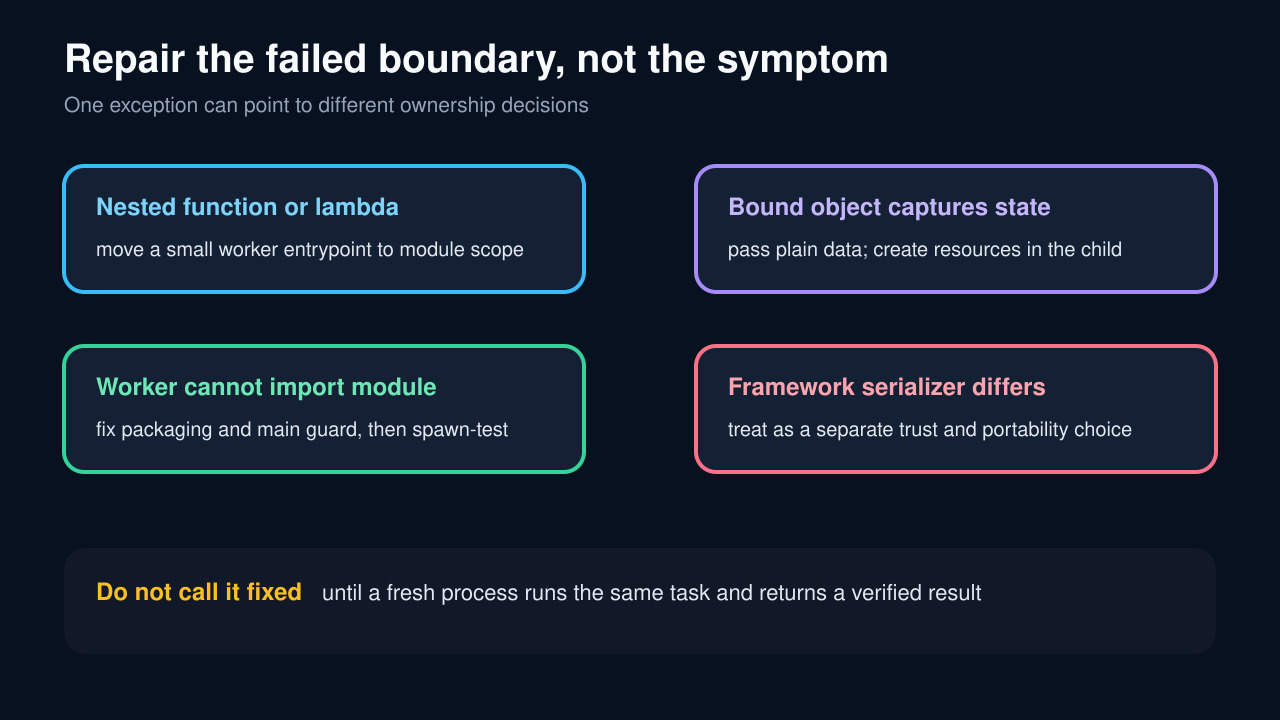
“Can’t pickle local object” means a process boundary could not serialize or later resolve one submitted object. The named object may be a nested function, lambda, bound method, closure, callback, dataset transform, lock, socket or an instance that captures one of them. The message does not prove that Windows is broken or that one serializer package is the right fix.
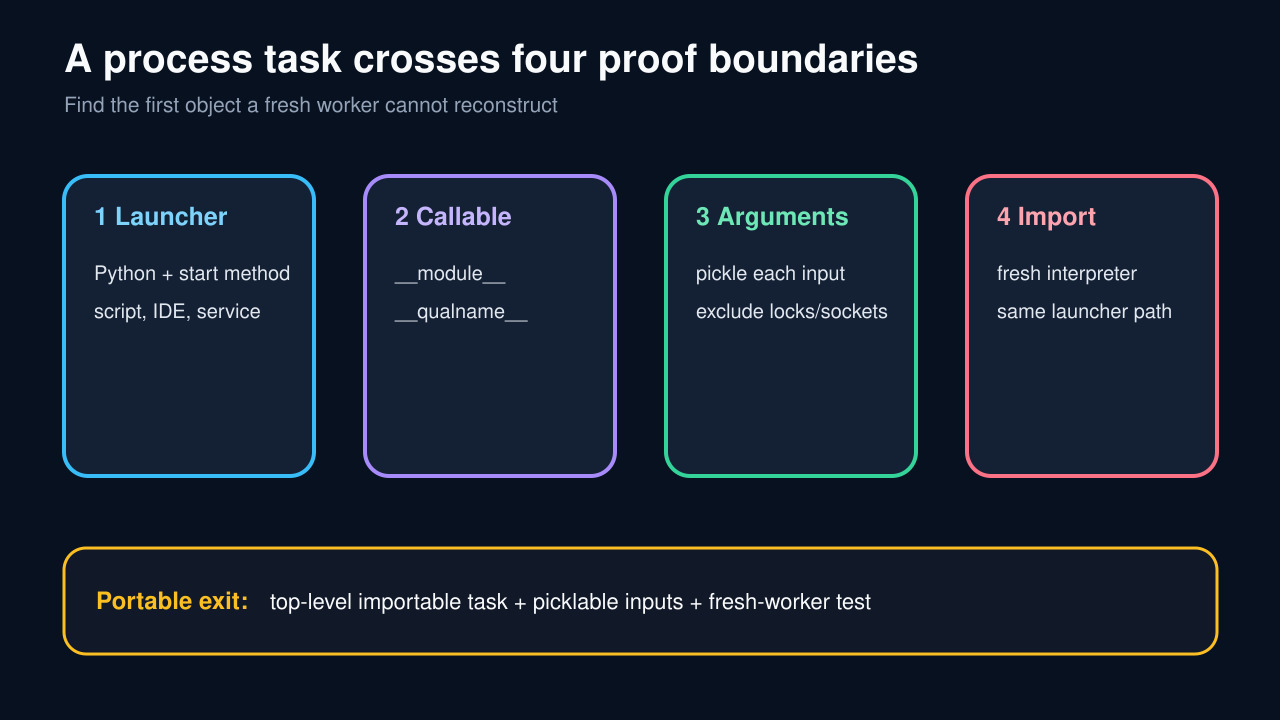
Build one evidence ledger from the production launcher. Record Python and library versions, start method, callable module and qualified name, every submitted argument type, and whether a fresh child can import and call the repaired entrypoint. Then change only the first failing boundary.
1. Freeze the real launcher and start method
Reproduce from the same script, test runner, notebook, IDE, service or framework that failed. Record `python -VV`, `sys.executable`, the multiprocessing context and `multiprocessing.get_start_method()`. A shell experiment using another interpreter or start method is not an equivalent control.
Keep the complete traceback. Identify whether failure occurs at `Process.start()`, `Pool.map()`, `submit()`, queue transfer, result return or framework worker startup. That location narrows what Python was trying to serialize.
2. Name the exact callable and object graph
For the submitted callable, record `type(fn)`, `fn.__module__` and `fn.__qualname__` when present. A qualified name containing `<locals>` or `<lambda>` is direct evidence that standard pickle cannot resolve it as an importable module attribute.
Test `pickle.dumps(fn)` and then each argument separately in a disposable diagnostic process. Do not log secrets or whole payloads. Record only the first failing type and safe structural path, such as `job.callback` or `dataset.transform`.
3. Prove importability in a fresh interpreter
Move the smallest worker entrypoint to module scope, keep process creation under `if __name__ == "__main__":`, and make the defining module installable or reachable through the production package path. Do not merely assign a nested function to a global variable: the worker still needs a stable importable definition.
Start a fresh interpreter with the same executable and working directory. Import the module and resolve the qualified name without relying on notebook state, a parent process mutation or an IDE-only path injection.
4. Separate captured resources from plain task data
A bound method can pull its entire instance into the pickle graph. Locks, open files, sockets, clients and live database connections should usually be created inside the child or replaced by small configuration values. Pass immutable identifiers and plain data rather than a parent-owned runtime object.
If the callable is importable but an argument fails, reduce the task to a minimal picklable record. Reconstruct expensive or stateful resources in a worker initializer or inside the worker, with explicit cleanup and error reporting.
5. Treat start-method and serializer changes as scoped decisions
Changing to `fork` may make one Linux test pass because the child inherits memory, but it does not prove a portable task contract and may be unsafe for threaded libraries. Record why the start method is required and test the supported platforms instead of using it as a universal escape hatch.
Cloudpickle, dill and framework serializers can handle more Python objects, but they change dependencies, compatibility and deserialization trust. Adopt one only when the application contract requires dynamic objects, the receiver is trusted and the exact production framework supports it.
6. Require a fresh-worker exit test
Run one small deterministic task through the same production launcher and start method. Verify that the worker starts, imports the module, receives the intended plain inputs, returns the expected value and exits cleanly. Then test one representative failure path so exceptions remain visible.
The exit record should include interpreter, start method, callable qualified name, input schema, worker PID, result checksum or expected value, and clean shutdown. A successful `pickle.dumps()` in the parent alone is not completion.