Technology · PRACTICAL GUIDE
Python BrokenPipeError? Prove the reader close, flush point and exit contract
Diagnose an early-closing pipeline consumer, buffering and interpreter shutdown before suppressing the traceback or changing SIGPIPE behavior.
A Python BrokenPipeError in a pipeline usually means the downstream reader stopped before the producer finished writing. The hard part is proving where the close occurred and preventing a second failure during interpreter shutdown.
This audit separates kernel pipe semantics, Python buffering, explicit flushes and command-line exit policy so an expected head-style cutoff can be quiet without hiding unrelated I/O faults.
Freeze the pipeline and component statuses
Copy the complete command, traceback, stderr and shell before changing signal handling. Record whether stdout is a terminal, file, pipe or socket, and capture every pipeline component's status. In Bash, inspect PIPESTATUS immediately after the exact reproduction; with pipefail enabled, also record the combined result. A successful head process does not prove the producer completed.
Reduce the command to the smallest producer and early-closing consumer that preserves the failure. Compare a full consumer such as cat with head -n 1. If the producer succeeds when all output is consumed and fails only after the reader exits, the evidence points to a closed downstream pipe rather than malformed output or an arbitrary Python crash.
Prove where the reader closes and the writer flushes
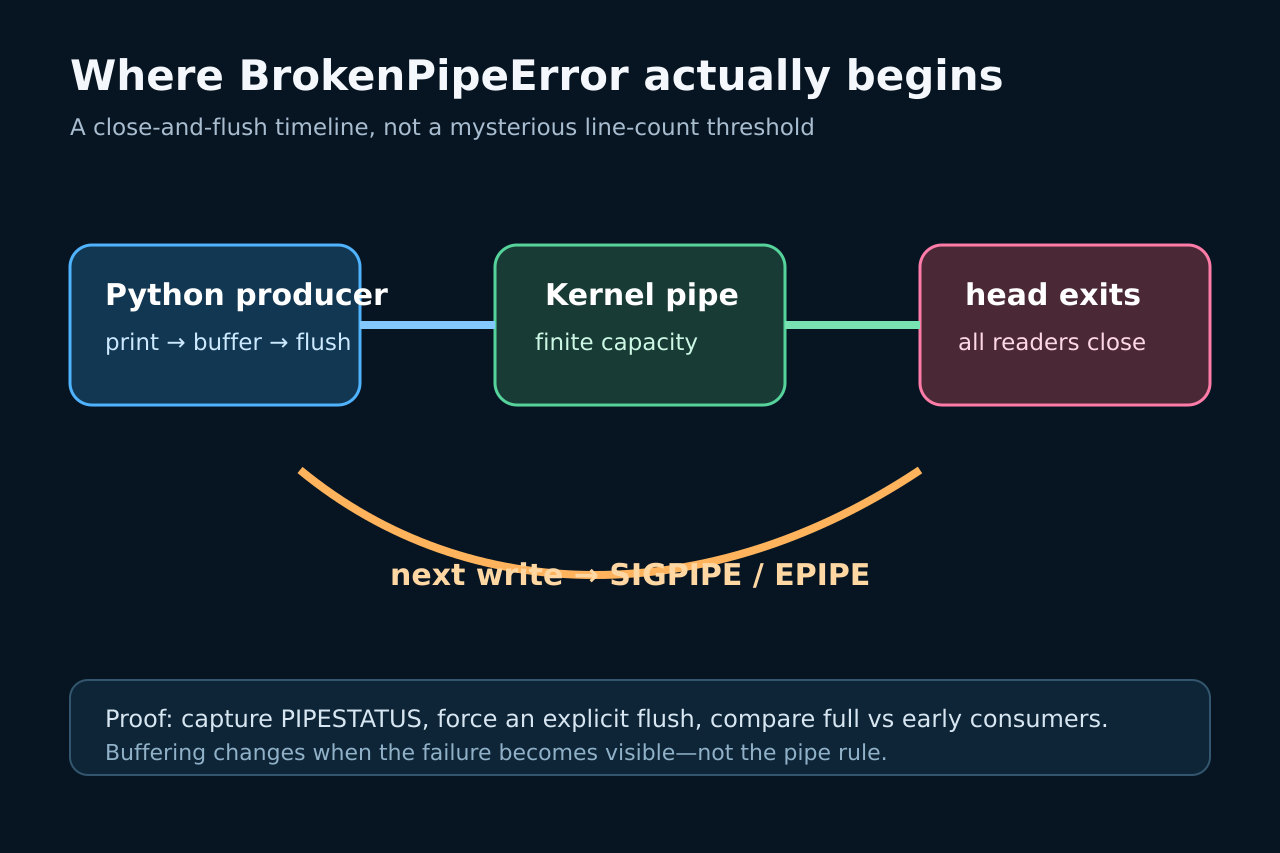
A pipe has separate read and write ends. Linux pipe documentation says that when every file descriptor referring to the read end has closed, a write generates SIGPIPE; if that signal is ignored, the write fails with EPIPE. Python normally converts this situation into BrokenPipeError so an application can clean up.
Make the write boundary visible. Put sys.stdout.flush() inside the same try block as output generation, then test with a consumer that closes early. Buffered text may delay the actual write until the buffer fills, an explicit flush runs, or the interpreter shuts down. The reported line can therefore be later than the code that produced the text.
Treat intermittent reproduction as scheduling and buffering evidence
Do not infer that a smaller output is safe because one run produced no traceback. The producer and consumer are scheduled independently, and the pipe has finite capacity. The producer may finish and flush before head closes, or it may write after the close. Python also changes stdout buffering when output is redirected away from a terminal.
Test several output sizes and repeat each case. Add an explicit final flush and, only for diagnosis, compare normal buffering with unbuffered mode or line flushing. Record the consumer limit, producer byte count and component statuses. Locate the close-and-flush race rather than searching for a magic safe number of lines.
Handle BrokenPipeError without a second shutdown traceback
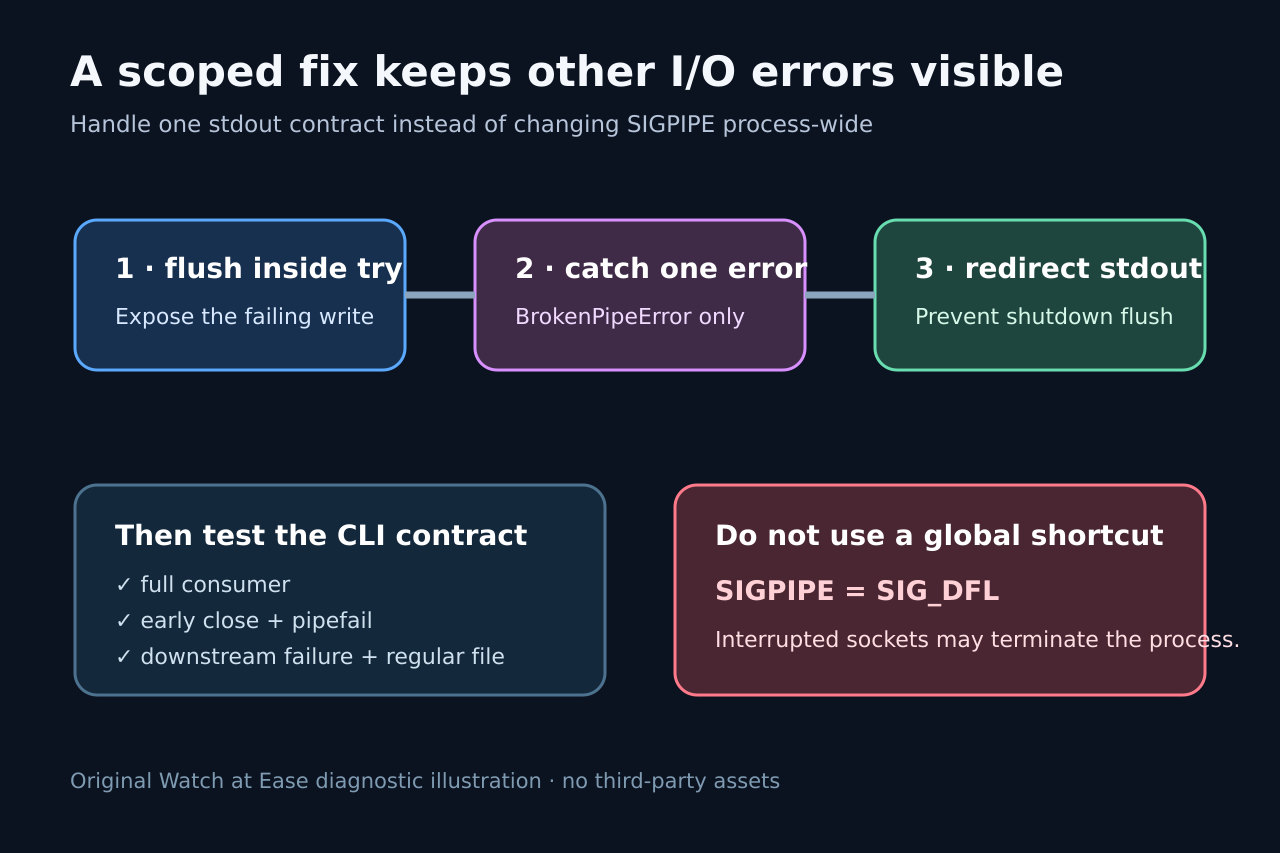
For a command-line producer that intentionally supports early-closing consumers, wrap output and an explicit sys.stdout.flush() in try. On BrokenPipeError, redirect the stdout file descriptor to the null device before exiting. Python's signal documentation gives this pattern because simply catching the first exception can leave the automatic shutdown flush pointed at the closed pipe.
Keep stderr separate from stdout so a genuine diagnostic is not written into the broken data channel. Do not catch OSError broadly unless the program can classify other I/O failures. A socket reset, disk error and closed shell pipeline do not share the same recovery contract even when they arrive through neighboring APIs.
Choose and test the command-line exit contract
Decide whether an early consumer close is normal completion for this CLI or a reportable failure. Filters designed for pipelines often suppress the traceback, but automation may still need a nonzero producer status. Document the choice and test it with the shell features users employ, including pipefail and component-status inspection.
Use a small matrix: complete consumer, head-style early close, downstream process that exits with its own error, and stdout redirected to a regular file. Assert stdout, stderr and each status separately. This prevents a cosmetic fix from hiding a real downstream failure or changing scripts that relied on the previous exit code.
Do not apply a global SIGPIPE default as a universal fix
Python's official documentation explicitly warns against setting SIGPIPE to SIG_DFL merely to silence a pipeline traceback. That global disposition can make the process terminate unexpectedly when a socket connection is interrupted. A local stdout handler preserves Python's exception model for other writes and makes the intended behavior reviewable.
If a framework already owns signal policy, trace that policy before changing it. Verify the final implementation with a local pipe and, where the program also writes to sockets, a controlled interrupted-socket test. Success means an expected early reader close is quiet under the documented contract while unrelated I/O errors remain observable.
Keep the evidence and rollback path
Save the minimal reproducer, Python version, operating system, shell, buffering mode and status matrix with the change. Record whether the fix is scoped to one CLI entry point or shared library code. Library functions should normally propagate BrokenPipeError unless their public API promises otherwise.
Rollback is simple when the change is local: remove the catch-and-redirect block and restore the previous exit semantics. Re-run the same matrix after upgrades because interpreter shutdown behavior, wrapper frameworks and shell settings can change the visible result even though the underlying pipe rule remains the same.