Travel/Public Service · PRACTICAL GUIDE
Can You Take a Power Bank on a Plane? U.S. Carry-On and Wh Rules
For U.S. passenger flights, a power bank is a carry-on-only lithium battery. Start with its watt-hour rating, not its charging-speed watts; the FAA generally allows up to 100 Wh, puts 101–160 Wh behind airline approval, and bars more than 160 Wh, while airlines can impose stricter rules.
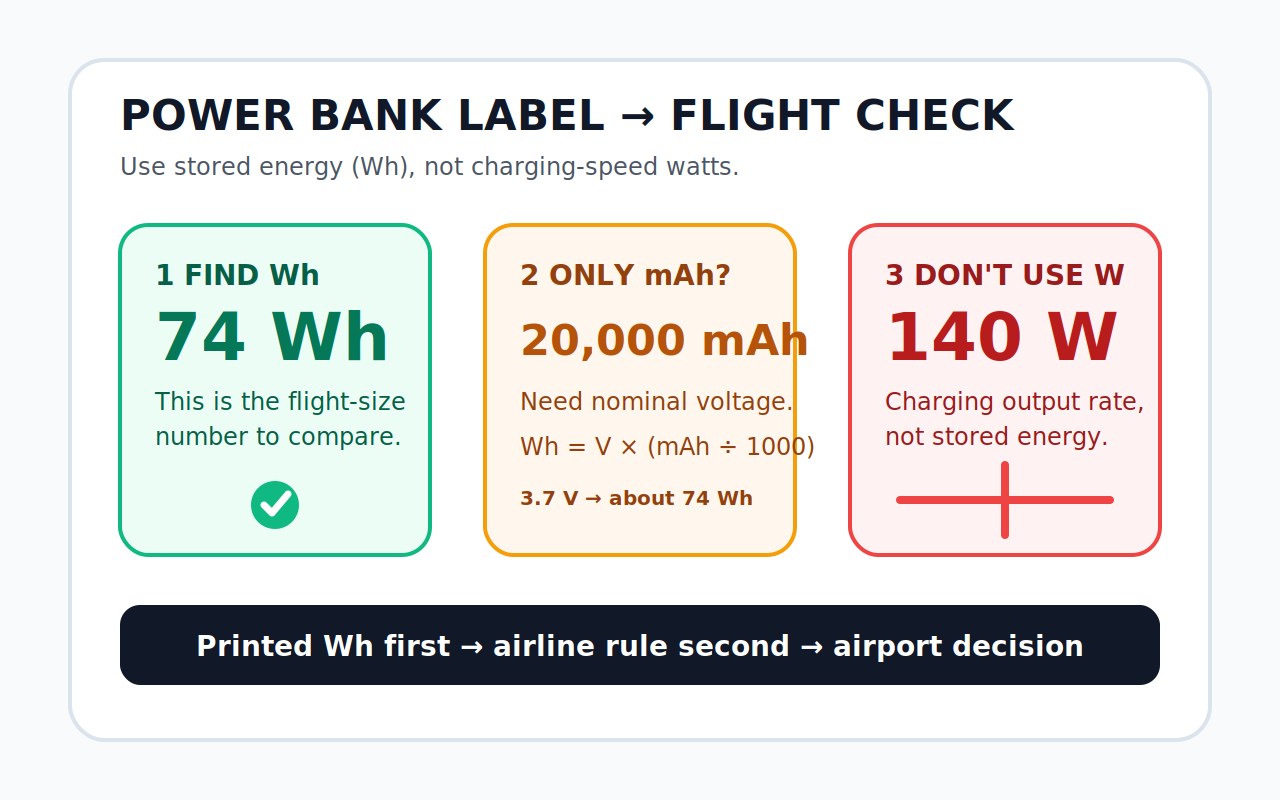
The first number to find on a power bank is its energy capacity in watt-hours (Wh). Do not confuse that with a headline such as “65W” or “140W,” which normally describes charging power, not how much energy the battery stores. The FAA says lithium-ion limits are based on Wh and gives the formula Wh = volts × amp-hours. If the bank shows mAh, divide by 1,000 to get Ah and multiply by the battery’s nominal voltage.
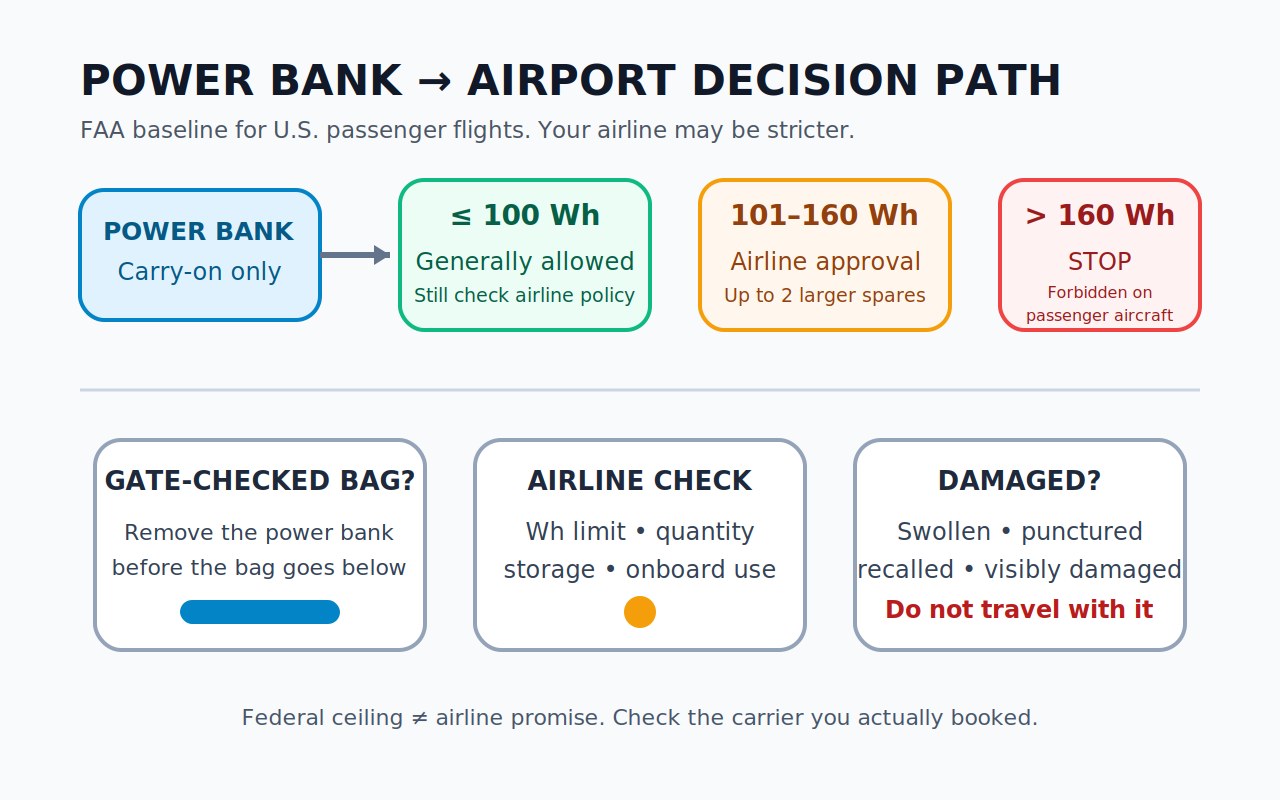
Then separate the federal baseline from the policy of the airline you actually booked. Under the FAA’s current U.S. passenger guidance, power banks are spare lithium batteries: they stay in carry-on baggage, 0–100 Wh is generally allowed, 101–160 Wh requires air-carrier approval and is limited to two larger spares, and more than 160 Wh is forbidden on passenger aircraft. The FAA also warns that airlines may set stricter quantity or Wh limits.
1. Read the power bank’s Wh rating before the big W or mAh number
Look first for a printed Wh rating on the battery case or product documentation. FAA guidance says lithium-ion batteries should be evaluated by watt-hours and gives the calculation Wh = V × Ah. If capacity is shown as milliamp-hours, convert mAh to Ah by dividing by 1,000, then multiply by the battery’s nominal voltage.
Do not substitute the USB output voltage or a charging-speed label such as 65W, 100W, or 140W. Watts describe a rate of power; watt-hours describe stored energy. If the Wh value is not printed and the nominal battery voltage is unclear, use the manufacturer’s documentation or ask the airline rather than guessing from the largest number on the box.
2. Apply the current U.S. baseline: 100 Wh, 160 Wh, then stop
The FAA’s August 10, 2026 passenger-battery FAQ says rechargeable lithium batteries from 0–100 Wh are allowed on passenger aircraft. Batteries from 101–160 Wh require approval from the air carrier. Batteries above 160 Wh are forbidden on passenger aircraft.
For power banks specifically, the same FAA page says they are spare lithium batteries and must be carried on, not checked. Larger 101–160 Wh spares are limited to two per person when the carrier approves them. Do not treat “under 160 Wh” as automatic permission: the approval branch starts above 100 Wh, and the airline can decline or set a lower limit.
3. If your carry-on is gate-checked, remove the power bank first
A power bank should not follow a gate-checked carry-on into the cargo hold. FAA and IATA passenger guidance both tell travelers to remove spare lithium batteries or power banks when a cabin bag is taken at the gate for loading below.
Protect the bank from short circuits and physical damage. Keep terminals or exposed contacts isolated, use the original packaging or a protective pouch when practical, and do not travel with a swollen, punctured, damaged, or recalled battery.
4. Check your airline because the federal ceiling is not a promise
FAA guidance explicitly says domestic and international airlines may impose stricter Wh and quantity limits. IATA’s traveler material likewise says local regulation and airline safety policies can differ, so the airline you booked is part of the answer—not an optional last-minute check.
Delta’s current battery page illustrates that difference: it publishes additional restrictions for power banks, including a two-bank limit, accessibility requirements and onboard-use restrictions. Treat those as Delta rules, not as a universal U.S. rule. For another carrier, open that carrier’s dangerous-goods or restricted-items page and check the same three things: Wh ceiling, quantity, and onboard storage/use.
5. Use mAh examples only after you know the nominal voltage
At a nominal 3.7 V, a 20,000 mAh bank calculates to about 74 Wh; 27,000 mAh is about 99.9 Wh; 30,000 mAh is about 111 Wh; and 45,000 mAh is about 166.5 Wh. Those examples show why mAh alone cannot define the flight category: the calculation also needs voltage.
For a 30,000 mAh / 3.7 V bank, the FAA baseline would put roughly 111 Wh in the 101–160 Wh approval range, but a stricter airline may still refuse it. A roughly 166.5 Wh bank is above the FAA’s 160 Wh passenger-aircraft ceiling. Use the actual printed Wh rating whenever available, and confirm the booked airline before leaving for the airport.