Science · NEWS EXPLAINER
Perseverance takes the off-world driving record: what the mileage does and does not measure
NASA reports 45.22 kilometres driven as of October 11. The new total marks mobility and reach; it is not a speed ranking or proof that the rover has found life.
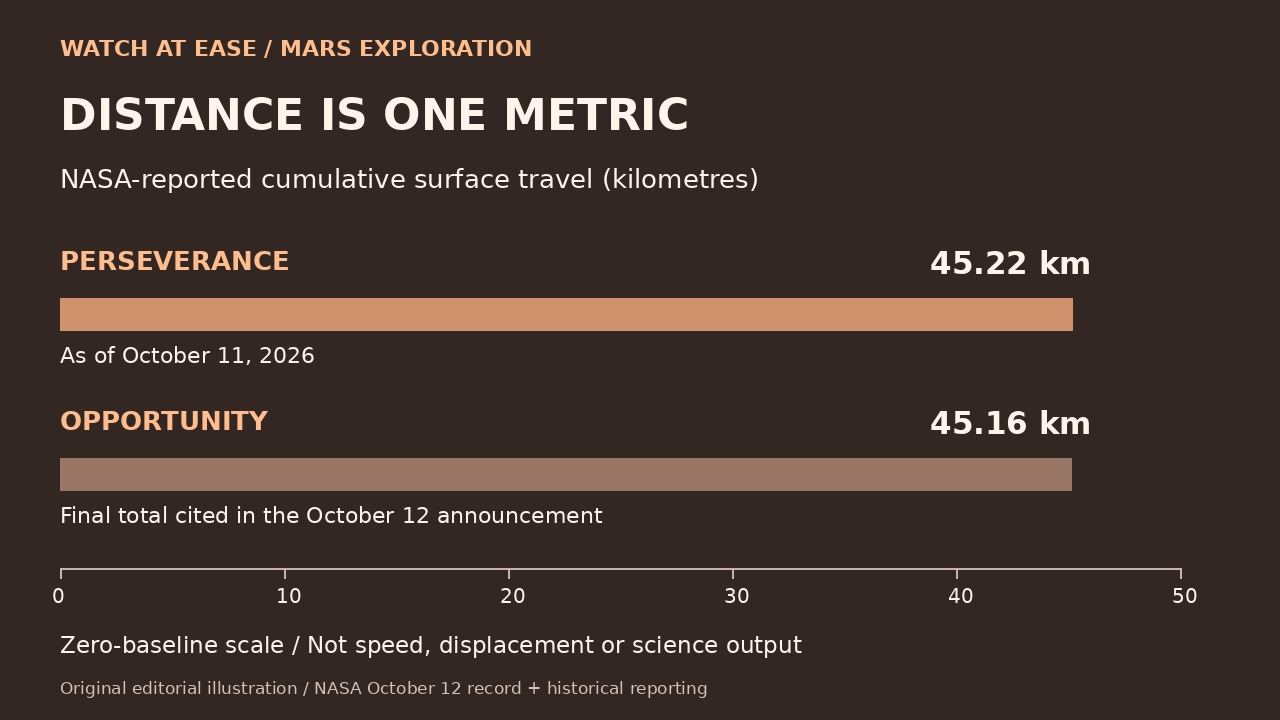
Perseverance has exceeded the off-world driving-distance record previously held by Opportunity, NASA announced on October 12. The agency puts the newer Mars rover’s cumulative distance at 45.22 kilometres, or 28.10 miles, as of October 11, compared with Opportunity’s 45.16 kilometres, or 28.06 miles.
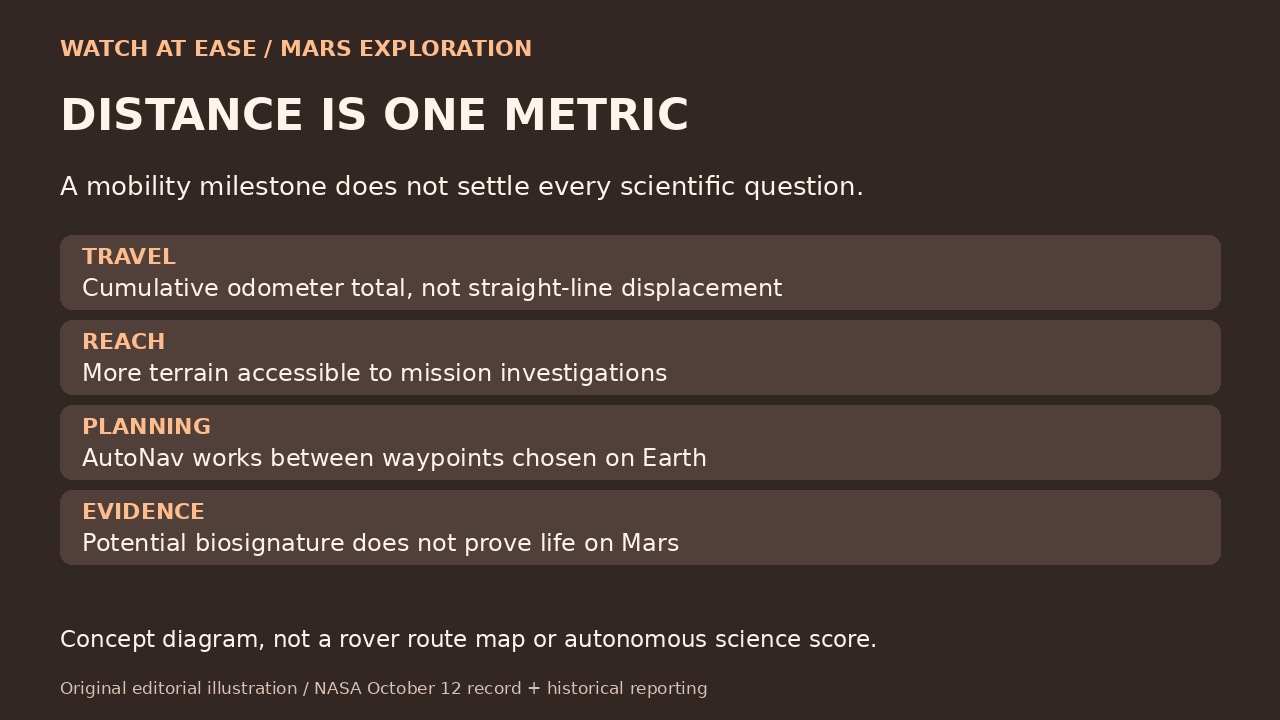
The useful achievement is sustained access to more terrain, not a race around an identical course. The two missions operated in different places, with different scientific work and years of technology between them. A distance record says something important about mobility while leaving other questions unanswered.
Read the number as an odometer total
NASA says Perseverance passed the mark on the 2,006th Martian day, or sol, of its mission. Its announcement describes roughly five and a half years of driving, compared with almost 15 years for Opportunity to accumulate its distance. That is mission history, not a controlled head-to-head speed test.
The kilometre and mile figures are rounded presentations of the reported totals. Do not turn their small difference into a claim about exact separation between the rovers: they are in different locations. Nor should an odometer total be mistaken for a straight-line displacement from the landing site or the distance covered in one drive.
Autonomy extends reach, with people still setting goals
The agency attributes much of Perseverance’s progress to AutoNav. It describes a rover that images terrain while moving, builds a three-dimensional hazard map and chooses a course between waypoints selected by planners on Earth. This combines onboard navigation with human mission planning; it does not remove the team from the process.
NASA reports that more than 90 percent of Perseverance’s accumulated distance used AutoNav to evaluate terrain. That share describes how the distance was driven, not how many scientific conclusions were made autonomously. The announcement also identifies sunlight glare as a remaining navigation limitation discussed by the operations team, so the record should not be read as unlimited driving capability.
The earlier record shows why measurement matters
An independent 2014 Planetary Society report by A.J.S. Rayl documented the work behind Opportunity’s earlier record, including original interviews with the mission team. Its account describes checking odometry, mapped routes and revised lunar-rover distances before announcing a comparison. It is historical reporting, not an independent measurement of Perseverance’s new 2026 total.
That history is a useful reason to keep the metric and source date visible. In the new announcement, NASA compares cumulative surface travel across missions; it is not ranking terrain difficulty, fastest single drive or scientific output. Our comparison graphic therefore retains the full reported totals and dates rather than using a truncated scale to exaggerate a narrow numerical lead.
More terrain is access to science, not a finished answer
The record came as Perseverance travelled through Lac de Charmes toward Idubi near Jezero Crater’s western rim. NASA says the team hopes to find traces of ancient hydrothermal systems there, and describes an extension of exploration through roughly the end of 2028. These identify a scientific direction and mission plan, not an already completed discovery or a guaranteed operating lifetime.
The announcement mentions a potential biosignature at Cheyava Falls and 29 collected rock and regolith samples. “Potential” is essential: the distance milestone does not establish that life existed on Mars. Follow the observations, analysis and stated uncertainty of each scientific result separately from the odometer. Greater mobility can bring more sites within reach without settling what every rock means.