Travel/Public Service · PRACTICAL GUIDE
Passport Validity for Travel: Check Six-Month and Transit Rules
There is no universal six-month rule: verify the destination buffer and anchor date, any passport-age limit, every transit point, and the airline document check before non-refundable payment.
A passport with less than six months remaining is not automatically unusable for international travel. There is no single worldwide six-month rule: the requirement depends on the destination, your nationality, the dates used by that rule, the age of the passport in some systems, and any transit points on the itinerary.
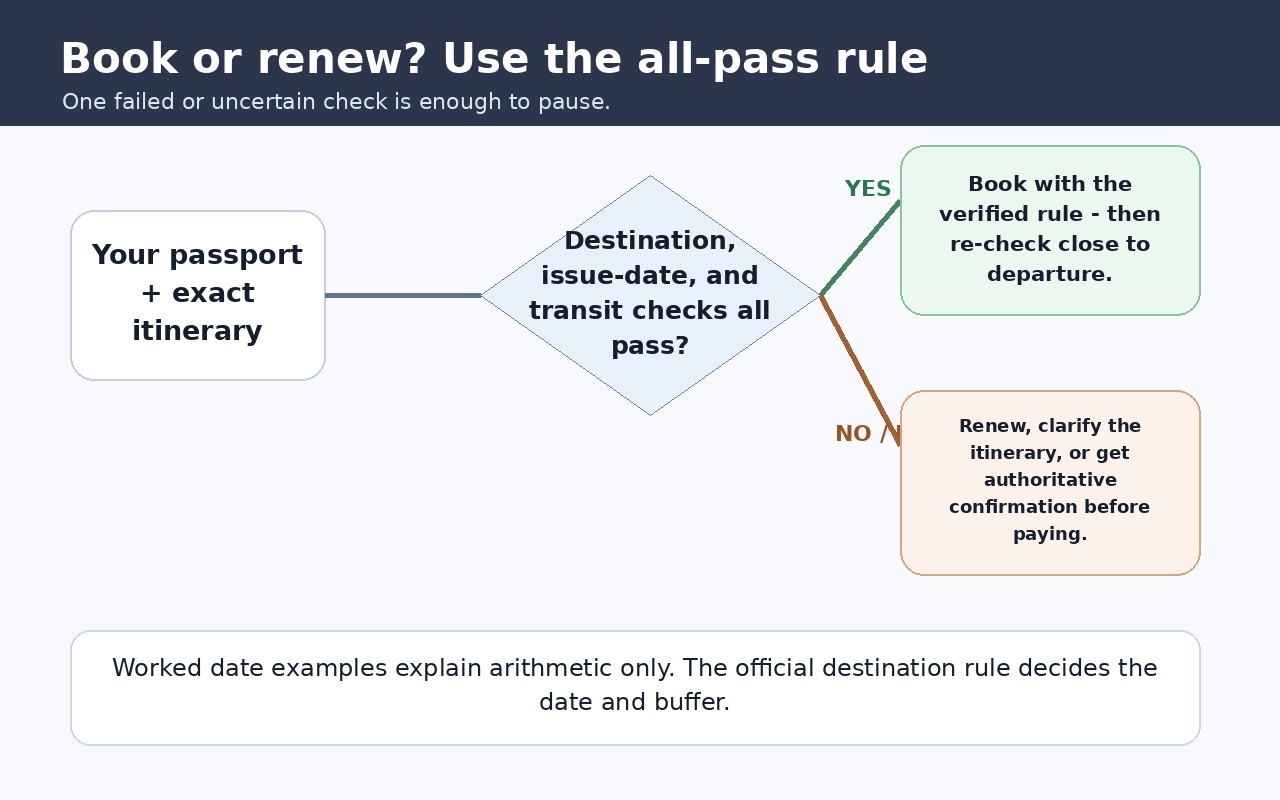
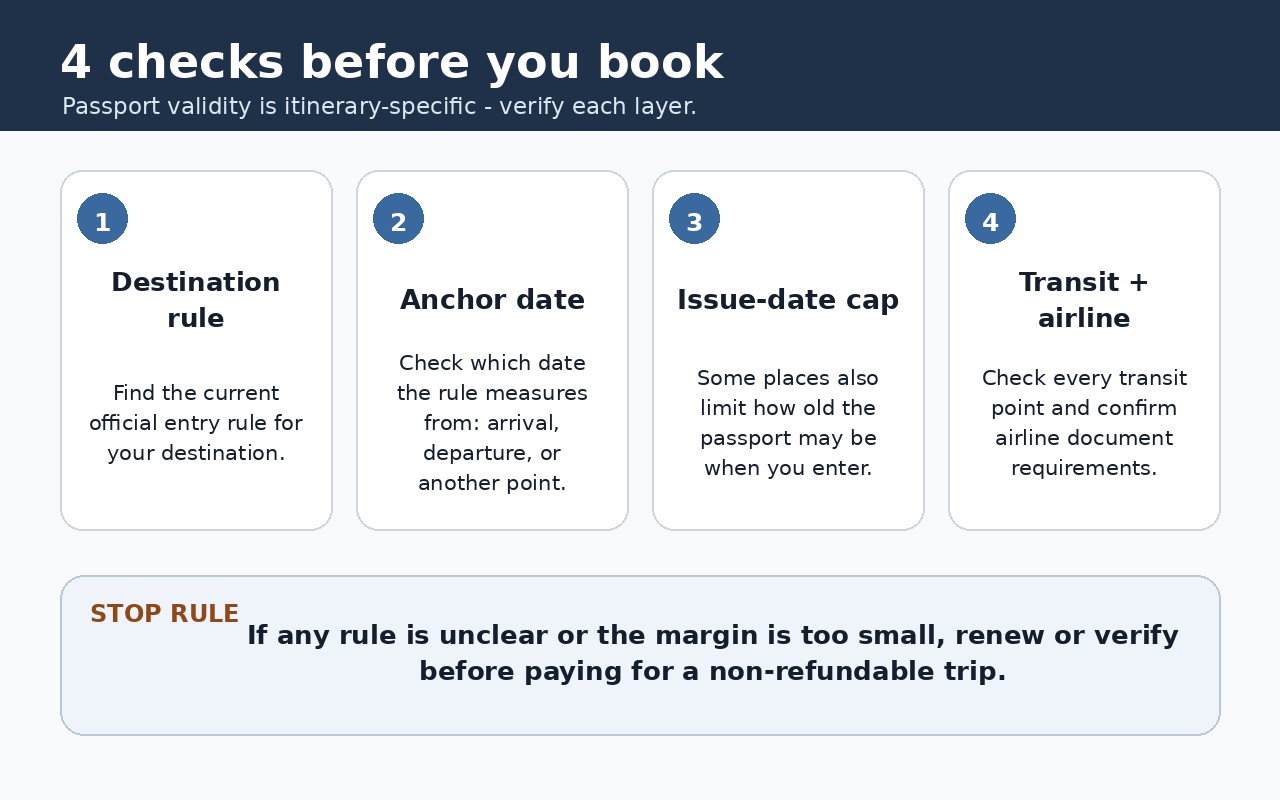
Before paying for a non-refundable trip, run four separate checks: the destination validity rule, the rule's anchor date, any issue-date or passport-age limit, and every transit or airline document requirement. If any one is unclear or leaves too little margin, renew or obtain authoritative confirmation before you book.
1. Start with the destination rule — and find its anchor date
Open the official immigration, border, embassy, or foreign-ministry guidance for the exact destination and your nationality. Do not assume “six months” applies everywhere. The State Department tells U.S. travelers that some countries require extra passport validity while others do not, and Canada likewise says there is no single answer because each country sets its own entry requirements.
Then identify the date the rule is measured from. A requirement may be stated relative to arrival, departure, the end of the authorized stay, or another defined point. Use the wording in the current official rule; a calculator is useful only after you know the correct anchor date.
2. Check passport age as well as expiry — Schengen can require both
Expiry date is not always the only test. For a typical short stay by a non-EU national, EU guidance says the travel document should be valid for at least three months after the intended date of departure from the Schengen area and should have been issued within the previous 10 years.
Treat those as separate checks. A passport can have enough time left before expiry but still fail an issue-date rule, or it can satisfy the issue-date rule but expire too soon. Use the current official rule for the specific trip rather than copying the Schengen example to another destination.
3. Check every transit point, not only the final destination
A connection can add its own document requirements, especially when you pass border control, change airports, leave the international transit area, or need a transit visa. Build the check from the entire booked route, not only the country printed in the trip title.
Use the transit-country authority where available and cross-check the complete itinerary in IATA Travel Centre. IATA provides personalized passport, visa, and health requirements and recommends re-checking because rules can change. A carrier check does not replace the destination government rule; it is a second itinerary-level verification.
4. Do a pre-payment itinerary audit before non-refundable booking
Write down the passport number only where a secure booking or official tool actually needs it, but keep the issue date, expiry date, nationality, destination, every transit country, and exact travel dates together. For each stop, record the official source, the rule, and the date the rule measures from. Then make sure the airline or IATA document check agrees with the route you plan to buy.
If the sources conflict, one rule is unclear, or your passport sits close to the minimum, stop before paying a fare that is difficult to change. Contact the destination authority or carrier with the exact itinerary. The goal is not to “win” a date calculation; it is to remove a document risk before money is committed.
5. Use worked dates for arithmetic, then decide whether to renew
Example only: if an official rule says the passport must remain valid for six calendar months after a stated departure date, add six calendar months to that specific departure date and compare the result with your passport expiry. If the rule instead uses arrival or another date, the calculation changes. For Schengen, separately test the three-month-after-departure requirement and the 10-year issue-date condition.
Proceed only when every applicable check passes with a comfortable margin and the itinerary is unchanged. If any requirement fails or remains uncertain, renew or obtain authoritative confirmation first. Re-check the official requirements near departure, because a valid answer at booking time is not a promise that rules will never change.