Travel · NEWS EXPLAINER
Oxford Street goes traffic-free: route, buses, deliveries and access explained
Nearly one kilometre between Orchard Street and Great Portland Street is now free of through traffic. Here is what changes for buses, taxis, bikes, deliveries, crossings and disabled visitors.
Oxford Street became traffic-free between Orchard Street and Great Portland Street on October 26, removing through buses, cars, taxis, private-hire vehicles, cycles, scooters and pedicabs from nearly one kilometre.
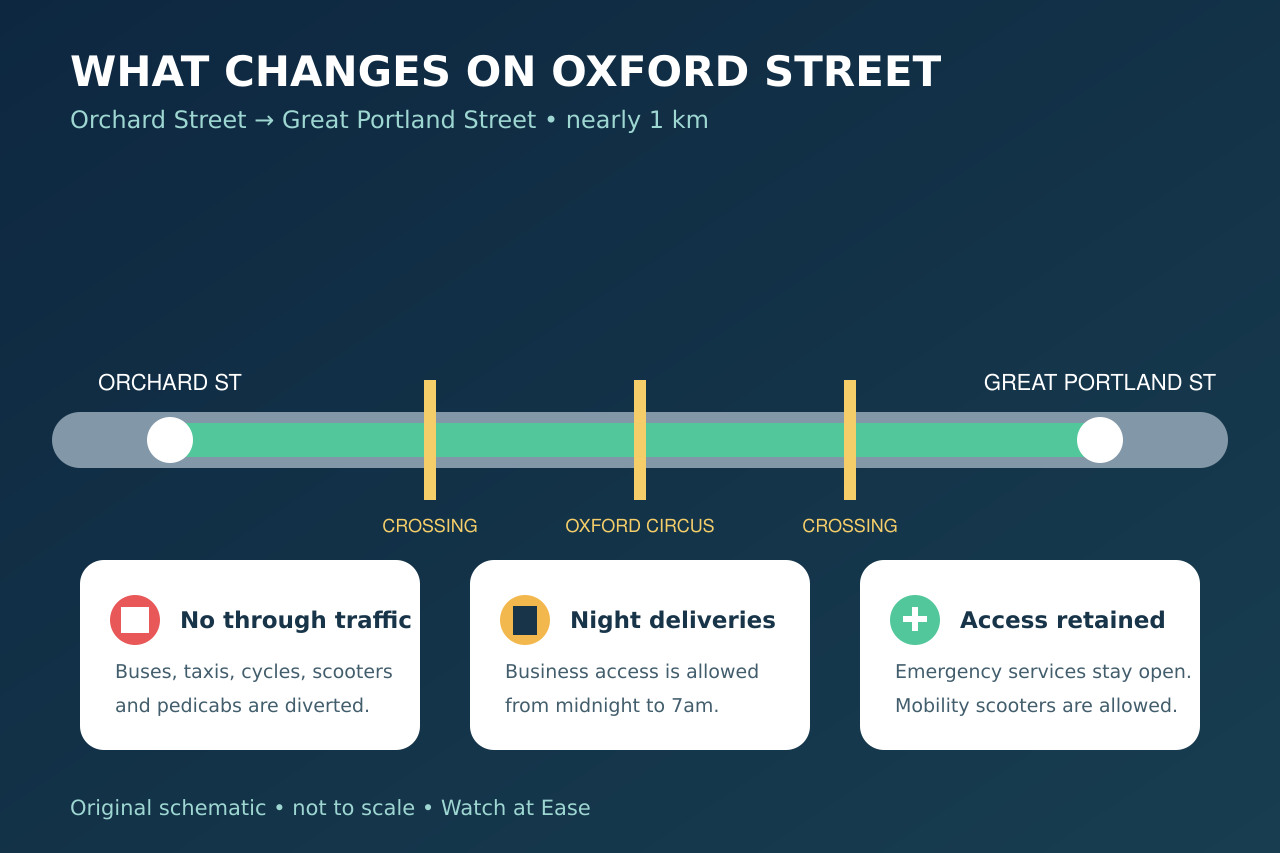
The street remains crossed by several north-south routes, emergency access stays open, mobility scooters are allowed and retailers can receive deliveries from midnight to 7am. The current layout is transitional, with trees, seating and two public squares planned for 2027.
Where the traffic-free section begins and ends
The change covers Oxford Street from Orchard Street near Marble Arch to Great Portland Street east of Oxford Circus. Vehicles cannot travel along the section, but north-south crossings such as Duke Street, New Bond Street, Regent Street and others continue to operate.
How buses, taxis and bikes are affected
Buses and taxis no longer run along the closed section. Routes including 7, 98 and 390 move to Wigmore Street, while replacement stops are on nearby streets. Taxi ranks remain close by. Cycles, e-bikes, e-scooters and pedicabs are not permitted through the pedestrian zone.
When shops can receive deliveries
Retailers and other businesses can use designated access routes from midnight to 7am. That overnight window supports servicing without restoring through traffic. Emergency services can enter at any time.
What disabled visitors should know
Mobility scooters are permitted. Step-free Elizabeth line entrances at Bond Street and Tottenham Court Road provide two accessible rail approaches. The transitional design is being monitored with feedback from residents, businesses and accessibility groups before permanent works are fixed.
What is temporary and what comes next
The launch is the first phase, with minimal construction before Christmas. By spring 2027, the programme calls for more than 50 trees, over 100 seats, two public squares, rest areas, better signs and new lighting. Those improvements are planned rather than already complete.