Tech · NEWS EXPLAINER
Google TPUs are planned for Oracle Cloud in 2027: what is confirmed and still missing
Oracle and Google announced a multiyear TPU rollout on OCI. A calendar-year target does not yet give customers a launch day, regional capacity or a price list.
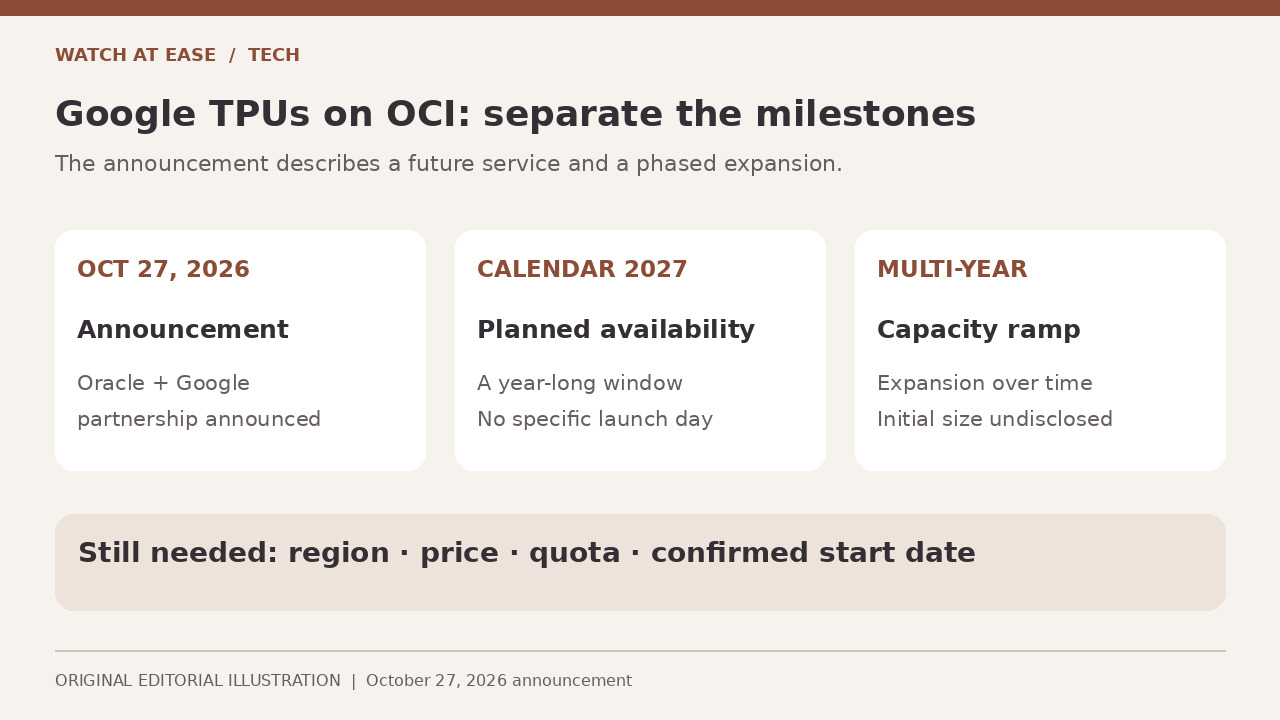
Oracle and Google announced on October 27 that Google Tensor Processing Units will come to Oracle Cloud Infrastructure in calendar 2027, with capacity expanding over multiple years. OCI will provide the power, cooling and data-center networking for the accelerators.
The companies describe OCI as the first hyperscaler outside Google to offer TPUs. That is a claim about a class of cloud provider, not proof of the first external TPU deployment of any kind. Data Center Dynamics notes a separate Google–Blackstone cloud project whose launch order remains relevant.
2027 is an availability window, not a dated launch
The official release specifies calendar 2027 and a multiyear ramp. It does not list a first available day, customer regions, prices or quotas. A team planning a production move still needs those service details before treating the announcement as capacity it can reserve.
In an original interview with Data Center Dynamics, OCI executive Karan Batta described a multiyear, multi-gigawatt partnership, while Oracle declined to give the initial deployment size. The scale describes an expansion plan over time; it does not establish how many chips a particular customer can obtain at launch.
Separate chip roles from the eventual service catalog
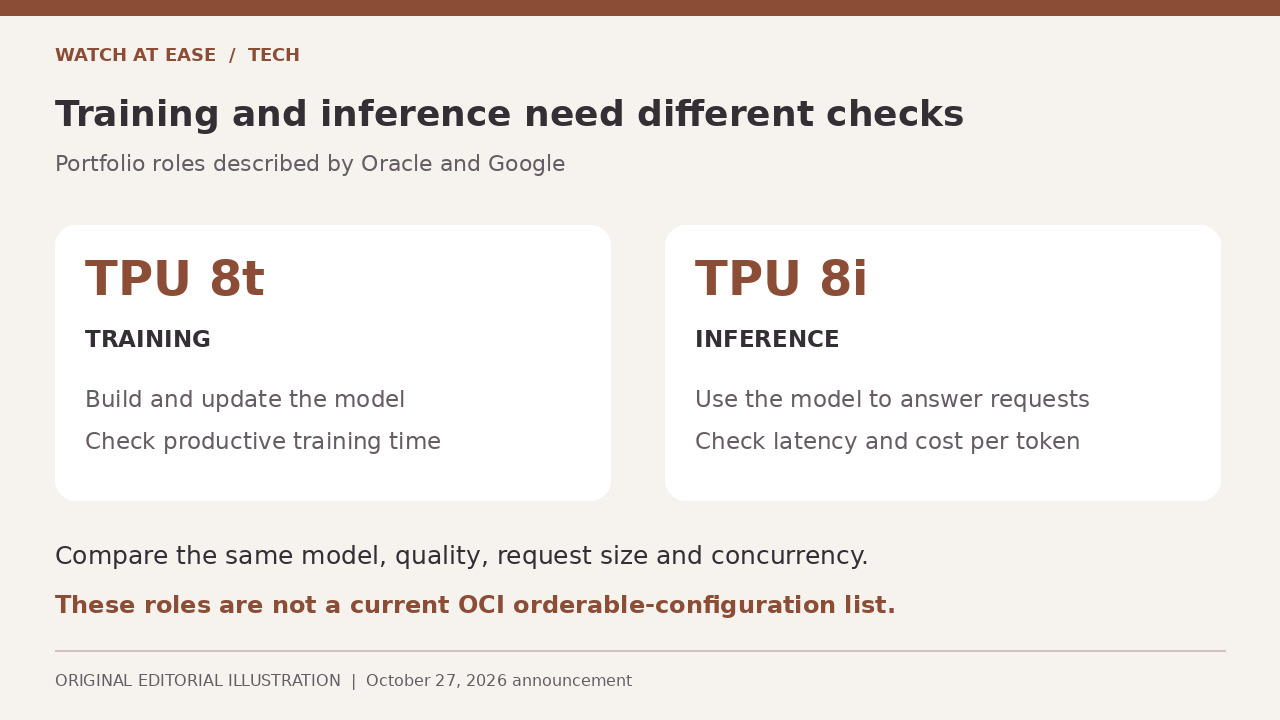
Oracle's release describes Google's eighth-generation portfolio as TPU 8t for training and TPU 8i for inference, the stage in which an AI model answers requests. Those roles help frame workload choices, but the announcement is not a region-by-region list of orderable configurations.
The joint engineering post discusses the open-source TorchTPU stack and familiar tools such as PyTorch and vLLM. These ecosystem statements are not a complete OCI support matrix. Check the exact model, framework version, operators and memory requirement against the eventual service documentation; this report has not tested a migration.
Compare the workload and the whole service
The joint post emphasizes productive training time and, for inference, latency and cost per token. A useful evaluation should keep the model, output quality, request size and concurrency comparable, then include data movement, storage and operational work. A chip's peak-compute number alone cannot settle the result.
Reuters reports that Oracle is also expanding Nvidia-based capacity and plans offerings from Cerebras and SambaNova. The TPU deal therefore broadens the announced hardware choices. Before committing, ask for a confirmed region and start date, usable quota, pricing, supported software and recovery commitments, then test the workload on the offered configuration.