Technology · NEWS EXPLAINER
Nvidia plans a minority Doctolib investment: what it means for control, data and AI products
The announced backing supports Doctolib’s AI work. It does not disclose a price, give Nvidia a board seat or make every planned patient and clinical assistant available today.
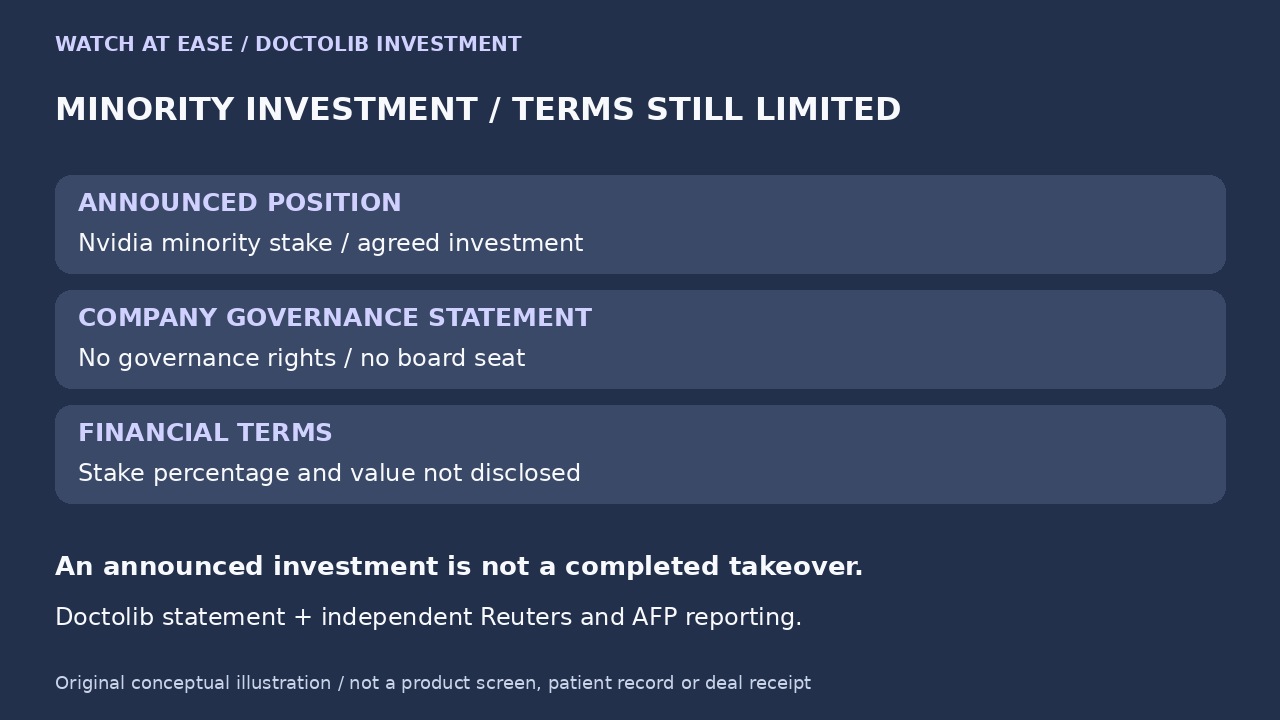
Nvidia has agreed to take a minority stake in Doctolib, the French healthcare technology company said on October 13. Doctolib presents the investment as support for its AI development, while Reuters reports that the stake size and financial value were not disclosed. The announcement is an investment plan, not a takeover or a blanket release of new products.
A minority investor, with the terms still incomplete
Doctolib’s official community announcement says Nvidia will hold a minority position without governance rights or a board seat. AFP separately interviewed Doctolib chief Stanislas Niox-Château and reported the absence of a board seat. That is a more specific description than simply saying the chipmaker bought the company.
Reuters also reported confirmation from Genesis AI, while citing newspaper reporting for Entalpic and Pigment. Those statements have different confirmation levels. This article focuses on Doctolib’s published terms rather than treating every company mentioned in the wider French investment story as having made the same announcement.
Data promises should remain attributed
Doctolib says health data will continue to be hosted in Europe and that partners and investors have no access to it. The company also says it develops and trains its own models while using open models in its European environments. These describe its announced commitments and architecture choices.
An equity announcement does not independently demonstrate implementation of every access control or establish the conditions for a particular patient’s data. Readers evaluating a service should distinguish the company’s stated policy from the applicable product documentation and consent information. The investment alone does not answer those separate questions.
Existing tools and future assistants are separate
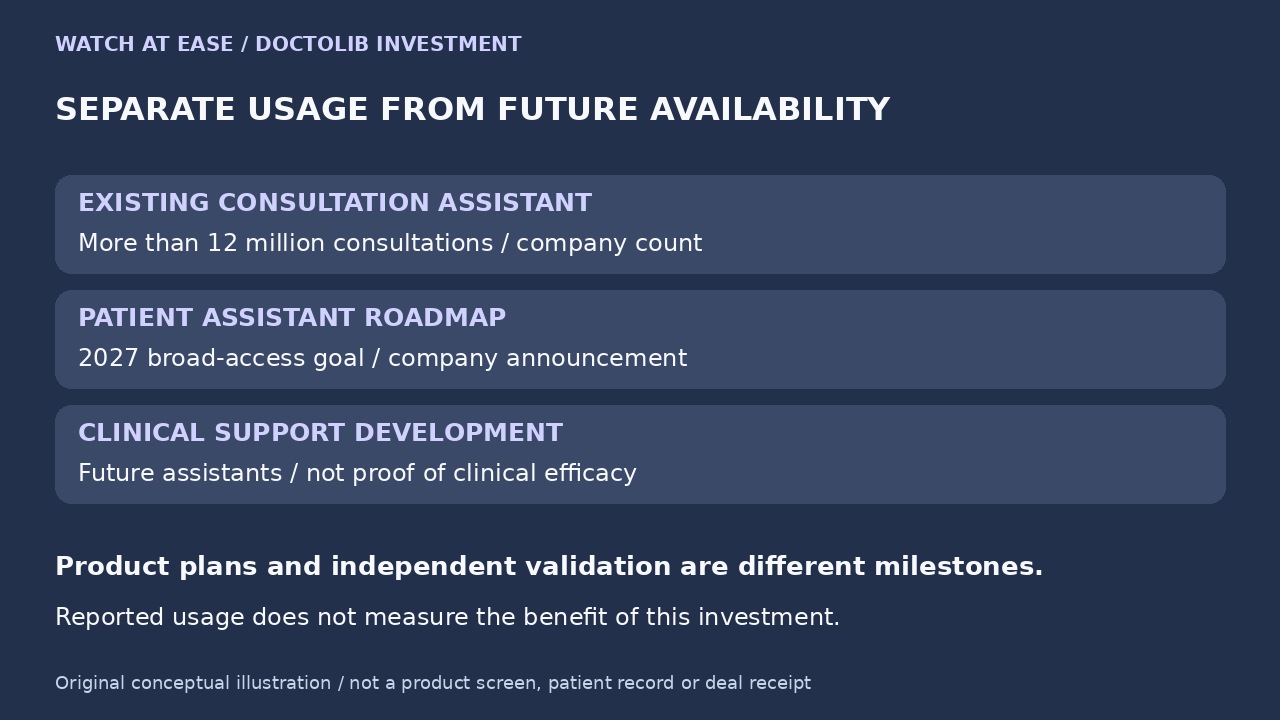
The company says its consultation assistant has documented more than 12 million consultations and already offers support for administrative work. That is a company-reported usage count, not a clinical-accuracy score, a patient-outcome study or an independently measured benefit from this investment.
Its community announcement describes clinical decision-support assistants as future development and gives 2027 as the intended broad availability for a personal patient assistant already used by 400,000 people in France. AFP quotes the chief executive describing clinical and administrative assistants as priorities for 2027/2028. The scopes differ; neither statement means every planned assistant is available everywhere today.
What the announcement actually changes
The new development is proposed financial and technical backing for an existing AI strategy. AFP reports that Doctolib intends to accelerate recruitment and development. Investment, hiring, product availability and demonstrated clinical performance are separate milestones; the announcement establishes the first plan rather than all later results.
For professionals and patients, the useful follow-up is the exact product and country covered, when access opens, which features remain in development and what data terms apply. No new price, universal access date or independent clinical validation for the future assistants is established by the reviewed investment material.