Technology · NEWS EXPLAINER
Nvidia’s $4,999 DGX Spark halves memory—what 64GB can run and when it ships
The 64GB DGX Spark keeps Nvidia’s GB10 platform but halves unified memory and starts at $4,999 on October 23. That price cut changes which models fit locally, while a two-system cluster begins near $9,998 before networking and accessories.

Nvidia says a 64GB DGX Spark will go on sale October 23 from six manufacturing partners with a $4,999 starting price. The cheaper desktop keeps the GB10 Grace Blackwell platform and Nvidia’s software stack, but its unified-memory pool is half the 128GB configuration, so model fit—not just compute throughput—is the central buying constraint.
The $4,999 model arrives October 23
Nvidia announced the 64GB DGX Spark on October 2 and says partner systems will be available October 23. The company lists Acer, ASUS, Dell Technologies, GIGABYTE, HP and Lenovo as launch partners. The $4,999 figure is a starting price, so a specific vendor configuration, storage option, taxes or support package may cost more. Hardware Busters and StorageReview independently reported the same date, capacity and base price.
What changed—and what did not
The new configuration cuts unified system memory from 128GB to 64GB. Nvidia says it otherwise uses the GB10 Grace Blackwell Superchip, the same local-AI software environment and a ConnectX-7 interface for linking systems. That means the lower price is not a new processor generation; it is chiefly a capacity tradeoff. For buyers, the practical question is whether the model, quantization, context window and runtime overhead fit inside 64GB with enough headroom for the operating system and applications.
“Up to 100 billion parameters” is a ceiling, not a promise for every model
Nvidia says the 64GB system can run AI models with up to 100 billion parameters. That statement should be read as a vendor capability ceiling under suitable conditions, not a guarantee that every 100B model will load or perform well. Parameter count alone does not determine memory use: weight precision and quantization, context length, key-value cache, framework overhead and concurrent workloads all matter. Buyers should verify the exact model file, quantization and runtime memory requirement instead of treating 100B as a universal fit.
Two 64GB systems start near $9,998—and are not one 128GB memory pool
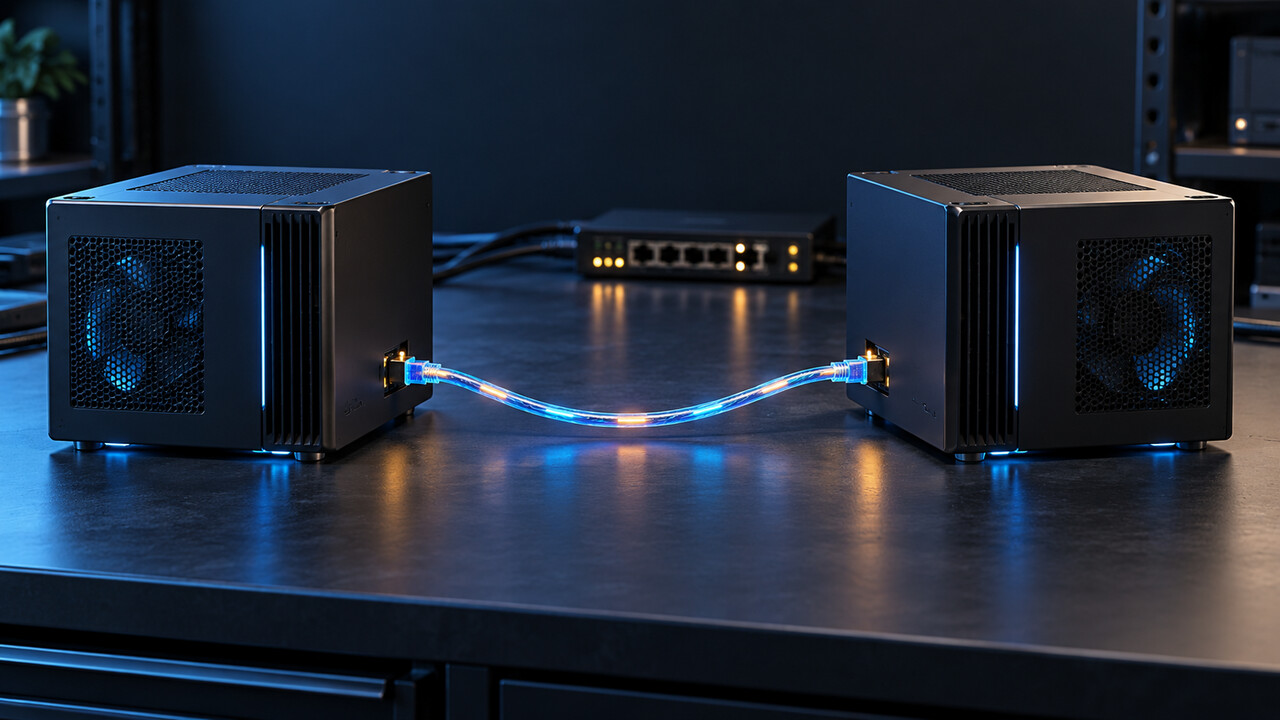
Nvidia promotes connecting two DGX Spark systems over 200GbE to work on larger jobs. At the announced base price, two 64GB units start near $9,998 before cables, switching, storage and tax. Distributed execution can divide some workloads, but two machines do not automatically behave like a single computer with one transparent 128GB memory pool. Software support, partitioning and communication overhead determine whether a specific model or training task benefits. Hardware Busters also reports the 128GB model at $6,950, making one higher-memory system potentially less expensive than two base 64GB systems for workloads that need a single larger address space.
The reported 1.7× result is Nvidia’s test, not an independent benchmark
Nvidia says two linked systems delivered up to 1.7 times the performance of one system in its Qwen fine-tuning test. The company’s post does not make that multiplier a general guarantee for other models, batch sizes or software paths, and the independent reports do not replace it with a separate controlled benchmark. Readers should treat 1.7× as a vendor-reported result for a named test and expect scaling to vary with compute balance and network communication.
A practical buying checklist
Before ordering, identify the exact local model and quantization you intend to run, then add memory for context, cache, the runtime, the operating system and other applications. Choose 64GB when the verified working set fits with headroom and the $4,999 entry price matters. Compare the 128GB configuration when a single larger memory pool is the main need. Consider two-node clustering only when the software explicitly supports distributed execution and the full system cost and scaling limits are acceptable. No source reviewed here establishes that a memory shortage caused the new model, so this article does not make that claim.