Technology · NEWS EXPLAINER
NEXTDC cuts FY27 guidance after Melbourne data-centre power delay
The operator removed roughly A$140 million tied to affected M3 contracts from its FY27 ranges after grid works were suspended. The capacity remains contracted, but billing, service credits and customer rights are still uncertain.
NEXTDC has sharply reduced its FY27 revenue, earnings and capital-spending forecasts after electricity-network delays pushed the next power increase for its M3 Melbourne data centre into FY28. The update separates contracted demand from the practical ability to energise and bill the capacity.
The bottleneck is grid delivery
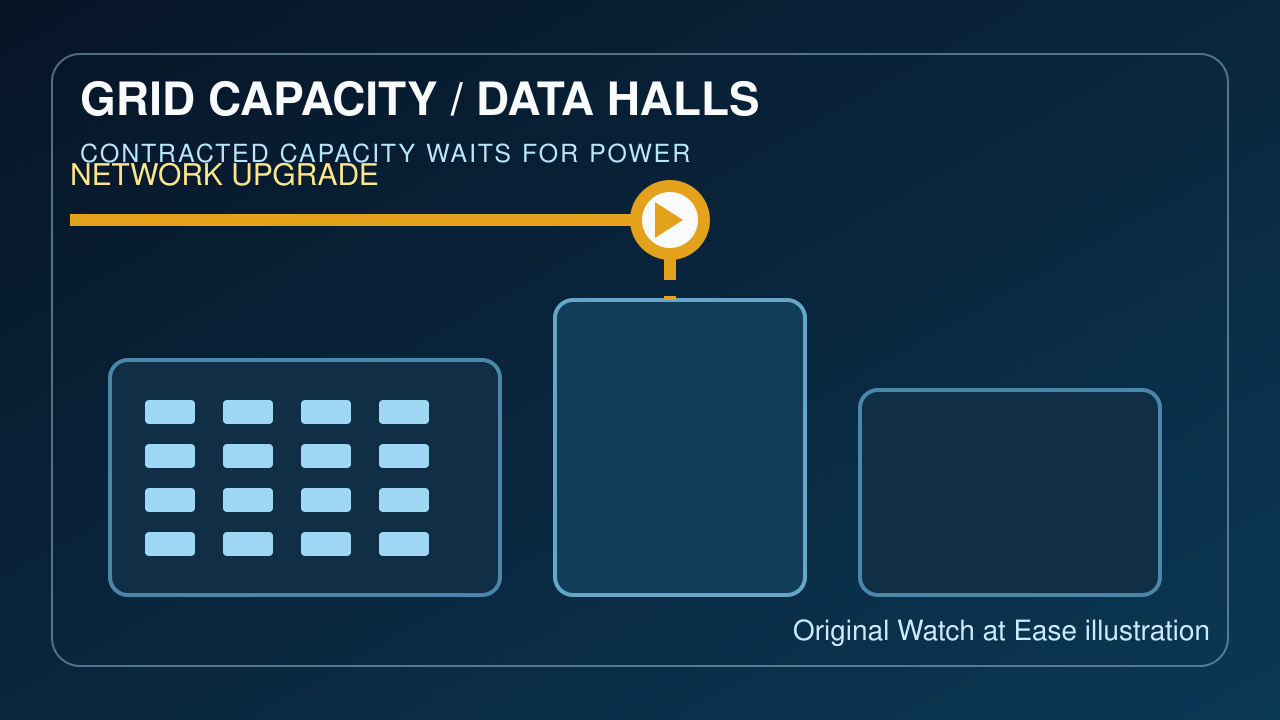
Jemena suspended parts of the 66kV network works needed for the next increase in supply to M3 after community opposition, access concerns and the absence of local-council consent. NEXTDC said Jemena does not expect to restart those works before February 2027, and the operator now expects the first power increase during FY28. Data-hall construction inside existing buildings continues, so the delay concerns energisation and billing rather than an announced cancellation of the campus.
Why the FY27 ranges changed so sharply
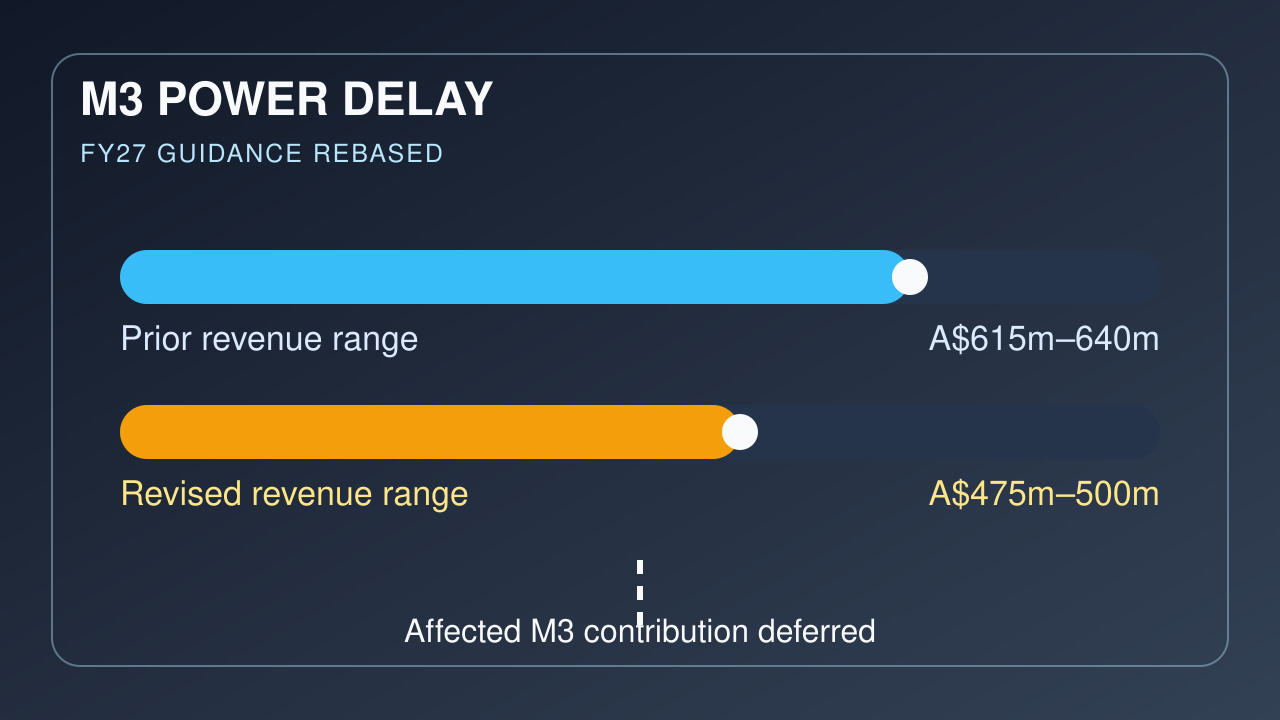
NEXTDC cut FY27 net revenue guidance to A$475 million–A$500 million from A$615 million–A$640 million. It also cut underlying EBITDA guidance to A$245 million–A$265 million from A$385 million–A$410 million. The August outlook had included about A$140 million of both revenue and EBITDA from the affected M3 contracts. The revised ranges exclude that contribution because its timing cannot yet be estimated reliably.
The contracts remain, but the outcome is not settled
The company says the delayed capacity remains under contract, subject to the customer’s rights, and it is discussing a revised power ramp. The contracts may provide service-level credits for late or insufficiently powered capacity and, in some circumstances, termination rights. NEXTDC is also examining force-majeure and related provisions. Readers should therefore distinguish contracted capacity from assured FY27 revenue: the commercial consequences have not been quantified.
Spending is being redirected
FY27 capital-expenditure guidance was reduced to A$4.5 billion–A$5.0 billion from A$5.25 billion–A$5.75 billion. NEXTDC has paused new development projects and land acquisitions not backed by customer contracts, while prioritising near-term contracted capacity. Its board plans to report the outcome of a broader capital review by the November 20 annual meeting and may consider selling selected development sites.
What the 44% share fall does—and does not—show
Reuters reported that the shares fell 44% and about A$3.1 billion of market value was erased in early trade. That reaction shows how heavily investors had relied on the timing of AI-linked infrastructure revenue, but it does not by itself prove customer demand disappeared. NEXTDC reported A$8.675 billion of liquidity and covenant compliance, while warning that future senior-debt drawdowns depend partly on expected billing profiles. The next useful disclosures are the capital-review result, the grid-work restart path and any quantified customer-contract effects.