Business · NEWS EXPLAINER
NextDC cuts FY2027 outlook after M3 Melbourne power delay defers A$140 million in revenue
The data-centre operator says the next power increase at M3 is now expected in 2028, lowering revenue, EBITDA and capital-spending guidance while it reviews future expansion.
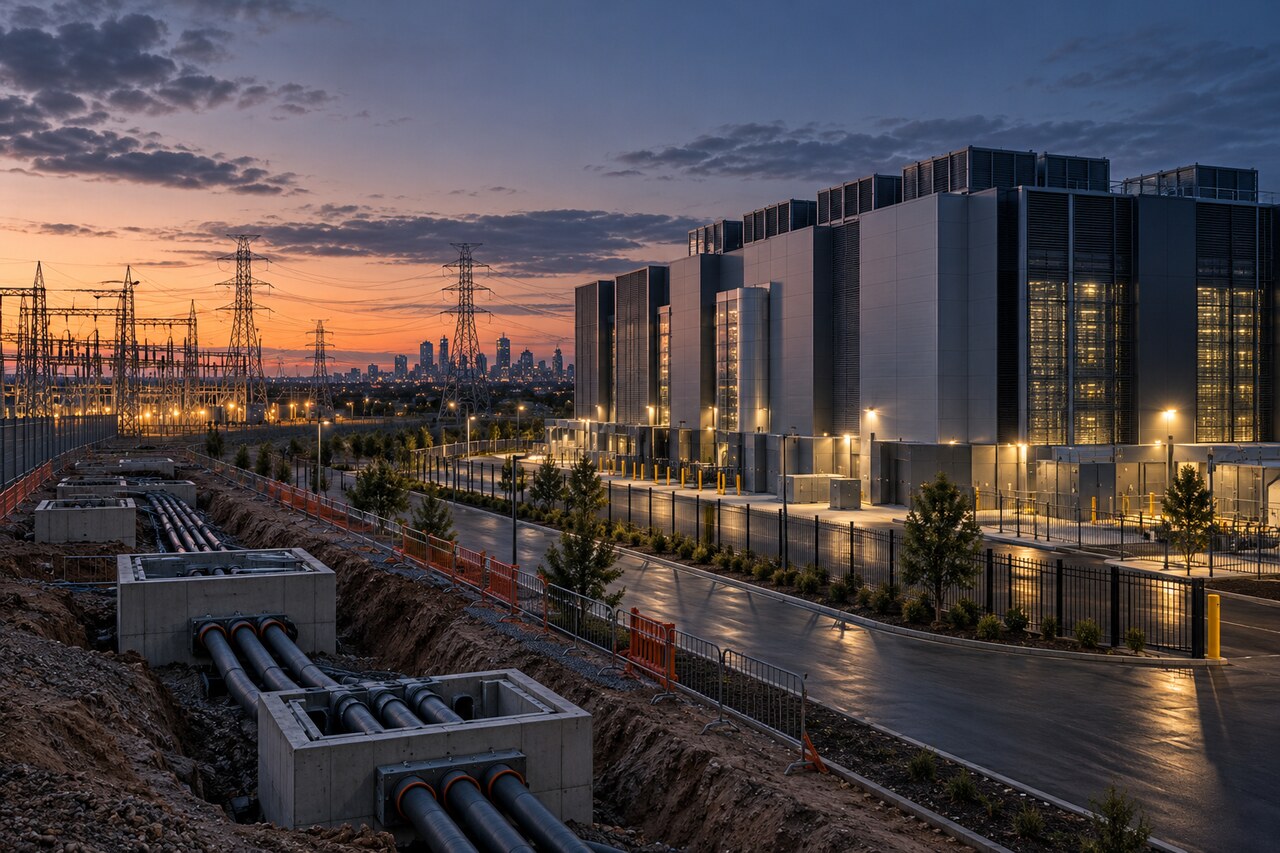
NextDC sharply reduced its FY2027 outlook after delays to electricity-network work at its M3 Melbourne data centre pushed about A$140 million of contracted customer revenue beyond the financial year.
The contracts have not been described as cancelled. The practical change is timing: the affected capacity cannot be delivered on the original schedule, so the revised guidance excludes its revenue and earnings contribution while the company reassesses spending and development plans.
What changed on October 21
NEXTDC said work needed to expand electricity supply to M3 Melbourne had been suspended and was not expected to restart before February 2027. That moves the next power increase into 2028. Because customer capacity depends on that connection, the company removed the affected M3 contribution from its FY2027 ranges instead of treating it as available on the earlier schedule.
The guidance cut is larger than a routine quarterly adjustment
Net revenue is now projected at A$475 million to A$500 million, versus A$615 million to A$640 million previously. Underlying EBITDA is expected at A$245 million to A$265 million, down from A$385 million to A$410 million. Each range is lower by roughly A$140 million, matching the contracted contribution that cannot be delivered within FY2027.
Deferred revenue is not the same as vanished demand
NEXTDC describes the affected amount as contracted customer revenue. The update changes when the company can supply capacity and recognize revenue; it does not say customers cancelled every affected contract. Delivery, contract remedies and any force-majeure position still depend on the underlying agreements, so readers should not convert “deferred” into “guaranteed later revenue.”
Expansion is being reconsidered, not simply erased
The company lowered FY2027 capital spending to A$4.5 billion–A$5.0 billion and paused new development projects and land acquisitions while conducting a broader review. It is also considering capital recycling, including possible sales of selected development sites. Initial review findings are due at its November 20 investor meeting.
Why the stock reaction was severe
Reuters reported the shares fell 41.7%, their worst session since the 2010 listing, as investors repriced both the near-term earnings gap and the risk that power, planning and community constraints could slow expensive data-centre expansion. The fall is market reaction, not a direct measure of the eventual contract loss.
What to watch next
The most useful checkpoints are whether electricity works restart after February 2027, the November 20 capital-allocation update, treatment of the affected customer contracts and any revised timetable for M3 stages 6 and 7. Those items will show whether the current problem remains a timing delay or becomes a broader capacity and financing constraint.