Tech · NEWS EXPLAINER
Microsoft’s Maia 300: a 2027 rollout plan and two different throughput claims
Microsoft announced its next inference system on October 12. Its 40% efficiency comparison and up-to-sevenfold rack comparison use different reference points; neither is a guarantee for every application.
Microsoft announced Maia 300 on October 12, with production deployment planned for 2027. The company intends to expand its Maia family to multi-gigawatt scale for its own AI products and services. An announced rollout plan is different from hardware already serving every customer.
Maia 200 is running; Maia 300 is the next deployment
Microsoft’s dated announcement says Maia 200 is already serving production workloads including Microsoft Copilot. It describes GitHub Copilot and Microsoft Foundry as following by the end of the year. Maia 300 production deployments begin in 2027. Keeping those generations and milestones separate avoids turning a future plan into present availability.
The two headline percentages measure different comparisons
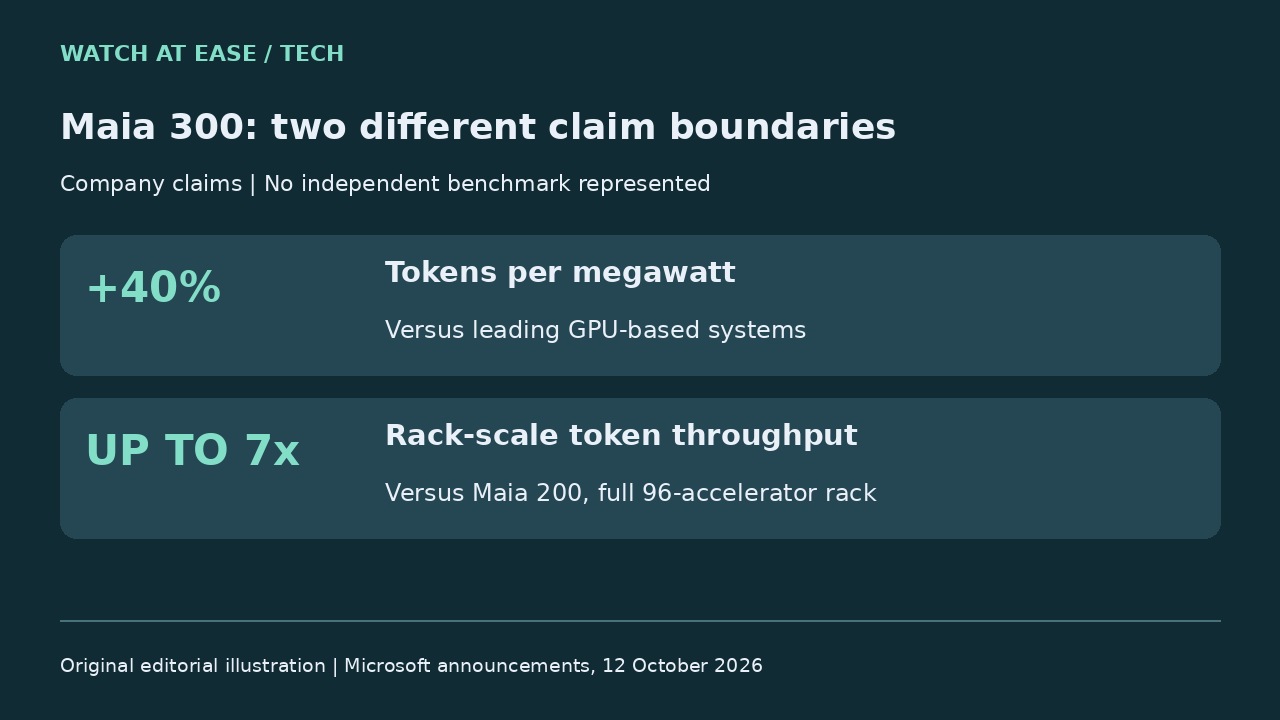
Microsoft expects Maia 300 to deliver 40% more tokens per megawatt than leading GPU-based systems. Separately, it claims up to seven times Maia 200’s rack-scale token throughput in a full 96-accelerator configuration. The comparison targets and denominators differ: output relative to power is not the same metric as total rack output.
Reuters notes that Microsoft did not name the GPU systems used for its comparison. These remain company performance claims. We have not tested Maia 300, and neither figure establishes the same improvement for every model, request length or deployment.
Rack power and chip power are different boundaries
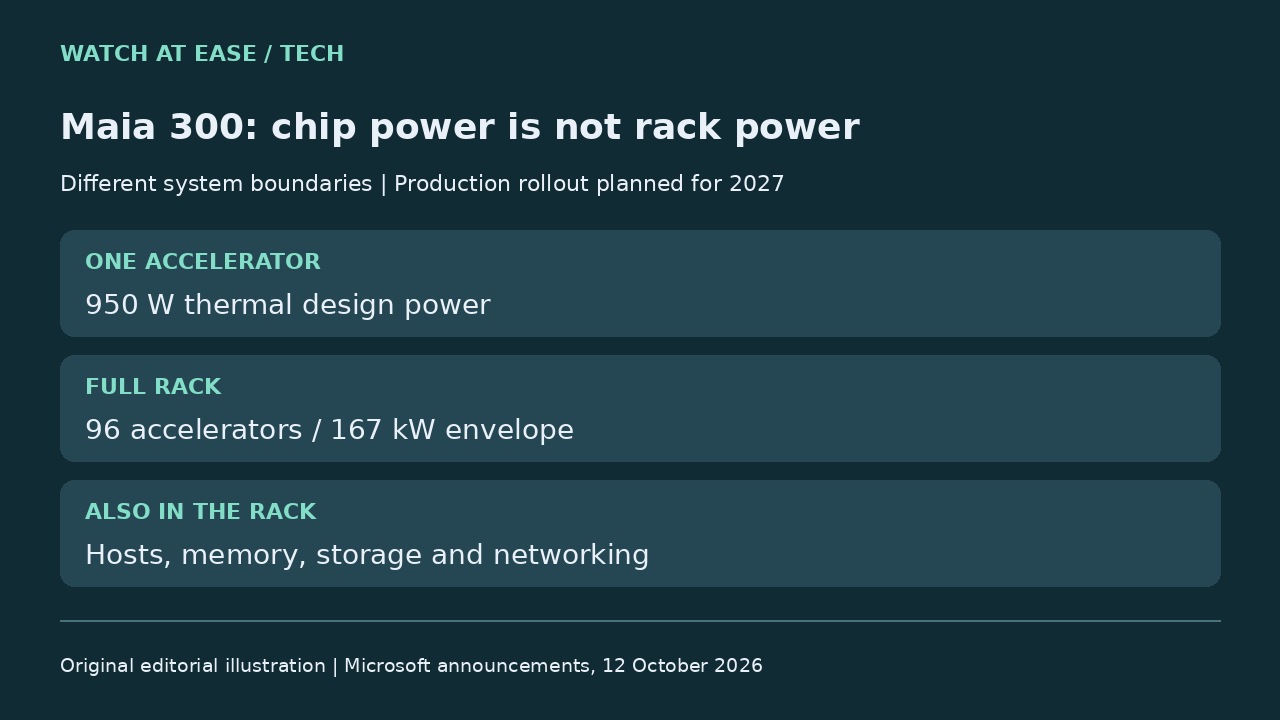
Microsoft’s technical account describes 96 accelerators in a 167-kilowatt rack, while one accelerator has a 950-watt thermal design power. Multiplying chip power alone does not recreate a complete rack’s power envelope: the rack also includes host processors, networking, memory, storage and cooling-related infrastructure.
The chiplet design separates compute, memory-controller and input/output functions. That is a disclosed architecture, not independent proof of a customer’s electricity bill or total operating-cost reduction.
What a customer can verify next
The useful next evidence is actual production rollout and service-specific availability, followed by measurements on the workload being considered. The Verge independently reports the 2027 production timeline; it does not provide an independent benchmark validating the 40% claim.
For an application evaluation, record the model, context length, concurrency, response speed target and measurement boundary. A tokens-per-megawatt claim and a rack-throughput claim answer different questions. This announcement alone does not establish a new Azure price, an access guarantee or a performance result for your application.