Technology · NEWS EXPLAINER
Lantronix previews Spotter: a small robotics board still needs workload evidence
The company’s new QCS6490-based platform is due in the fourth quarter. Its advertised compute and power figures describe a vendor claim, not a tested result for a complete robot.
Lantronix introduced Spotter on October 13, describing a compact onboard computing platform for drones and mobile robots. It is previewing the board at AUSA in Washington, D.C., and says availability is planned for the fourth quarter of 2026. That is an announced product and delivery window, not evidence that customers can already obtain every production configuration.
For teams evaluating a civilian robot, the interesting question is whether the board can run their actual sensing and AI workload within the system’s limits. The release supplies a processor name, physical dimensions and advertised performance. Those are starting points for evaluation rather than a substitute for measuring the complete application.
What the announcement actually establishes
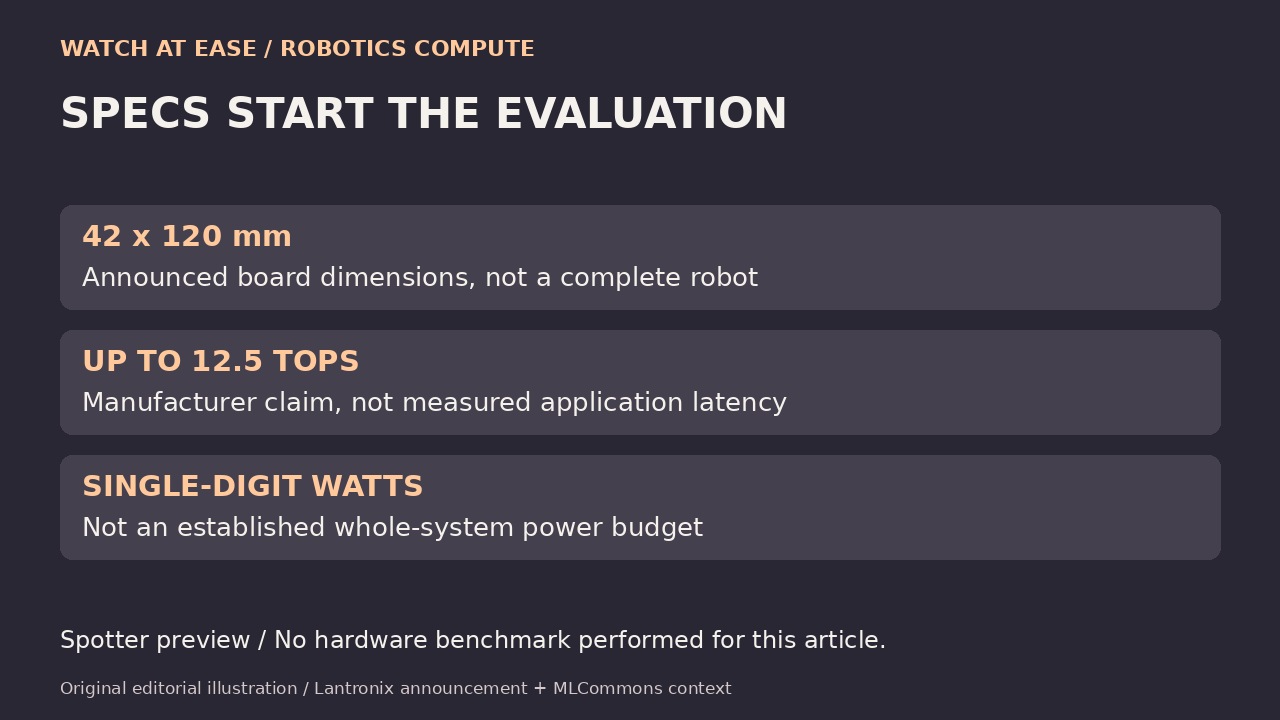
The release identifies the Qualcomm Dragonwing QCS6490 and Lantronix Open-Q 6490 system-on-module as the foundation. Lantronix says Spotter combines onboard AI, vision, sensing and vehicle control on a 42 × 120 mm board, with up to 12.5 TOPS of AI performance at single-digit watts. Those numbers and integration claims are supplied by the manufacturer; we have not benchmarked a unit.
The company also names PX4, ArduPilot, Betaflight and MAVLink support. That list does not establish that an existing robot’s sensors, firmware and application will work unchanged. This article does not provide deployment instructions or claim to have validated a particular control configuration.
A compute figure does not describe an application
A peak operations figure is different from the time needed to process an actual input. As independent context, MLCommons’ April 2025 MLPerf Inference 5.0 announcement describes benchmarking across specific AI workloads and introduces both a low-latency interactive test and an automotive object-detection test. Its approach illustrates why a workload and a response metric need to be identified.
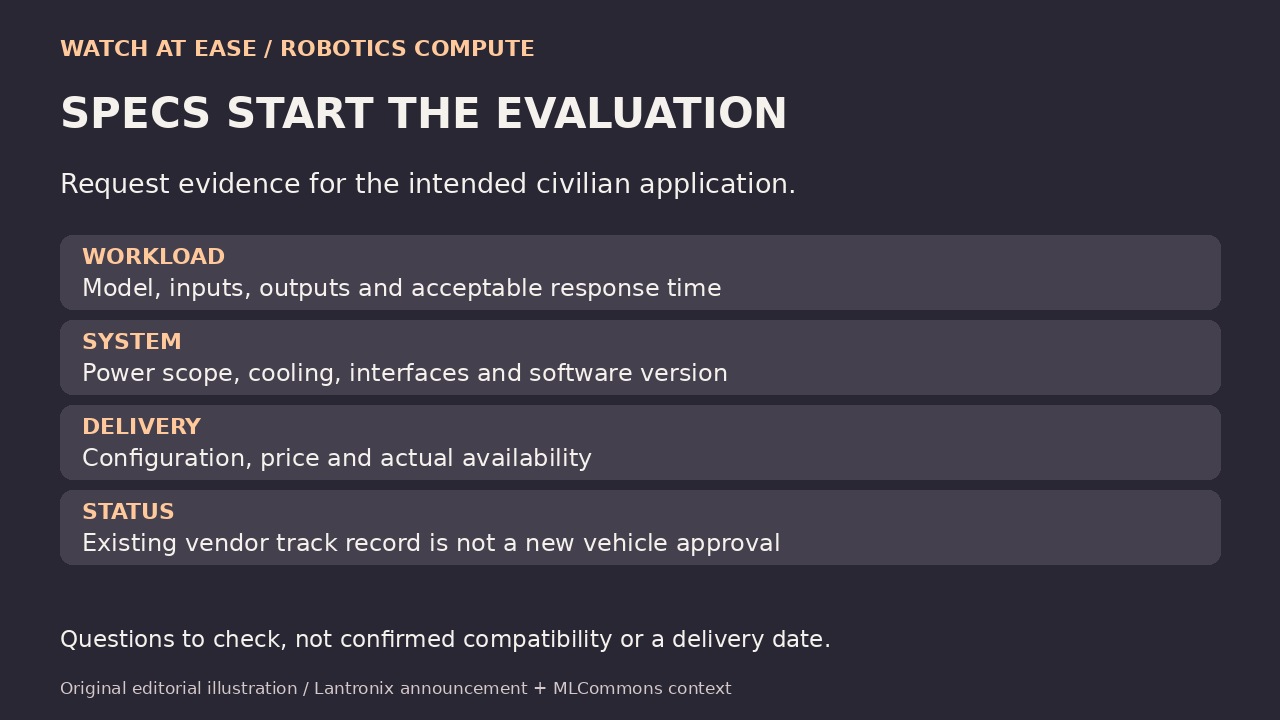
That dated benchmark announcement is not a Spotter test or proof that this new board has any MLPerf result. When requesting a demonstration, specify the model, input format, required output and acceptable delay, then ask which software configuration produced the measurement. Comparing a vendor headline with an unrelated benchmark score would not answer the same question.
Evaluate the board inside the full system budget
The announced dimensions describe the board, not the complete enclosure, wiring or sensor assembly. Likewise, the release’s single-digit-watt statement does not supply an entire robot’s power budget or a measured battery runtime. Buyers should establish what the quoted power condition includes before applying it to a proposed design.
Ask for measurements under the intended workload, the cooling arrangement used, and the interfaces and software versions included in the demonstration. These are editorial evaluation questions, not additional specifications confirmed by the release. A small board can simplify an integration project while still leaving system-level work to the customer.
Keep preview, availability and approval separate
Lantronix calls the platform production-ready, but its release says availability will be in the fourth quarter of calendar 2026. It provides a route to request a demonstration rather than a public selling price or a delivery date for a selected configuration. Treat those commercial details as items to confirm, not blanks to fill with estimates.
The release also says Lantronix compute already flies in Blue UAS-approved drones. That statement about an existing track record does not, on its own, identify Spotter as an individually approved complete drone. Our diagrams therefore separate the announced board, the proposed application test and delivery arrangements. They are original illustrations of questions to check, not hardware photographs or measured performance charts.