Science · NEWS EXPLAINER
Cygnus carries 12 heat-shield experiments: a flight test, not proof of Mars readiness
KREPE-3 will turn a cargo spacecraft’s planned disposal into a materials test. The October 9 departure is confirmed; performance results are still ahead.
Twelve experimental capsules left the International Space Station inside Cygnus XL on October 9. Their next job is to measure what happens to different heat-protection materials during atmospheric re-entry—not to bring a crew home or announce that a Mars landing system is ready. NASA’s KREPE-3 project uses an already scheduled cargo disposal flight to obtain measurements that laboratory tests and computer models cannot fully replace.
What actually happened—and what is still planned
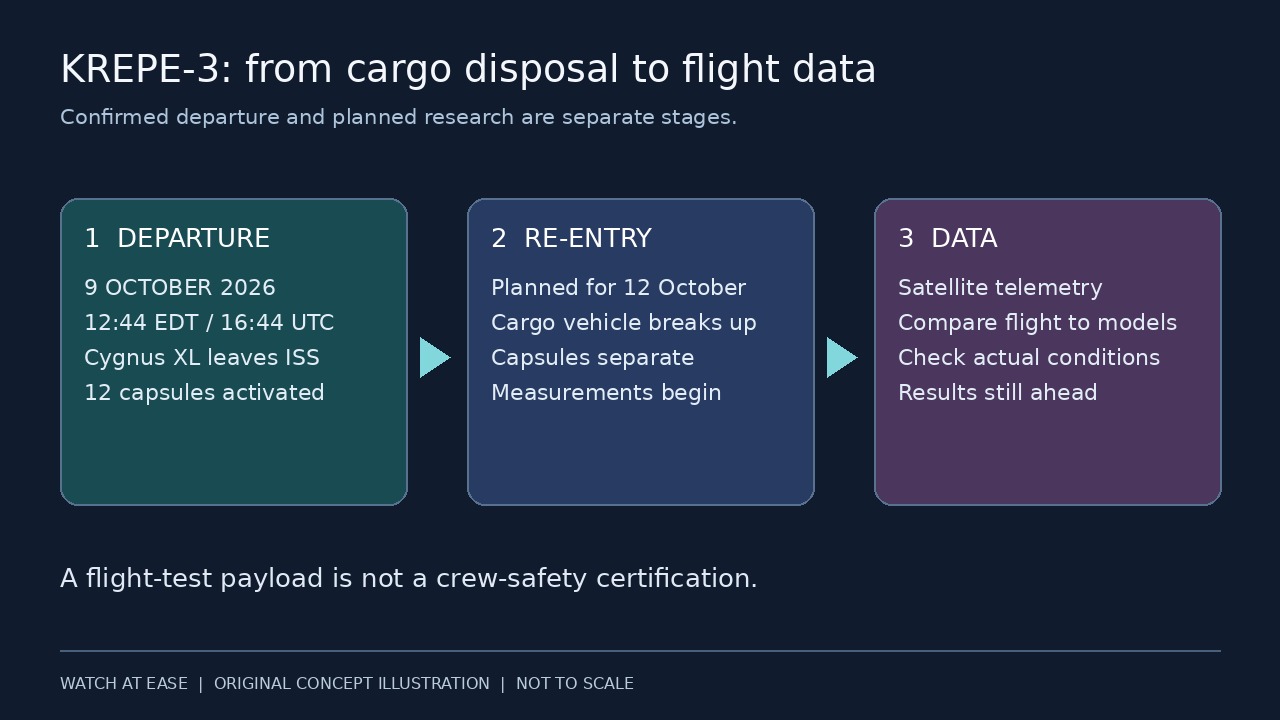
NASA confirmed that Canadarm2 released Cygnus XL at 12:44 p.m. EDT (16:44 UTC) on October 9, ending nearly six months at the station. Astronauts had activated the experimental capsules before departure. NASA’s subsequent station update schedules deorbit for Monday, October 12 and says it will not provide coverage of that operation.
That distinction matters when reading launch-style headlines. The cargo vehicle has departed, but the capsule measurements and their interpretation are future steps. One independent departure report lists October 11; this article follows NASA’s current October 12 plan. A planned date is a schedule, not evidence that the spacecraft has already re-entered.
How a disposal flight becomes a research flight
KREPE-3, the third Kentucky Reentry Probe Experiment mission, places small instrumented capsules inside a spacecraft already destined for controlled disposal. As Cygnus breaks apart on its planned atmospheric route, the capsules are intended to separate and collect flight data. The approach avoids a dedicated launch for this particular test.
Their sensors measure temperature, pressure, motion, magnetic field and light. Satellite signals are intended to transmit measurements to researchers. The useful outcome is data about how each configuration behaves; NASA’s announcement does not promise recovery of the capsules or report a completed, successful data return.
It is testing more than one new heat shield
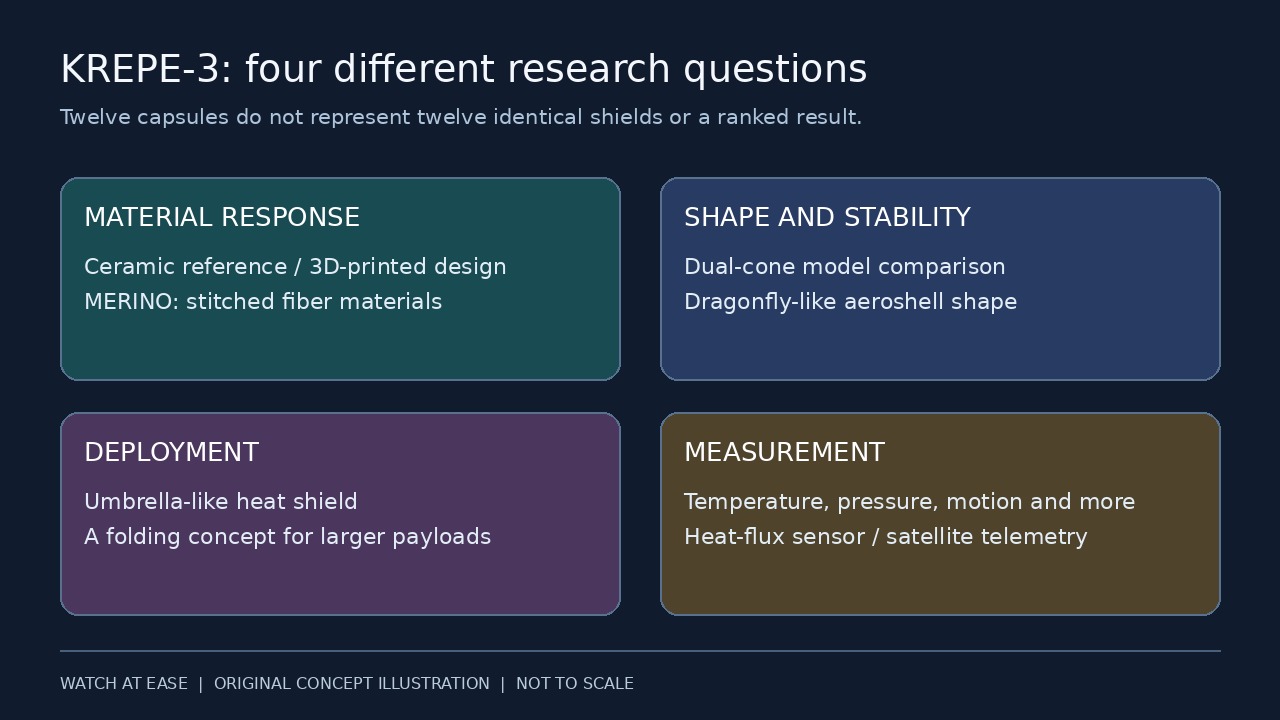
The payload includes established shuttle-type ceramic material alongside newer designs. A NASA Johnson–Oak Ridge project contributes a 3D-printed shield. NASA Ames contributes MERINO, a family of stitched carbon-and-phenolic-fiber materials, including a configuration on a dual-cone experiment intended to compare flight behavior with computer predictions.
Other capsules examine the stability of a shape resembling Dragonfly’s protective aeroshell and an umbrella-like deployable shield. A Stuttgart-developed heat-flux sensor adds a measurement experiment. These are different research questions—material response, aerodynamic stability, deployment and instrumentation—not 12 identical shields competing in a published ranking.
What would make the next update meaningful
Readers should look next for confirmation of the planned re-entry, telemetry received and the conditions under which each configuration was tested. Comparisons with predicted temperatures, loads or stability would help explain whether the data support a design change. Those findings are not included in the departure announcement.
Using a disposal flight can make early research more practical. It does not, by itself, certify a crewed vehicle or prove performance in Mars’s different atmosphere. A later claim of mission readiness would need its own evidence. For now, the concrete advance is that a diverse set of experiments is in flight, with measurements still to come.