Science/Climate · NEWS EXPLAINER
JUICE returns to Earth for a gravity assist on its way to Jupiter
ESA’s latest cruise report lists a September 28 closest approach at 11:45:12 UTC, about 8,641 km above Earth, as the Jupiter-bound spacecraft uses the flyby to reshape its trajectory and test science systems.
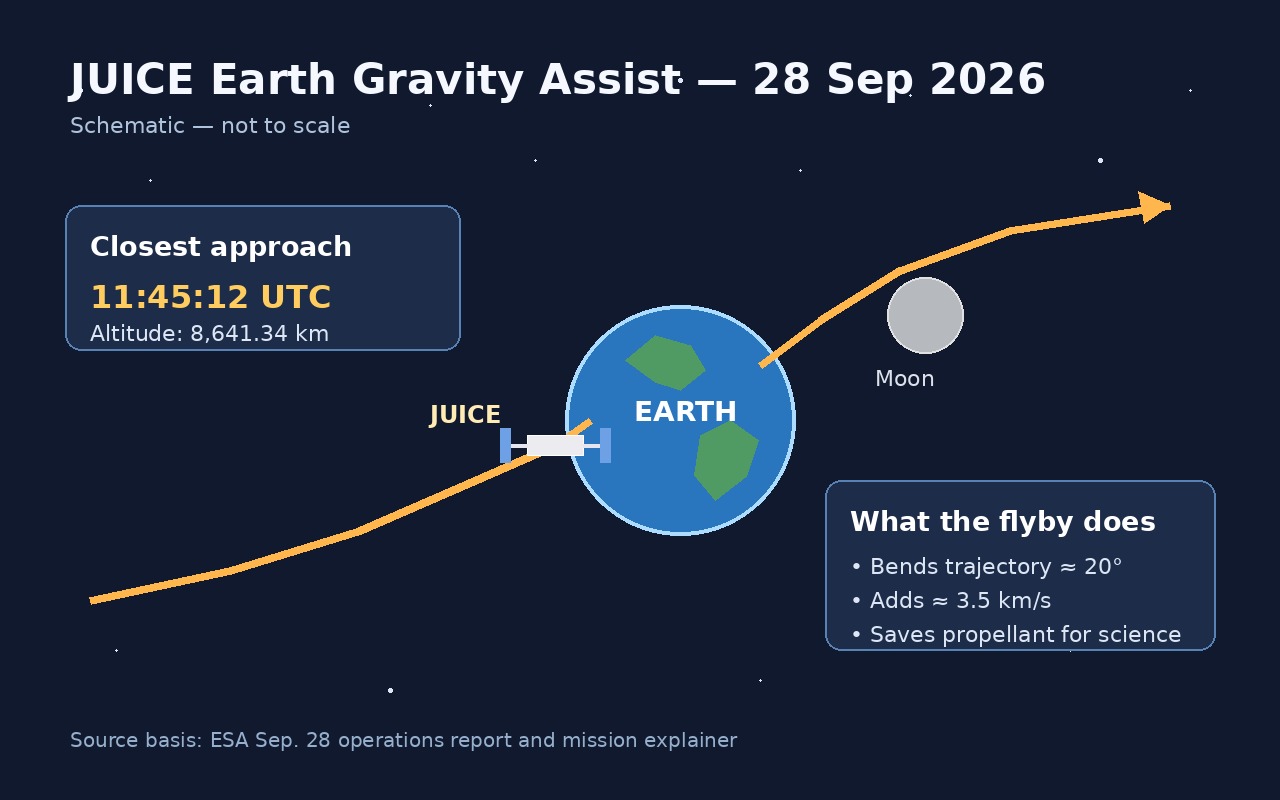
ESA’s Jupiter Icy Moons Explorer, Juice, is back at Earth on September 28 for another gravity assist. The mission’s latest operational cruise report lists closest approach at 11:45:12 UTC and an altitude of 8,641.34 km, a precisely timed pass designed to change the spacecraft’s path without spending the equivalent amount of propellant.
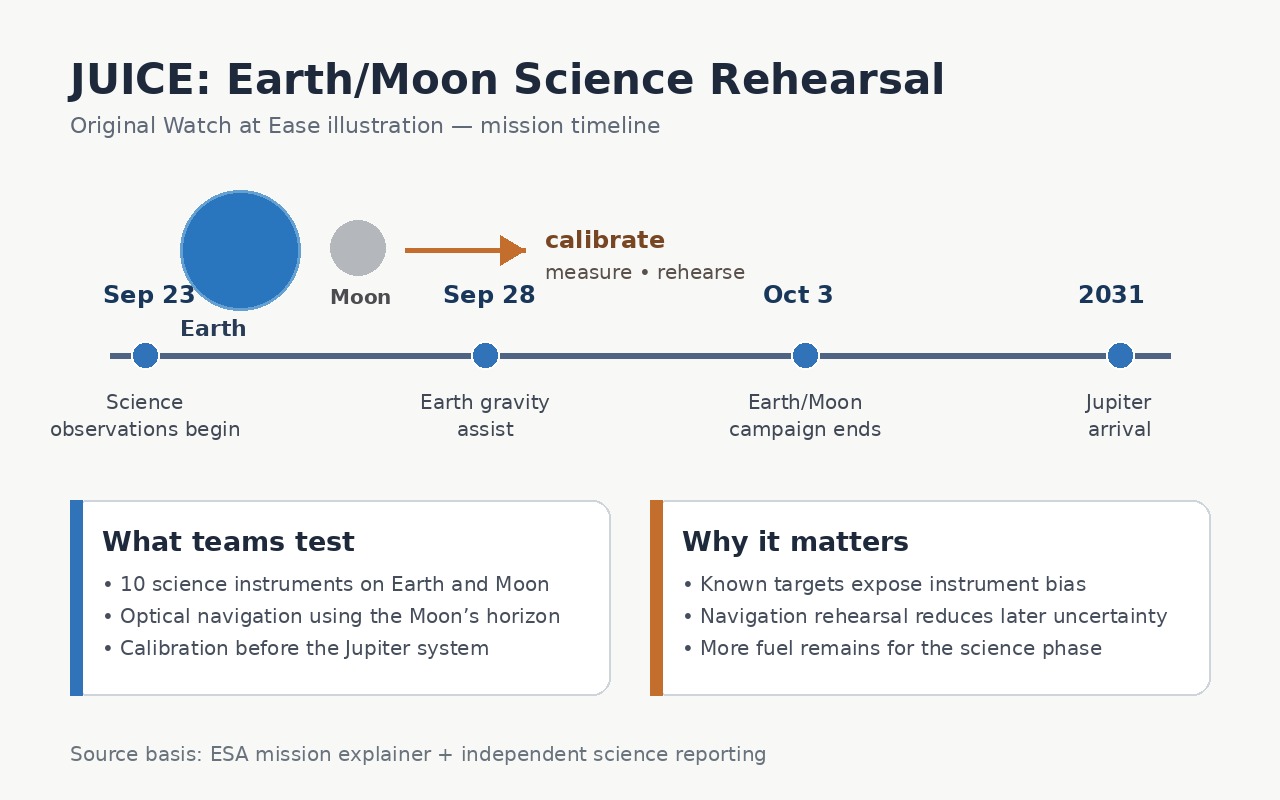
The flyby is also a rehearsal for science at Jupiter. ESA says Juice’s 10 science instruments are observing Earth and the Moon from September 23 to October 3, while the navigation camera is testing a Moon-horizon technique that should help the spacecraft steer around Jupiter’s moons.
The flyby changes the route without a giant fuel burn
A direct trip to Jupiter would demand far more launch energy and later braking propellant. Gravity assists let a spacecraft exchange orbital energy with a planet so mission planners can alter speed and direction while preserving fuel for the science phase.
ESA says the September 28 encounter should bend Juice’s trajectory by about 20 degrees and add roughly 3.5 km/s. The current operations report lists the scheduled closest approach at 11:45:12 UTC and 8,641.34 km above Earth.
Earth and the Moon are also a rehearsal for Jupiter
ESA is using familiar targets to check the payload before Juice reaches the much less familiar Jovian system. All 10 science instruments are scheduled to observe Earth and the Moon between September 23 and October 3 for calibration and coordinated measurements.
The navigation camera is also testing a technique that identifies the Moon’s horizon for optical navigation, while other observations include Earth’s magnetic environment and magnetotail. Scientific American notes that the pass therefore combines trajectory work with real science and navigation rehearsal.
September 28 is one step in a longer gravity-assist chain
Juice already used a lunar-Earth gravity assist in 2024 and Venus in 2025. After this September 2026 Earth pass, ESA plans another Earth gravity assist in January 2029 to keep shaping the route to the outer Solar System.
The spacecraft is scheduled to reach Jupiter in July 2031, then study Europa, Ganymede and Callisto through dozens of flybys before eventually entering orbit around Ganymede. The gravity-assist chain preserves propellant for that long scientific tour.