Science · NEWS EXPLAINER
Japan’s MMX mission is set to launch for Phobos: timeline, sampling plan and what to verify
JAXA schedules the Martian Moons eXploration mission for October 20 in Japan, with a backup window through November 7. MMX aims to study both Martian moons, land on Phobos, collect at least 10 grams and return the sample in 2031—but the launch and every later milestone still require official confirmation.
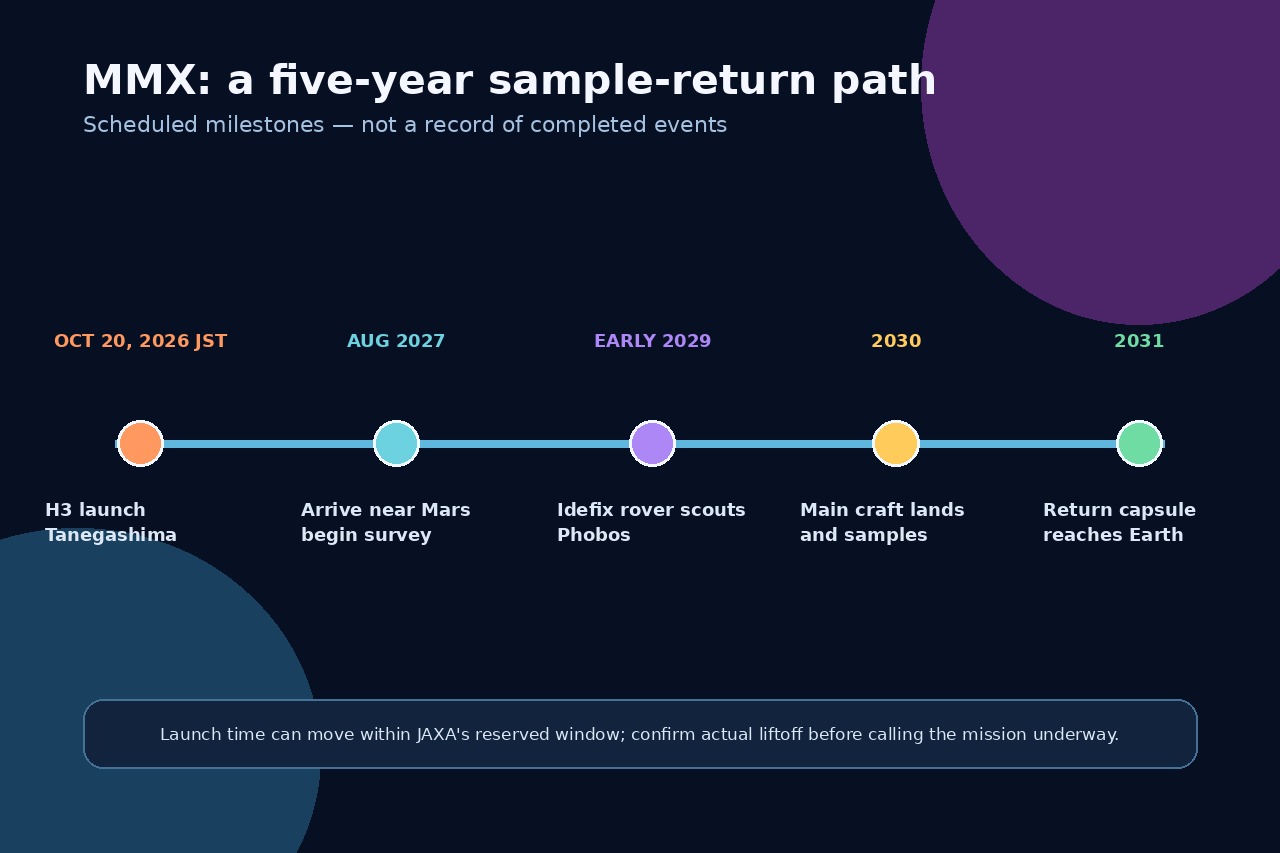
Japan’s space agency has scheduled its Martian Moons eXploration spacecraft, or MMX, to lift off on an H3 rocket from Tanegashima at 4:41:03 a.m. Japan Standard Time on October 20, equivalent to 19:41:03 UTC on October 19. JAXA lists a reserved launch period through November 7. The mission has not launched at publication time, so readers should distinguish the schedule from confirmed liftoff and orbit insertion.
The schedule is precise, but it is still a schedule
JAXA’s official notice gives the target time as October 20 at 4:41:03 a.m. JST from the Yoshinobu Launch Complex at Tanegashima Space Center. NASA gives the equivalent time as 3:41 p.m. EDT on October 19. Weather, range safety or technical reviews can still move a launch, and JAXA’s reserved period runs from October 21 through November 7.
The first useful verification points are therefore operational rather than scientific: a final go decision, actual H3 liftoff, separation from the launch vehicle and an official statement that the spacecraft is healthy. A scheduled broadcast or countdown is not the same as a completed launch.
Why a Phobos sample could answer a Mars-system question
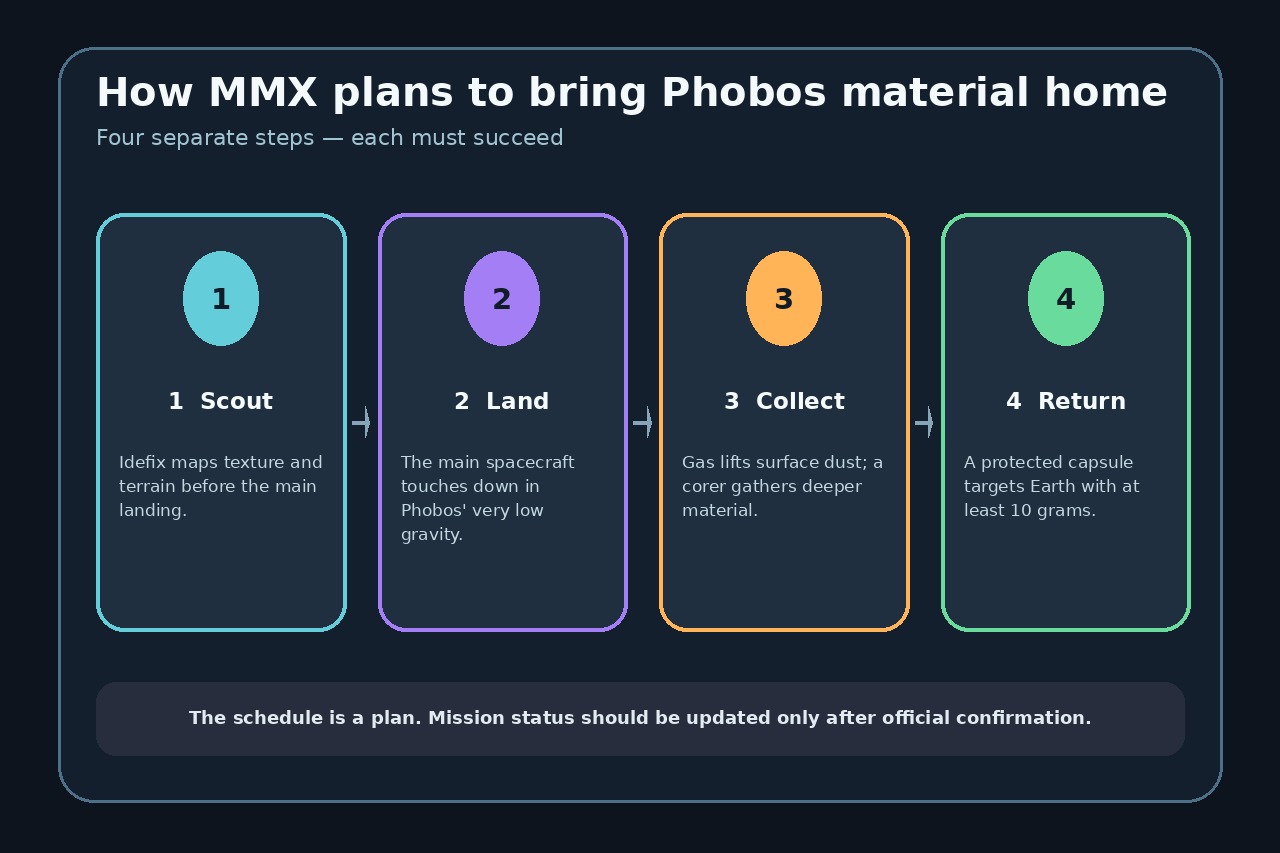
Phobos and Deimos may be captured asteroids, or they may have formed from debris after a large impact on Mars. MMX will observe both moons and then descend to Phobos. Material collected from its surface could preserve clues about which origin story is more likely and about how small bodies moved material through the early solar system.
The mission is designed to return at least 10 grams, far more than a token dust touch. That minimum does not mean 10 grams have already been secured: collection comes years after launch and depends on cruise, orbital operations, landing and sampling all working.
The mission chain runs from launch to a 2031 return
NASA says MMX is expected to reach the Martian system in August 2027 and lists sample collection no earlier than December 2028. ESA’s planning page places its Idefix rover deployment in early 2029 and the main spacecraft’s Phobos landing and sampling activities in 2030. These are planning milestones from different agency pages, not a single guaranteed day-by-day timetable.
ESA says the spacecraft will first enter a quasi-satellite orbit around Phobos, study both moons, deploy the small Idefix rover and attempt two main-spacecraft sampling operations before departing for Earth. The return capsule is planned to land in Australia in 2031. Readers should use updated agency timelines as the mission progresses.
MMX is Japanese-led with substantial international hardware
JAXA leads the mission, while NASA, ESA, France and Germany contribute instruments, tracking or hardware. NASA describes the MEGANE gamma-ray and neutron spectrometer, the P-Sampler pneumatic sampler and Deep Space Network support. NASA says it will receive and curate about 15 percent of the returned sample.
ESA describes eleven science instruments plus the Idefix rover, communications and ground-support contributions. These partnerships widen the science return, but they do not change the sequence of dependencies: launch, cruise, arrival, survey, landing, sampling, departure, re-entry and recovery each need separate confirmation.
What to check on launch day and after
First, confirm the time on JAXA’s current mission page because launch notices can change. Second, look for an explicit liftoff report rather than relying on a scheduled stream. Third, wait for spacecraft separation and health confirmation. Fourth, keep the 2031 sample-return goal separate from near-term milestones.
MMX would be the first mission intended to return material from Phobos and, as ESA notes, from a moon other than Earth’s. That makes the attempt scientifically important. It does not make every planned step inevitable, so good coverage should label future dates as targets and update them only from fresh agency statements.