Technology · NEWS EXPLAINER
IonQ agrees to buy Elisity: what the $1.3 billion ceiling means for security customers
The proposed all-stock deal includes a conditional earnout and still needs to close. Its planned combination links access controls with cryptographic migration, two jobs that should not be confused.
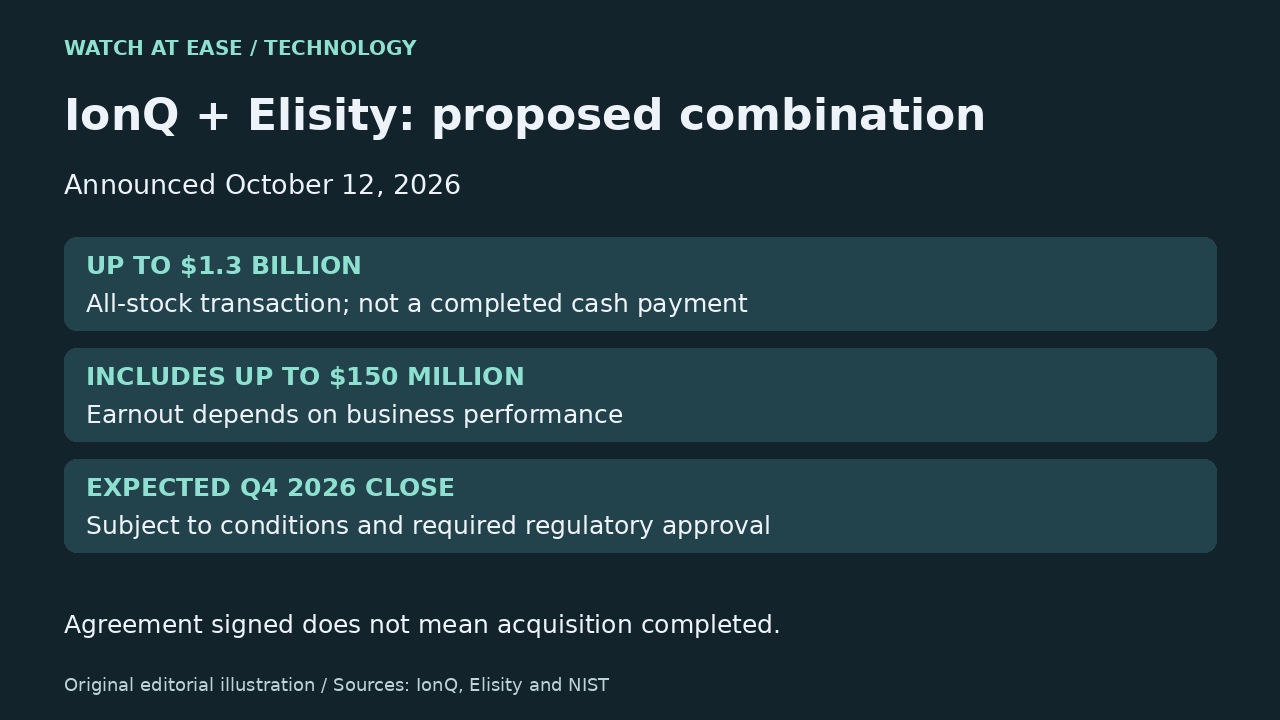
IonQ has agreed to acquire cybersecurity company Elisity in an all-stock transaction valued at up to $1.3 billion, including up to $150 million tied to future business performance. The companies expect a fourth-quarter 2026 closing, subject to customary conditions and required regulatory approval. This is an agreement announcement, not confirmation that the acquisition has closed.
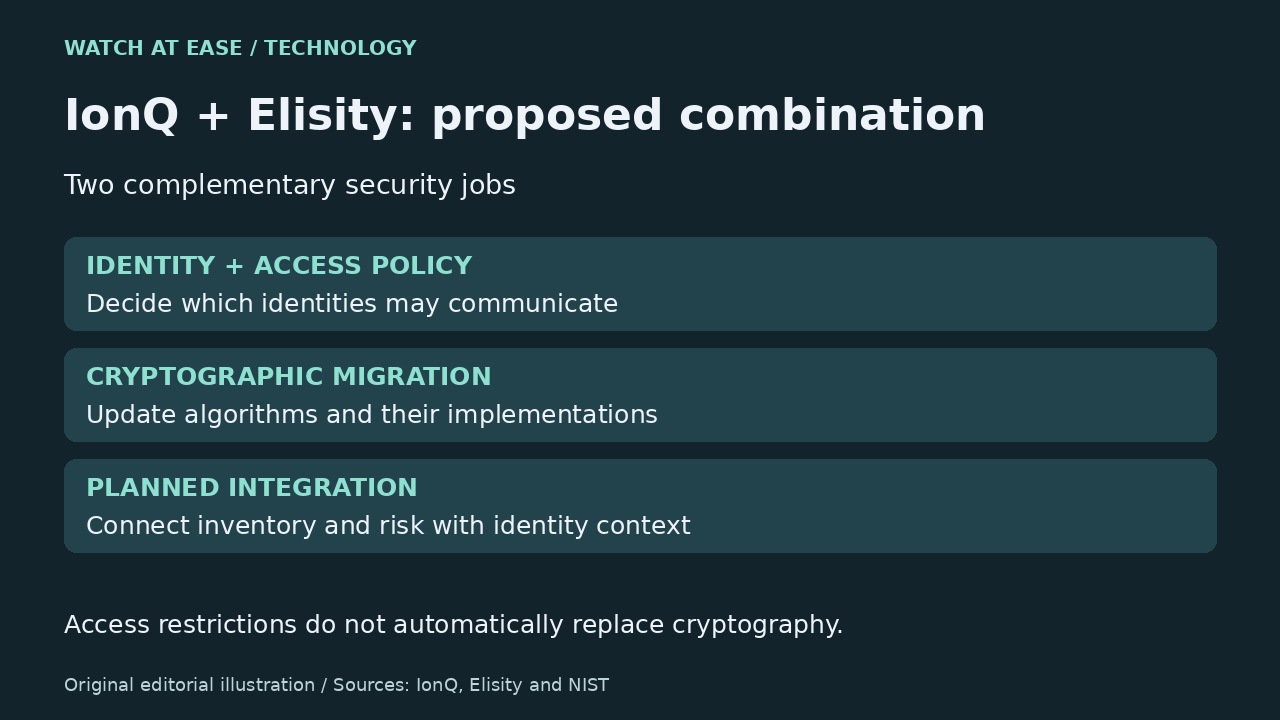
For security customers, the proposed combination has a practical distinction: controlling which identities can communicate does not itself replace vulnerable cryptography. Elisity describes a future connection between its IdentityGraph platform and IonQ’s quantum-security capabilities, while keeping existing operations running. That roadmap still needs to be delivered.
Read the price as a ceiling, not a completed cash payment
IonQ’s terms describe stock consideration, with an earnout dependent on Elisity’s performance. The $150 million is included within the stated maximum; adding it again would overstate the announced deal. The share count is to be determined at closing using a specified 20-trading-day volume-weighted reference price, bounded between $33.07 and $49.61.
Those reference-price limits are transaction mechanics, not a forecast of IonQ’s trading price. Nor does an expected Q4 closing establish an exact completion date. Approval and other closing conditions remain part of the agreement.
Separate existing policy controls from the proposed integration
In his customer statement, Elisity CEO James Winebrenner says IdentityGraph already brings together identity and contextual information to support least-privilege communication policies. Teams can simulate policies before enforcement. These are the seller’s descriptions of its existing platform, not results from our own product test.
The next phase would add cryptographic inventory and risk information to that context, helping customers prioritize upgrades around affected identities and operations. Winebrenner describes that work as following closing and says he would remain CEO. Neither statement supplies a generally available integration date or a replacement contract for existing customers.
Access control and cryptographic protection solve different problems
NIST’s zero trust architecture summary rejects automatic trust based only on network location or ownership. Authentication and authorization are separate decisions made before access to an enterprise resource. That helps explain why an identity-policy platform can matter even when an organization already encrypts traffic.
Post-quantum cryptography concerns algorithms designed to resist attacks from sufficiently capable quantum computers. NIST released its first three finalized PQC standards in August 2024, covering key establishment and digital signatures. This historical milestone predates the deal. Access restrictions can reduce exposure, but they do not automatically change an application’s cryptographic algorithms; a proposed acquisition is not evidence that a deployment has completed that migration.
What customers can verify next
A useful follow-up is a written product and support plan: which current features remain supported, which cryptographic-discovery or integration features are shipping, what requires a future release, and how compatibility will be tested. These are editorial questions prompted by the announced roadmap, not commitments that either company has already made.
Watch separately for a closing announcement and a dated release specifying integration availability. Existing deployment evidence, supported versions and customer terms are more useful for evaluating readiness than treating “quantum” as a blanket security guarantee. This article verifies the announcement and its stated scope; it does not assess investment value or claim hands-on validation of the combined platform.