Technology · NEWS EXPLAINER
HomePod mini 2 costs $149: check the Siri AI delay and Mac requirements before ordering
Apple plans October 30 availability, while Siri AI arrives through a later update with no date announced. The new Mac speaker mode also requires a Mac with Wi-Fi 6E or later; an S10 chip alone does not make every promised feature usable.
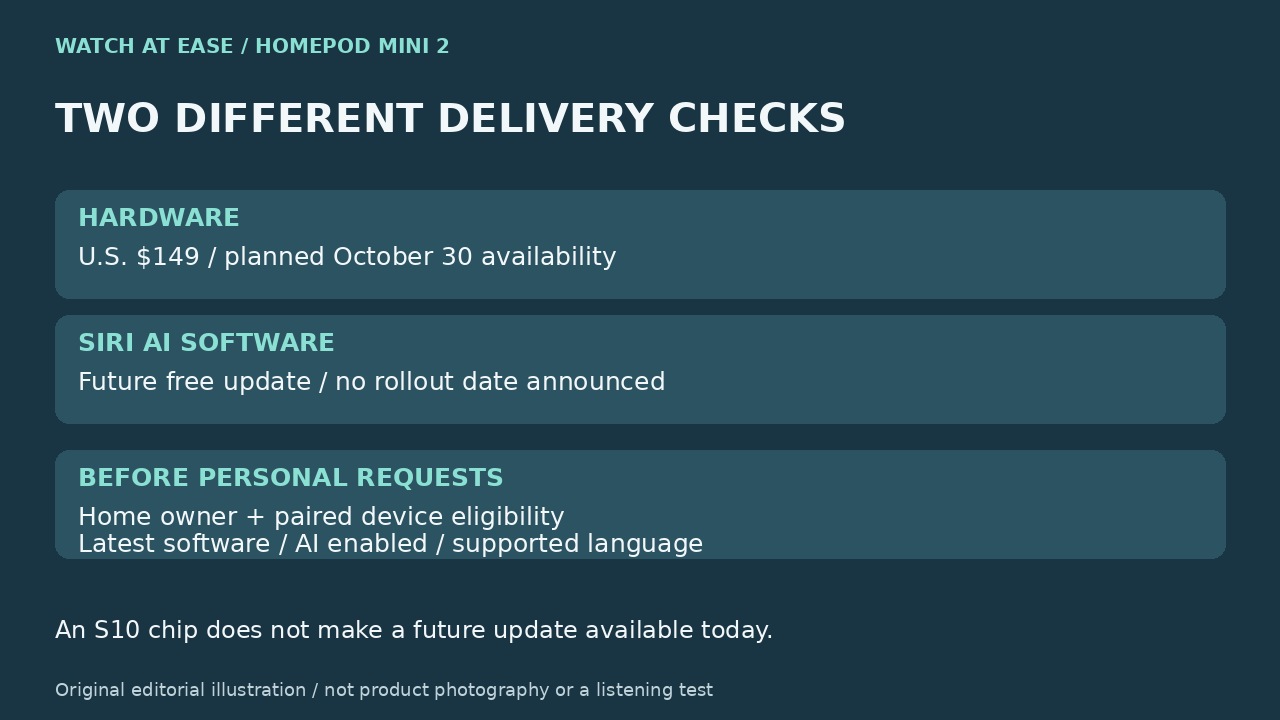
Apple announced HomePod mini 2 on October 13, 2026, with US preorders at $149 and planned store availability on October 30. Its S10 chip, Sound Glow lighting and new audio connections are the confirmed hardware story. Siri AI is a separate future software delivery, so buyers should evaluate the speaker against what they need when it arrives.
Separate the delivery dates
Apple lists pink, green, blue, white and midnight, and says HomePod mini 2 is compatible with HomePod software 27.2. The October 30 date is planned hardware availability, not a dated promise that Siri AI will be active. Both MacRumors and The Verge explicitly identify the AI update as arriving later. Buying now means accepting that distinction.
Apple initially lists English for Siri AI in the US, Australia, Canada, India, New Zealand, Singapore, South Africa and the UK. It has not given the HomePod update a release date. If an AI conversation is the reason for replacing a working speaker, wait for a published rollout and verify the actual language and region rather than assuming that a preorder reserves working AI. The Verge reports that Apple confirmed Siri AI will not come to the original HomePod mini; that statement still does not date the new model’s update.
Check the home owner and each personal device
Apple’s footnote requires the owner of the home in the Home app to have an Apple Intelligence-enabled iPhone or iPad running the latest software, with Siri AI enabled and set to a supported language. Personal-context requests also require a paired compatible device. Apple says the speaker can recognize up to six household voices; that is a vendor feature description, not our measurement of recognition accuracy. For advanced cross-app actions, Apple separately specifies an Apple Intelligence-enabled iPhone.
Once Siri AI is enabled on a supported speaker, Apple says users without their own compatible iPhone or iPad can use broader knowledge, conversations and improved music discovery. That does not give them access to another person’s messages or calendar. Apple also notes daily limits for certain server-model features and future paid expanded access; the free update does not establish unlimited use of every feature.
A Mac connection has its own hardware gate
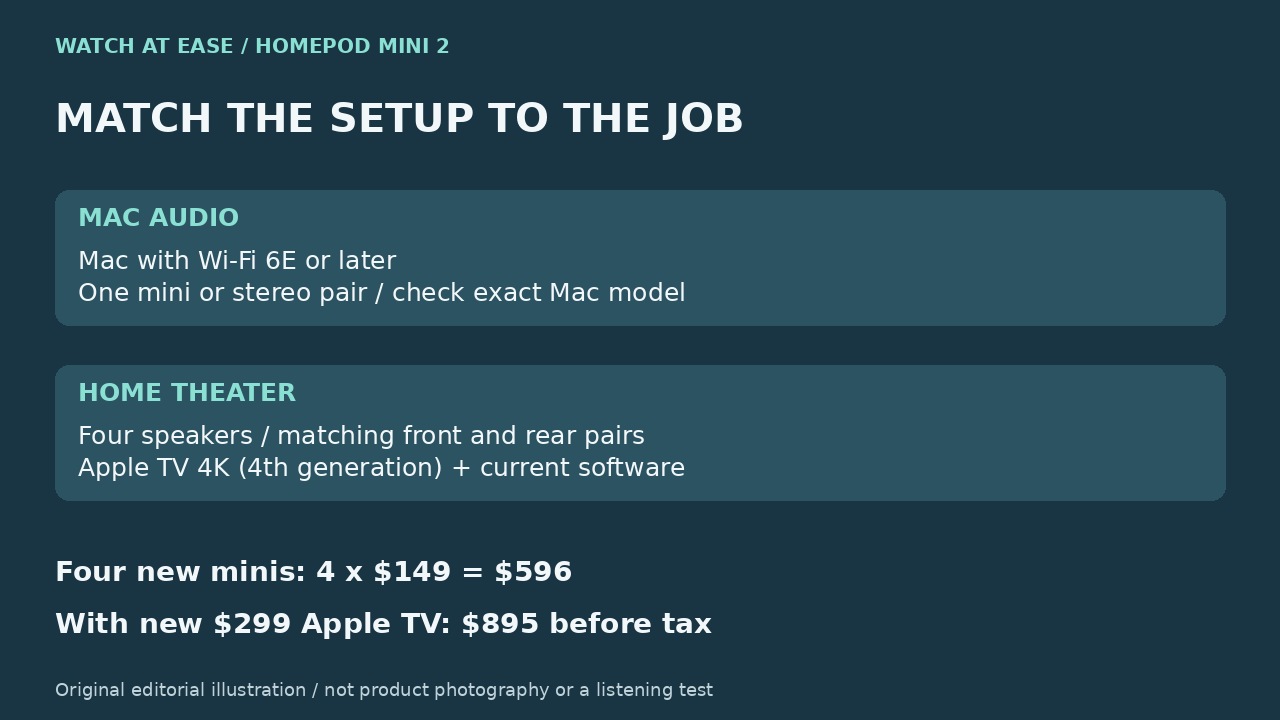
The new audio-companion mode can make one speaker or a stereo pair the Mac’s default output, but Apple limits the feature to Macs with Wi-Fi 6E or later. Check the exact Mac model and supported software before ordering two speakers. A familiar AirPlay menu or a new router is not proof that an older Mac meets this specific requirement.
The Verge’s Jennifer Pattison Tuohy reports seeing a launch demonstration in which game sound appeared in sync with on-screen action. That is useful first-hand observation, but it is a short demo, not a measured latency test for video calls, games or every network. Apple’s computational-audio claims and the S10 chip likewise do not substitute for a comparative listening test.
Price the intended setup, not a feature list
A single speaker is $149 and a pair is $298 at the announced US prices. Four new minis total $596 before tax; adding the separately announced $299 fourth-generation Apple TV 4K gives an $895 hardware subtotal. These are our simple additions, not a complete installation quote. Apple requires matching front and rear pairs using HomePod mini 2 or second-generation full-size HomePods, plus the new Apple TV and current operating-system software. Existing mismatched speakers do not automatically form that setup.
Sound Glow responds to music and album artwork; its voice control requires an Apple Intelligence-enabled iPhone running current software. Treat it as a visual feature, not proof of better sound. The practical ordering checklist is the desired use, actual Mac and owner-device eligibility, speaker count and willingness to wait for AI. Check Apple’s future rollout before treating a software promise as a delivered reason to upgrade.